TL;DR:
- Sheer curtain panels filter light and add softness to a room, but they do not provide full privacy at night. Using proper fabric, fullness, and layering ensures they perform well and create an airy, textured atmosphere. Layering sheers with heavier curtains offers versatile light control and privacy options.
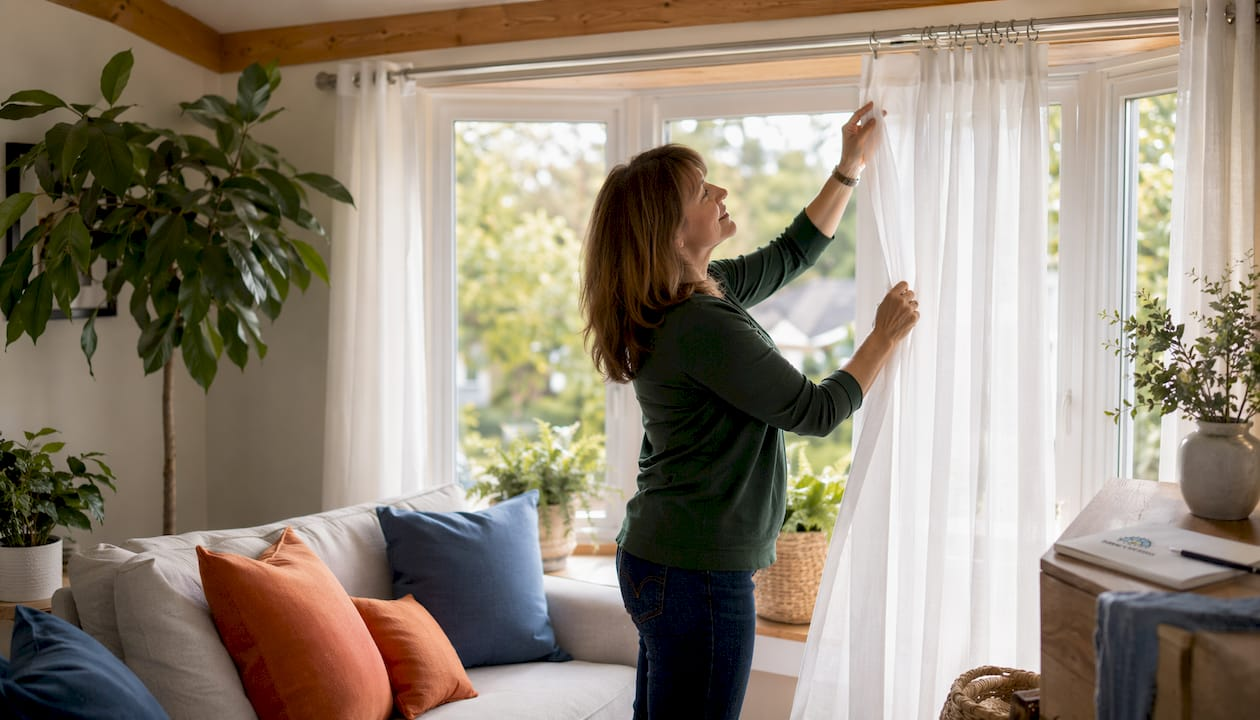
A sheer curtain panel is a translucent, lightweight fabric panel designed to filter natural daylight while adding softness and visual depth to a room. Unlike blackout or room-darkening treatments, sheer panels work with light rather than against it. They soften glare, create an airy atmosphere, and add a layer of texture to windows without closing off a space. Homeowners and renters alike use them in living rooms, dining rooms, and bedrooms where the goal is warmth and openness, not full darkness. Understanding what sheer panels do, and what they cannot do, is the first step to using them well.
What is a sheer curtain panel made of?
Sheer curtain panels are defined by their fabric. The material determines how much light passes through, how the panel drapes, and how the finished window looks. The three most common sheer fabric types are voile, organza, and linen blends, each with distinct properties.
| Fabric | Light Transmission | Best For | Character |
|---|---|---|---|
| Voile | ~70% | Everyday living spaces | Soft, fluid, lightweight |
| Organza | ~60% | Formal rooms, dining areas | Crisp, structured, lustrous |
| Linen blend | ~55% | Casual, organic interiors | Textured, relaxed, natural |
Voile transmits roughly 70% of incoming light, making it the most luminous choice for everyday spaces. It is typically a cotton and polyester blend, which gives it durability alongside its delicate appearance. Organza sits at around 60% light transmission and suits formal settings because of its slight sheen and firmer hand. Linen blends transmit about 55% of light and deliver a relaxed, organic look that works well in farmhouse or coastal interiors.
Fabric choice also affects durability. Polyester and cotton blends hold up well to regular washing and daily sun exposure. Silk-based organza looks refined but requires more careful handling. Knowing your room’s demands before selecting a fabric saves time and money.
Pro Tip: Order fabric samples before committing to a full panel order. The way a fabric transmits light in a store is rarely the same as how it performs against your specific window and wall color.
For a deeper look at how fabric weight and weave affect opacity, the curtain panel opacity guide from Beautifulwindowselgin covers the full spectrum from sheer to blackout.

What are the benefits of sheer curtain panels?
Sheer curtain panels do more than soften a window’s appearance. They serve several practical functions that homeowners often underestimate until they experience the difference firsthand.
Sheers soften harsh sunlight and reduce screen glare, which matters in home offices and living rooms where afternoon sun hits screens directly. They also filter UV rays, with most sheer fabrics blocking 70–90% of ultraviolet light. That level of UV filtration meaningfully slows the fading of furniture, flooring, and artwork over time.
The aesthetic benefits are equally real. Sheer panels add a layer of visual softness that bare windows simply cannot provide. They create a sense of depth and movement, especially when a breeze catches the fabric. Sheers work best in spaces where light and atmosphere take priority over full privacy, including living rooms, dining rooms, and upper-floor bedrooms.
Key benefits at a glance:
- Filters and softens incoming daylight without blocking it
- Reduces glare on screens and reflective surfaces
- Blocks 70–90% of UV rays to protect furniture and flooring
- Adds visual texture and a sense of airiness to any room
- Creates the illusion of larger, taller windows when hung correctly
- Works as a base layer in a full window treatment system
Pro Tip: Pair sheer panels with heavier drapes on a double rod. During the day, the sheers handle light and atmosphere. At night, close the drapes for full privacy and darkness. This single setup covers every situation without replacing any hardware.
How do sheer panels perform for privacy and light control?
Privacy is the most misunderstood aspect of sheer curtain panels. Sheers provide solid daytime privacy by obscuring the view into your home when outdoor light is brighter than indoor light. The physics are straightforward: light travels from bright to dark, so during daylight hours, people outside see the bright fabric, not the interior.
At night, that equation reverses. When interior lights are on and it is dark outside, sheers offer essentially no privacy. Anyone outside can see clearly into a lit room through sheer fabric. This is not a flaw in the product. It is simply the nature of translucent material.
| Condition | Privacy Level | Recommendation |
|---|---|---|
| Daytime, sunny exterior | Good | Sheers alone are sufficient |
| Daytime, overcast | Moderate | Sheers work with some caution |
| Nighttime, lights on | None | Add blackout or opaque drapes |
| Nighttime, lights off | Good | Sheers alone are fine |
Sheers are not suitable as the only window treatment in street-facing bedrooms, bathrooms, or any room where nighttime privacy is non-negotiable. For those spaces, curtain lining fabric or a secondary opaque panel is the right solution. Layering sheer panels with heavier curtains on a double-rod system is the standard professional approach for day-to-night versatility.
Pro Tip: If you want sheers in a bedroom but need nighttime privacy, install a double rod. Keep the sheer on the inner rod and a lined drape on the outer rod. You get the soft daytime look and full coverage after dark.
For rooms where blocking all light is the goal, the blackout curtain panel guide from Beautifulwindowselgin explains the difference in construction and performance.
How to hang sheer curtain panels for the best effect
Installation technique determines whether sheer panels look polished or flat. Two measurements matter most: rod height and rod width.
Mount the rod 6–10 inches above the window frame and extend it 8–12 inches beyond the window edges on each side. This placement creates the visual impression of a larger, taller window and a higher ceiling. It is one of the most effective and lowest-cost ways to change how a room feels.

A fullness ratio of 2:1 to 2.5:1 is the professional standard for sheer panels. This means the total fabric width should be two to two-and-a-half times the width of the rod. Panels hung at a 1:1 ratio look flat and sparse. The ripple and movement that make sheers beautiful come directly from that extra fabric volume.
Installation best practices:
- Mount the rod at least 6 inches above the frame, closer to the ceiling when possible
- Extend the rod 8–12 inches beyond the window on each side
- Use a fullness ratio of 2:1 to 2.5:1 for a full, luxurious drape
- For floor-length panels, allow the fabric to just touch or lightly pool on the floor
- Use a double rod when layering sheers with heavier drapes
- Keep the sheer panel on the inner rod, closest to the glass
Common mistakes include hanging the rod directly on the window frame, using panels that are too narrow, and choosing a single rod when layering is the intent. Each of these errors makes the window look smaller and the treatment look budget-level, regardless of fabric quality.
Pro Tip: For renters who cannot drill into walls, tension rods mounted inside the window frame still benefit from the fullness ratio rule. Use panels that are at least twice the rod width for a finished look even with a simple setup.
Beautifulwindowselgin’s guide on pairing sheers with drapes covers double-rod layering in detail, including hardware recommendations and panel length guidance.
What sheer curtain styles and colors work best?
Sheer curtain styles range from plain and minimal to richly detailed, and the right choice depends on the room’s existing character.
Plain voile panels in white or ivory suit almost any interior. They read as neutral and let the room’s other elements take center stage. Embroidered sheers add a layer of pattern without adding visual weight, making them a good fit for traditional or transitional spaces. Lace sheers work well in cottage or vintage-inspired rooms. Mesh or open-weave sheers suit modern and industrial interiors where texture matters more than softness.
Style options worth considering:
- Plain sheers: White, cream, or soft gray for a clean, versatile look
- Embroidered sheers: Subtle patterns that add detail without heaviness
- Lace sheers: Intricate texture for traditional or cottage interiors
- Patterned sheers: Geometric or floral prints for a more expressive statement
- Colored sheers: Soft pastels or warm tones to complement wall color and furniture
Color selection follows a simple rule: lighter sheers maximize light transmission, while deeper tones reduce it slightly and add more visual presence. Soft pastels like blush, sage, and pale blue work in rooms with neutral walls. White and cream remain the most versatile options across all interior styles.
Fabric selection shapes the room’s atmosphere as much as color does. Linen blends create an organic, relaxed mood. Organza reads as formal and polished. Voile sits comfortably in the middle, suitable for casual and refined spaces alike. For a broader view of how fabric type affects style, Beautifulwindowselgin’s curtain fabric types guide covers the full range of options available to homeowners.
Key Takeaways
Sheer curtain panels filter light and add visual softness to a room, but they require the right fabric, fullness ratio, and layering strategy to perform well.
| Point | Details |
|---|---|
| Definition and function | Sheer panels are translucent fabric treatments designed to filter daylight, not block it. |
| Fabric determines performance | Voile, organza, and linen blends each offer different light transmission and visual character. |
| Daytime privacy only | Sheers obscure views during daylight but provide no privacy at night with interior lights on. |
| Fullness ratio matters | A 2:1 to 2.5:1 ratio prevents flat panels and creates the ripple effect sheers are known for. |
| Layering solves limitations | A double-rod system with sheers and opaque drapes covers every light and privacy scenario. |
What I’ve learned from years of watching sheers get it wrong
Most homeowners treat sheer curtains as an afterthought. They buy a single panel, hang it on a rod mounted directly on the frame, and wonder why the room still feels bare. The fabric is rarely the problem. The installation almost always is.
The two details that change everything are rod height and fullness. Mounting a rod close to the ceiling and extending it well past the window edges transforms a modest window into a focal point. Adding enough fabric to create genuine ripple and movement turns a flat panel into something that actually softens the room. These are not design secrets. They are basic principles that most people skip because they are not obvious from the product packaging.
I also think sheers get unfairly dismissed as impractical because of the nighttime privacy issue. That criticism is valid only if you expect a single sheer panel to do everything. Pair it with a lined drape on a double rod and the limitation disappears entirely. The layered approach is not a workaround. It is the correct way to use sheers, and it gives you more flexibility than any single heavy curtain ever could.
For renters especially, sheers are one of the most effective and reversible ways to change how a space feels. They add softness, light, and a sense of intention without permanent changes. That combination is genuinely hard to replicate with any other window treatment at the same price point.
— Marrion
Beautifulwindowselgin’s fabrics and services for sheer panels
Beautifulwindowselgin carries a curated selection of designer drapery fabrics suited to sheer curtain projects, from lightweight voile-weight textiles to embroidered and jacquard options for more detailed treatments. Fabrics are sold by the yard with nationwide shipping, making it straightforward to order the exact quantity your windows require.

For homeowners who want a precise fit from the start, Beautifulwindowselgin offers professional window treatment measurement services that take the guesswork out of panel sizing. The team also provides design consultations and custom drapery making for clients who want a finished result without the DIY process. Whether you are sourcing fabric for a single window or outfitting an entire home, Beautifulwindowselgin supports the project from fabric selection through installation guidance.
FAQ
What is a sheer curtain panel used for?
A sheer curtain panel filters incoming daylight, reduces glare, and adds visual softness to a room. It is not designed to block light or provide full privacy.
Do sheer curtains provide privacy?
Sheers provide daytime privacy by obscuring the view when outdoor light is brighter than indoor light. At night with interior lights on, they offer no privacy.
What fabric is best for sheer curtain panels?
Voile is the most popular choice for everyday spaces, offering approximately 70% light transmission and a soft, fluid drape. Organza suits formal rooms, and linen blends work well in relaxed or organic interiors.
How wide should sheer curtain panels be?
A fullness ratio of 2:1 to 2.5:1 is the professional standard. The total fabric width should be two to two-and-a-half times the rod width to achieve a full, rippled appearance.
Can sheer panels be used alone without other curtains?
Sheers work well alone in living rooms, dining rooms, and upper-floor bedrooms where daytime privacy is sufficient. For street-facing rooms or nighttime privacy needs, pair them with a lined drape on a double rod.
Recommended
- What Is a Patterned Curtain Panel? A Complete Guide – Fabric Store in Columbia, SC | Drapery Making Services
- Why Compare Curtain Panel Sizes: A 2026 Sizing Guide – Fabric Store in Columbia, SC | Drapery Making Services
- Curtain Panel Opacity Explained: A Homeowner’s Guide – Fabric Store in Columbia, SC | Drapery Making Services
- What Is a Blackout Curtain Panel? A 2026 Guide – Fabric Store in Columbia, SC | Drapery Making Services