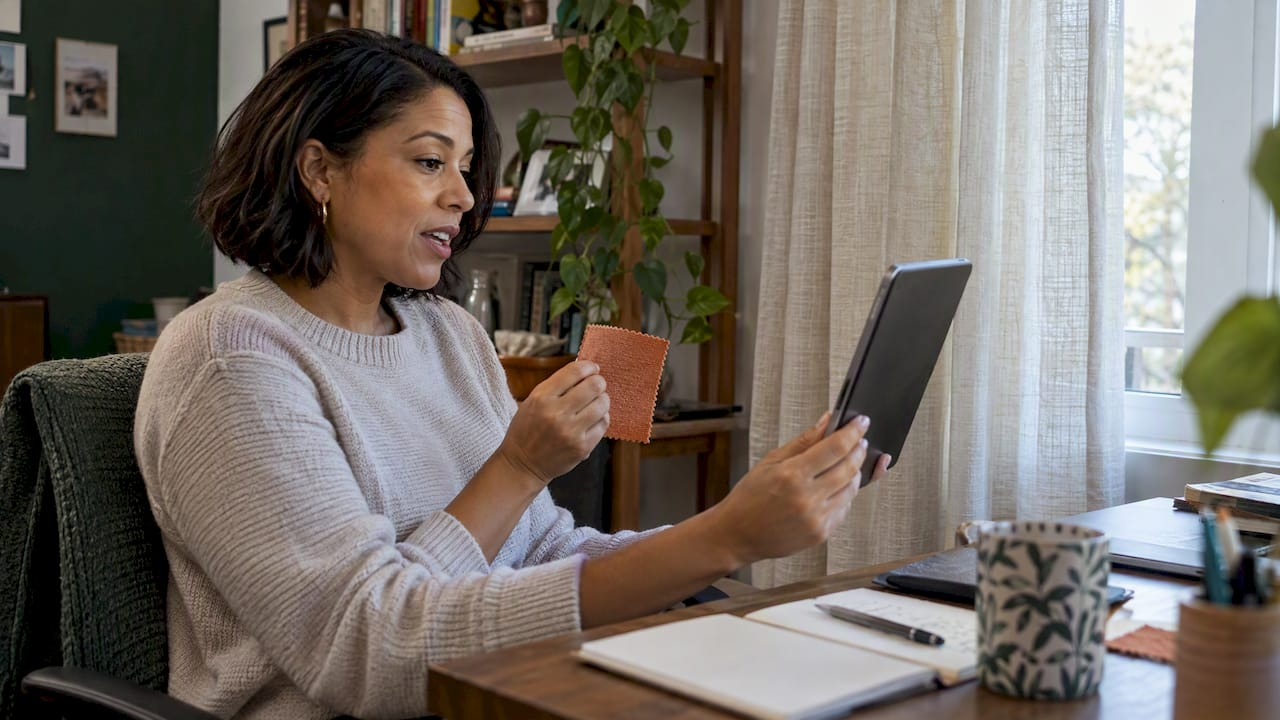
A virtual drapery consultation is a remote design session in which you and a drapery specialist settle fabric, heading style, lining, hardware and measurements without a showroom visit. You share photos and window dimensions, review options on screen, receive physical samples by mail, and approve a quote before anything is cut. It works well for most standard windows, and it works best when you arrive prepared. This guide explains each step, what to gather beforehand, and the few situations where someone still needs to come to the house.
TL;DR
- A virtual consultation replaces the showroom visit with room photos, a measurement sheet, a conversation and mailed fabric samples.
- Prepare before the session: photos of every window, measurements in inches, the rod or track position, and a short list of how each room is used.
- Decide fabric, heading style and lining together, because each one changes how the others behave. Always judge color and texture from a physical swatch in your own light.
- After the session you receive a quote, approve it, and the workroom produces the drapery. Installation guidance follows delivery.
- Bay windows, arched windows, motorized tracks and very tall or wide openings are the cases where an in-person measurement is still worth it.
Table of Contents
- What a virtual drapery consultation is
- Who benefits most from a remote session
- What to prepare before the session
- How the consultation unfolds, step by step
- Questions the consultant will ask you
- Choosing fabric, style and lining remotely
- What a virtual session cannot do
- Our perspective
- Start your project with us
- After the consultation: a checklist
- FAQ
- Sources
What a virtual drapery consultation is
Traditionally, a drapery consultation meant a designer in your living room with a tape measure, a sample book and a notepad. A virtual consultation moves the same conversation online or onto the phone. The questions are identical: what the room is for, how much light and privacy you need, what style suits the furniture, and what budget applies. Only the way information travels changes.
Three things make the format work:
- Photos and measurements stand in for the visit. The consultant sees the window, the wall, the ceiling height and the surrounding furniture through your images.
- A conversation replaces the sales floor. You talk through options with a person, rather than scrolling an endless catalog alone.
- Swatches replace the showroom wall. Color and texture are the two things a screen cannot judge, so physical samples arrive by mail before you commit.
A reviewer at House Beautiful who tested a custom drapery company’s online process noted that curated fabric, hardware, pleating and lining choices made remote selection easier, and that she still ordered physical swatches to judge texture and color at home. That combination, guided choices plus real samples, is the pattern a good virtual consultation follows.
Who benefits most from a remote session
Remote consultations suit several kinds of buyers:
- Homeowners outside the local area. Distance no longer limits who you can work with, since fabric and finished panels ship nationwide.
- Busy households. A 30 to 45 minute call fits around work and school schedules better than a window for a home visit.
- Interior designers and staging professionals. A designer who already has the client’s measurements and photos can use a remote session to source fabric quickly.
- DIY decorators and sewers. If you plan to sew the panels yourself, a consultation can focus purely on fabric choice, yardage and heading style.
- Drapery workrooms and upholsterers. Trade buyers often know exactly what they need and want a knowledgeable person to confirm fabric weight, width and availability.
What to prepare before the session
The quality of a virtual consultation depends almost entirely on what you send. Spend an hour on preparation and the session itself becomes faster and more precise.
Photos of every window
Take two or three images per window, in daylight:
- One straight-on shot, taken from the center of the room, showing the whole wall.
- One close shot of the window frame and the area above it, so the consultant can see the ceiling, any crown molding and the available space for a rod.
- One image of the room from the doorway, so the furniture, flooring and wall color are visible.
Keep the camera level and avoid filters. Note the time of day, because light direction affects how fabric will look.
Measurements in inches
Accurate numbers prevent most remote-ordering errors. Our own guides walk through the process in detail: how to measure windows for custom drapery and a step-by-step DIY measuring guide. In short, bring the following:
| Measurement | What to record |
|---|---|
| Window width | Outside edge to outside edge of the frame, at the widest point |
| Window height | Top of frame to sill, and top of frame to floor if panels will reach it |
| Rod or track width | Planned length, including how far it extends past each side of the frame |
| Rod height | Distance from the floor to where the rod will sit |
| Ceiling height | Floor to ceiling, measured at the window wall |
| Obstructions | Radiators, vents, switches, furniture or door swings near the window |
Measure each window separately, even when they look identical. Older houses in particular have openings that differ by half an inch or more. Use a steel tape rather than a cloth one, and write down the number you read rather than rounding.
How the room is used
A short note for each room helps the consultant steer you correctly:
- Is it a bedroom that needs room darkening, or a dining room where light is welcome?
- Do the windows face south or west, where sun will fade fabric over time?
- Are there children or pets that make washability a priority?
- Is a street or neighbor close enough that privacy matters during the day?
Inspiration and constraints
Collect three or four images of drapery you like and say what you like about each: the fullness, the length, the color, the way it hangs. Also note anything fixed, such as a sofa upholstery color or a paint shade you cannot change. Constraints narrow the field and save time.
How the consultation unfolds, step by step

1. Discovery
The consultant asks about the room, the windows and the result you want. Expect questions on light control, privacy, existing furniture, color palette, budget and timing. The more specific your answers, the more targeted the fabric suggestions.
2. Style and heading
Next comes the way the panel hangs. Pinch pleat gives a tailored, structured look. Rod pocket is simple and casual. Grommet is contemporary and easy to slide. Each heading style needs a different amount of fabric, so this decision affects yardage and cost. If you want a sense of the options before the call, our guide to choosing drapery covers styles and how they suit different rooms.

3. Fabric and lining
This is where the conversation becomes most technical. Weight, fiber content, width and pattern repeat all matter. A heavy jacquard or upholstery-weight textile falls in deep folds. A lighter embroidered fabric filters light. Lining adds body and protects the face fabric from sun, and a blackout or thermal lining changes how the panel hangs and how much it weighs. Our overview of window treatment fabric tips for homeowners is a useful companion at this stage.
4. Samples
After the call, samples are mailed so you can check them against your walls, flooring and furniture. Look at them in morning light, afternoon light and under lamps at night. Hang them against the window, because a swatch laid flat on a table tells you little about how the fabric will drape and transmit light.
5. Quote and approval
The consultant combines yardage, labor, lining, hardware and any installation support into a quote. Review the measurements on the quote line by line before approving. This is the last inexpensive moment to catch a mistake.
6. Production and delivery
Once approved, the panels are made to your measurements. Custom work through a workroom is not instant: our article on drapery workrooms and typical custom project timelines explains why custom projects take weeks rather than days. Plan around that if you have an event or a move-in date.
Questions the consultant will ask you
It helps to know these in advance, so you can answer without guessing:
- What is this room used for, and at what time of day? This tells the consultant how much light control and which fabric weight to propose.
- Do you want the drapery to open and close daily, or mostly stay put? Frequently used panels need smoother headings and sturdier fabric.
- Mounted at the ceiling, above the frame, or inside it? Mounting position changes the length and the visual height of the room.
- Do you want the panels to touch the floor, break slightly or hover? Length is a style decision that must be fixed before measuring.
- What is the budget range? A candid number lets the consultant choose fabric and lining that fit instead of showing options you will not buy.
- Who will install? Installation by a professional, a handyman or yourself affects hardware choices and the instructions you need.
Choosing fabric, style and lining remotely
Remote choosing goes best when you reduce choices early. Instead of browsing every fabric, give the consultant three fixed points: the function (light, privacy, insulation), the style (formal, relaxed, modern) and the care level you accept (dry clean only, or machine-washable). A shortlist of three or four fabrics is much easier to evaluate than forty.
A few practical rules:
- Check fabric width. Many decorator fabrics come 54 to 58 inches wide. Width determines how many panels or seams a window needs. Our catalog lists the width of each fabric, for example this grey 58-inch fabric in a polyester and linen blend.
- Match lining to the room. Bedrooms and media rooms usually call for blackout or heavier lining. Living areas often do better with a standard lining that keeps the fabric looking full.
- Consider pattern repeat. Large patterns need extra yardage to match across panels.
- Judge color on a swatch. Screen colors vary by device. Treat any on-screen shade as an approximation until the sample is in your hand.
What a virtual session cannot do
Remote work has limits, and an honest consultant will tell you when they apply. An in-person measurement or visit is still worth arranging in these cases:
- Bay, bow or arched windows. Angles and curves are hard to capture from photographs and a handheld tape.
- Very wide walls of glass or floor-to-ceiling windows. Small errors multiply over distance, and hardware must be strong enough for the load.
- Out-of-square openings. If the ceiling or floor slopes, a professional can measure each side and adjust the finished length.
- Motorized tracks or complex hardware. Wiring, outlets and power placement need to be seen.
- Large whole-house projects. Coordinating many rooms is easier with someone who has seen the layout.
In these situations, a hybrid approach works: hold the design conversation remotely, then hire a local installer or measurer to verify the numbers before production.
Our perspective
We approach a virtual consultation as a way to remove guesswork, not as a shortcut. We are a small business based in Columbia, SC, and we sell designer fabrics by the yard, ready-made curtain panels and custom drapery making, with one-on-one design consultation, sample support and professional installation guidance. That mix shapes how we think about remote work.
Our experience is that mistakes rarely come from the design conversation. They come from measurements taken in a hurry, a swatch judged under a single light, or a heading style chosen before anyone calculated the fabric it requires. So we ask customers to slow down at exactly those three points, and we would rather answer a question twice than remake a panel.
We also believe the fabric deserves as much attention as the style. A refined woven pattern, a satin finish or a durable upholstery-weight textile behaves differently once it is pleated and hung, and a sample is the only honest way to see that. If you are weighing made-to-measure work against off-the-shelf panels, our comparison of custom drapery and store-bought curtains sets out the trade-offs plainly.
— Marrion
Start your project with us
If you are ready to turn photos and measurements into finished drapery, our team offers one-on-one design consultation, fabric samples and custom drapery making, along with installation guidance after delivery. Contact us through the site to discuss how to arrange a consultation for your windows and what to send in advance.

You can browse designer fabrics by the yard, including embroidered fabrics, hospitality-grade upholstery fabric and ready-made curtain panels, or start from our custom drapery making service page. Prices are shown on each product page.
After the consultation: a checklist
Before approving a quote, confirm each of these:
- Every measurement on the quote matches your notes, in inches.
- The finished length and mounting height are written down, not assumed.
- The fabric, color and lining named on the quote match the samples you approved.
- The heading style and fullness are stated.
- Hardware is included or clearly excluded.
- The production timeline and delivery method are understood.
- You know who installs, and what instructions come with the panels.
For designers and workrooms who run many consultations, our notes on a consultation workflow and an interior designer consultation guide cover how to structure the handoff from design to production.
FAQ
Is a virtual drapery consultation as good as an in-person one?
For standard rectangular windows, yes, provided your photos and measurements are accurate and you review physical samples. The in-person visit adds value for bay windows, arches, motorized hardware and unusual rooms. A hybrid approach covers both.
What do I need to send before the session?
Send photos of each window and the room, measurements in inches, the planned rod position and a short note on how each room is used. Add a few inspiration images and any fixed colors, such as upholstery or paint.
Can I really choose fabric without seeing it in person?
You can narrow the choice on screen, but the final decision should come from a physical swatch viewed in your own light. Reviewers of online custom drapery services, such as this House Beautiful review, report ordering swatches for the same reason.
How long does it take to get custom drapery after approving the quote?
Custom drapery is made to order, so it takes weeks, not days. The exact timeline depends on fabric availability, the heading style and the workroom schedule, so ask for the current estimate when you receive your quote.
Do I need to measure the windows myself?
Usually yes, and a careful homeowner with a steel tape can do it well. If your windows are curved, very large or out of square, have a local professional measure them before production.
Leave a Reply