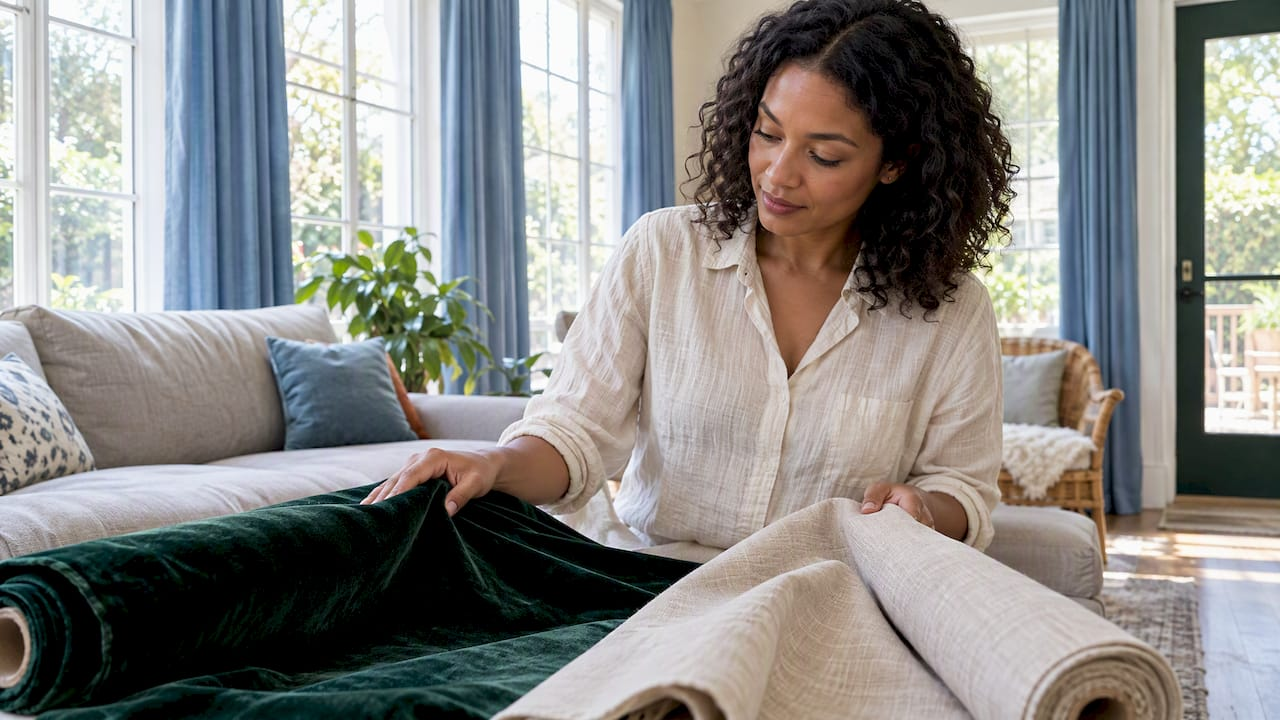
Velvet and linen are two of the most requested upholstery fabrics, and they solve different problems. Velvet is plush, rich in color and generally forgiving of heavy use, though its pile can flatten and it collects dust and pet hair. Linen is light, breathable and relaxed, but it wrinkles, and unblended versions suit lower-traffic seating best. The right choice depends less on which fabric is “better” and more on who sits on the furniture, how often, and how much care you are willing to give it.
This guide compares the two on appearance, comfort, durability, cleaning, fiber and construction, and room-by-room fit, so you can order yardage or commission a piece with confidence.
TL;DR
- Choose velvet for deep color, a soft hand and a formal or glamorous look. Pick a performance or polyester-blend velvet if the seating gets daily use.
- Choose linen for a breathable, casual, natural look, ideally in a tight weave and in a lower-traffic spot or with a blend for added resilience.
- Velvet’s weak points are pile crushing, visible dust and pet hair, and pressure marks. Linen’s weak points are wrinkles, staining in light colors and shrinkage if washed incorrectly.
- Check the cleaning code on any fabric before you buy, and ask for a sample to test in your own light.
Table of Contents
- Velvet vs linen at a glance
- How they look and feel
- Comfort across the seasons
- Advantages and disadvantages of velvet
- Advantages and disadvantages of linen
- Durability: fiber is only half the story
- Cleaning and care
- Matching the fabric to the room and the household
- A quick decision path
- Our perspective
- Shop velvet and upholstery fabric by the yard
- FAQ
- Sources
Velvet vs linen at a glance
| Factor | Velvet | Linen |
|---|---|---|
| Look | Rich, deep color, formal or glamorous; matte cotton velvet reads more casual | Natural, relaxed, slightly rumpled, airy |
| Feel | Smooth, plush, warm | Crisp to soft, breathable, softens with time |
| Durability | Can be very wear-resistant, especially performance or polyester velvets | Strong fiber, but quality and weave matter; best in lower-traffic areas when unblended |
| Main drawbacks | Flattened pile, pressure marks, dust and pet hair | Wrinkles, stains in light shades, shrinkage, fading in direct sun |
| Best rooms | Formal living rooms, dens, bedrooms, family rooms in performance versions | Sunrooms, coastal or modern living rooms, guest rooms, bedroom seating |
The rest of this article explains the reasoning behind each row.
How they look and feel
Velvet is a pile fabric. Its short, dense surface reflects light differently depending on the direction of the nap, which is why velvet color looks so deep. Houzz explains that this produces color far more intense than a similarly dyed flat-weave cotton or linen. That same nap means a velvet sofa can look slightly different from one angle to another, which is part of its appeal and something to check on a sample before you commit.
Linen is the opposite in character. It is a flat, woven fabric made from flax, with a visible texture and a natural, slightly uneven surface. The Spruce describes linen as suited to a natural, casually rumpled look, while velvet is plush and luxurious. Livingetc’s comparison puts it in similar terms: velvet feels smooth and luscious and brings glamor and depth, while linen breathes well and creates a relaxed, casual aesthetic.
Velvet is not limited to formal rooms, though. Interior designer Natalie Kraiem, quoted by Veranda, sees velvet as unusually adaptable: matte cotton velvet can feel casual, while high-sheen velvet feels formal. If you want velvet but not the red-carpet effect, look for a matte finish in a muted tone.

Comfort across the seasons
Breathability is where linen earns its reputation. Designer Susana Simonpietri, quoted by Architectural Digest, describes linen or cotton upholstery as light and breathable for keeping cool, while velvet can feel warmer in spring and summer. In a sunroom or a warm-climate home with long summers, that difference is noticeable on bare skin.
Velvet’s warmth is an advantage in cooler months and in dens, media rooms and bedrooms where you want a cozy, enveloping feel. In a home with air conditioning running most of the year, the temperature difference matters less, and appearance and durability usually decide.
Advantages and disadvantages of velvet
Advantages
- Color depth. The pile gives saturated shades such as emerald, navy or deep rust a richness that flat weaves rarely match.
- Soft hand. Velvet feels smooth and inviting, which suits seating people linger on.
- Wear resistance. Interior designer Nina Lichtenstein, quoted by Livingetc, notes that velvet exudes luxury on a practical level and can withstand heavy use. Houzz reports that some velvets carry heavy-duty abrasion ratings as high as 250,000 double rubs.
- Spot-cleaning. Livingetc’s designers say velvet can be more wear-resistant and easier to spot-clean than linen.
Drawbacks to plan for
- Pile changes. Houzz warns that even durable velvet can develop flattened or crushed pile through ordinary use. The Spruce notes velvet can show dirt and flatten with use.
- Dust and hair. Livingetc says velvet can attract dust and pet hair and may need brushing or professional cleaning.
- Cleaning limits. Some velvets must be treated with water-free solvents or by a professional, so the cleaning code matters (more on that below).
None of these are reasons to avoid velvet. They are reasons to choose the right velvet: a polyester or performance-blend construction with a firm abrasion rating handles family use far better than a delicate, fine-pile cotton velvet.
Advantages and disadvantages of linen
Advantages
- Natural, airy look. Linen pairs easily with plain color schemes and gives a room a fresh, light character.
- Strength. New Mexico State University’s home-furnishings guide describes linen as strong and durable. Mitchell Gold, quoted by Architectural Digest, says linen can be very durable and grow stronger and softer with time.
- Ages well when quality is high. Lichtenstein notes that top-tier linens become more comfortable and desirable as they age.
Drawbacks to plan for
- Wrinkling. The NMSU guide describes linen as somewhat stiff and prone to wrinkles, and it may need ironing. After extensive lounging, a linen sofa may lose a crisp, wrinkle-free look, as Gold points out.
- Stains. Gold adds that lighter colors generally lack the stain resistance a household with children may need. Livingetc notes linen can absorb stains if untreated.
- Shrinkage. NMSU says linen can shrink unless specially finished, and Livingetc warns that washing an unsuitable cover can cause shrinkage.
- Sun fading. The Spruce notes that colored linen can fade in direct sunlight, so placement near a bright window deserves thought.
If you love the linen look but want more resilience, a linen blend is a practical middle path. Veranda’s Kraiem characterizes unblended linen as best in lower-traffic areas, which implies that blends and tighter constructions widen where it can work.
Durability: fiber is only half the story
Comparing fibers alone can mislead. A Virginia Tech extension publication on upholstered furniture notes that linen is a strong flax fiber, but that fabrics with a tight weave and tightly twisted yarns are more durable than those with decorative slubs. In other words, a loosely woven, slubby linen will not perform like a dense, even one, even though both are “linen.”

The same principle applies to velvet. Cotton velvet, polyester velvet and performance velvet behave differently. NMSU advises selecting home furnishings fabrics by expected wear, abrasion resistance, fiber content, weave and finish. Those five questions are a better checklist than the fabric name.
When reading a product listing, look for:
- Abrasion rating (double rubs). Higher numbers indicate more resistance to wear. Our own guide to upholstery fabric durability explains how to read them and when a very high number is more than a household needs.
- Fiber content. Polyester and blends tend to add resilience to both velvet and linen looks.
- Weave density. Tight and even beats loose and slubby for daily seating.
- Finish. A stain-resistant treatment can change how a fabric behaves with spills.
- Cleaning code. It tells you what you can safely use when something spills.
Cleaning and care
Both fabrics reward routine care more than emergency care. The Virginia Tech publication recommends vacuuming upholstery weekly with an upholstery attachment, never a stiff brush, and reversing cushions and pillows that contain down, feathers or fiberfill on a regular schedule. That simple habit slows the dust build-up on velvet and the dulling of linen.
Reading the cleaning code
Upholstery tags carry letter codes that tell you which cleaning method is safe. Our guide to upholstery cleaning codes W, S, WS and X covers each one. The most important caution: the Virginia Tech publication says that on X-coded fabrics, water-based foam or solvent cleaning agents may cause excessive shrinking, fading or pile distortion. For an X-coded velvet or linen, vacuuming and light brushing are the safe options.
Velvet care
- Blot spills right away rather than rubbing.
- Brush the nap gently with a very soft brush to lift dust and restore the pile.
- For extensive soiling, consult a professional cleaner. Manufacturer care guidance for fine velvets generally calls for spot-cleaning with a mild water-free solvent, so check the tag before using water.
Linen care
- Treat stains early, since untreated linen can absorb them.
- Do not machine wash a cover unless the maker says it is washable, because of the shrinkage risk noted above.
- Expect to steam or iron slipcovers if you want a crisp look, or embrace the rumple as part of the style.
For a fuller routine covering every fabric in the house, see our fabric maintenance workflow guide.
Matching the fabric to the room and the household
Architectural Digest’s guidance is that upholstery choice should follow how furniture will be used: high-traffic family rooms need durable fabrics, while lower-use pieces such as bedroom settees or headboards can accommodate a wider range of textiles. Mitchell Gold adds that the household and its willingness to maintain the fabric matter more than appearance alone, and that delicate or highly textured textiles are poor choices around messy children and pets, while durable or slipcovered upholstery is more forgiving.
In practice:
- Family room with kids or pets. A polyester or performance velvet in a mid-tone is a sensible starting point. Livingetc’s pairing of velvet with luxury and warmth fits a home where comfort counts, and its wear resistance helps. Avoid very light linen here.
- Formal living room. Velvet in a deep or jewel tone suits a more structured, polished space, as Livingetc’s comparison of velvet with formal settings suggests.
- Coastal, modern or sunroom seating. Linen suits these settings with its relaxed, breathable look. Choose a tight weave, and consider a blend for durability.
- Bedroom bench, headboard or accent chair. Either fabric works. Lower use means you can choose purely on look and feel.
- Mixed spaces. Velvet and linen coexist well, with linen for the larger, airy pieces and velvet for pillows or an accent chair. Our post on velvet versus linen curtains shows how the same pairing works at the window.
A quick decision path
- Who uses the piece daily? Children, pets and frequent lounging point to velvet in a performance or polyester construction, or a tight-weave linen blend in a darker shade.
- How warm is the room? Hot, sunny rooms favor breathable linen. Cool or cozy rooms favor velvet.
- How much upkeep will you accept? If you do not want to iron or steam, linen’s rumple has to be part of the look you want. If you do not want to brush a nap, choose a flatter or matte velvet.
- What color do you want? Very saturated color is velvet’s strength. Soft neutrals and natural tones are linen’s.
- What does the sample say? Order a swatch, look at it in morning and evening light, rub it, press it, and spill a little water on it if the maker says that is safe.
Our perspective
Most upholstery regrets come from choosing by photograph rather than by use. A velvet that looked flawless online can show pressure marks in a busy family room, and a pale linen can look tired within a season if nobody planned for stains.
We approach the choice the way a workroom does: start with the household, then the room, then the fabric. We encourage customers to order samples first, because texture, sheen and nap direction are things a screen cannot show. Our curated selection of designer fabrics is chosen so that the look and the practical performance both hold up, and we guide customers on construction, fiber and cleaning codes before they buy.
For velvet, we suggest looking closely at fiber content and finish. For linen, we suggest looking at weave density and whether a blend suits the seating. Either way, the best upholstery is the one that suits how you actually live.
Marrion
Shop velvet and upholstery fabric by the yard
If you are ready to compare real swatches, our velvet fabric collection for upholstery and window curtains is a good place to start. Our shop also offers hospitality-grade upholstery fabric for seating that sees constant use, fabric sold by the yard with nationwide shipping, and sample support so you can test a fabric at home first.

Beautiful Windows Elgin is based in Columbia, SC, and also provides custom drapery making and design consultation. Visit our main shop page to browse categories, request samples or ask about a project. For more background before you buy, our upholstery fabric types guide and our tips for selecting upholstery fabric walk through the decision step by step.
FAQ
Is velvet or linen more durable for a sofa?
It depends on the specific fabric rather than the name. Velvet can carry heavy-duty abrasion ratings, with Houzz reporting some as high as 250,000 double rubs, though its pile can still crush with use. Linen is a strong fiber, but its performance depends on quality and weave, and unblended linen suits lower-traffic seating best.
What are the disadvantages of a linen sofa?
Linen can crease or wrinkle, show marks, absorb stains if untreated and shrink if an unsuitable cover is washed. Lighter colors generally lack the stain resistance a child-friendly household may need. Choosing a tight weave, a blend or a darker shade helps.
Is velvet upholstery easy to clean?
Often it is easier to spot-clean than linen, according to the designers Livingetc quotes, but it can attract dust and pet hair and may need brushing or professional cleaning. Always check the cleaning code first, because water can damage some velvets. Blot spills quickly and vacuum with an upholstery attachment weekly.
Does velvet feel hotter than linen?
Generally, yes. Architectural Digest, quoting designer Susana Simonpietri, says linen and cotton upholstery are light and breathable for staying cool, while velvet can feel warmer in spring and summer. In an air-conditioned room the difference is smaller.
Can I use velvet and linen together in one room?
Yes. The two contrast well: linen brings a fresh, relaxed base and velvet adds depth and warmth. A linen sofa with velvet pillows or an accent chair is a common, balanced approach.
Sources
- Linen vs Velvet Sofas: Which is the Best Choice? (Livingetc)
- How to Cool a Room Without AC (Architectural Digest)
- Sofa Secrets: Find Out How Velvet Could Work for You (Houzz)
- Best Couch Fabrics: 9 Types of Upholstery Materials (The Spruce)
- Selecting Fabrics for Home Furnishings (New Mexico State University)
- What Is Upholstery and How Do You Choose the Best Fabric (Architectural Digest)
- Upholstered Furniture (Virginia Tech)
- 8 Fabrics That Always Look Timeless (Veranda)
Leave a Reply