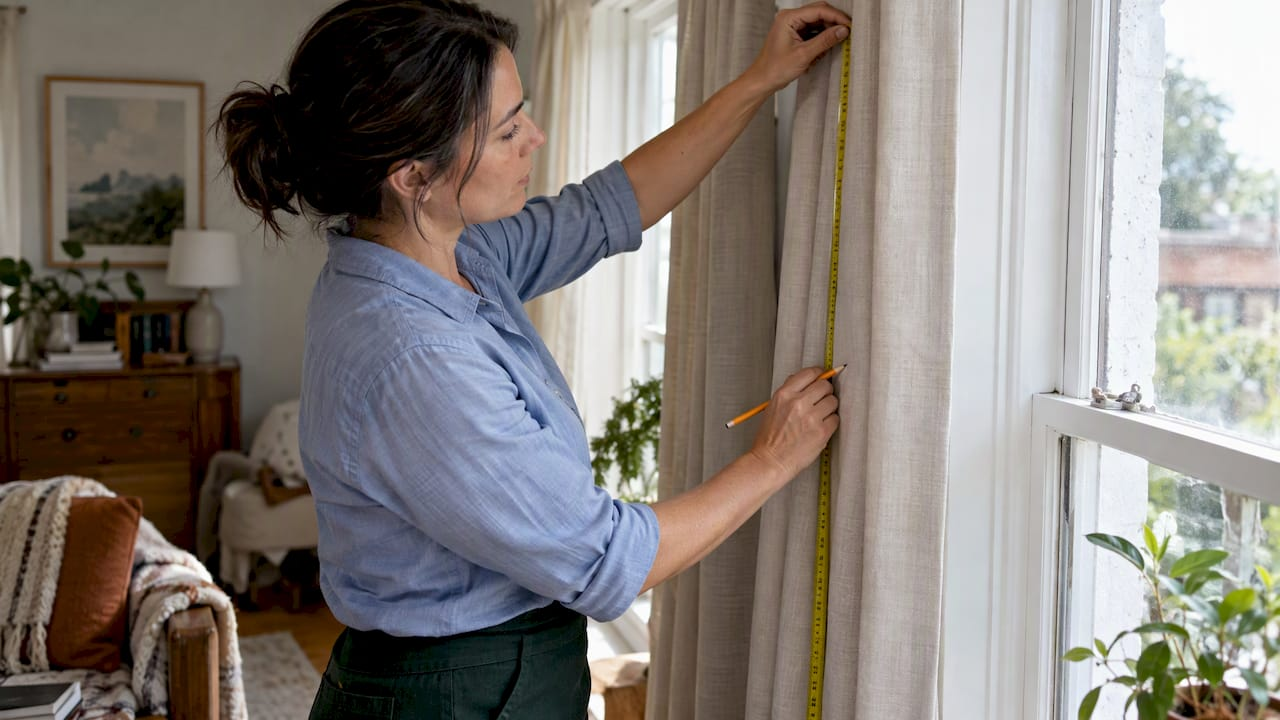
A tieback is a flexible cord or fabric band that wraps around a curtain panel, while a holdback is a rigid, wall-mounted fixture the panel rests against. Choose tiebacks for decorative softness and lighter panels. Choose holdbacks when heavier or fuller panels need steady, structural support.
TL;DR:
- For heavy or full panels, measure the stack before choosing a holdback; its arm must clear the fabric and keep the glass visible.
- Position fixtures a few inches beyond the window frame so open curtains leave the glass clear, and adjust height to the panel’s length and fullness.
- Drywall needs a rated anchor, while heavy drapes should attach to a stud or heavy duty anchor; check both fixtures with a level before drilling.
- Renters can avoid wall screws with magnetic tiebacks; some holdbacks attach to wooden trim, but heavy panels still need secure support.
- In homes with toddlers or pets, avoid long loops and dangling tassels; magnetic tiebacks also contain small magnets that must stay out of reach.
Table of Contents
- How tiebacks and holdbacks differ in material and function
- Tieback and holdback styles and the mood they set
- Where to place tiebacks and holdbacks
- When to choose a tieback and when to choose a holdback
- How to install tiebacks and holdbacks
- Styling tips for finish, scale, and layering
- Cleaning and caring for tiebacks and holdbacks
- Child and pet safety around tiebacks and holdbacks
- A drapery specialist’s note: mock it up before you drill
- Get coordinated fabrics and custom drapery from us
- FAQ
- Sources
How tiebacks and holdbacks differ in material and function
Both pieces pull a curtain away from the glass, but they do it in different ways, and that changes the whole silhouette of the window.
Tiebacks are soft. They are made from rope, braided cord, tassels, or fabric bands, and they fasten around the gathered panel with a loop, a hook, a clip, or a tied knot. Because they cinch the fabric, they create a gentle waist in the drape. The curtain curves inward at the cinch point and flares out above and below it, which reads as relaxed and traditional.

Holdbacks are rigid. They are metal or wood arms, pegs, or knobs screwed into the wall beside the window. The panel is pulled to the side and rests against the fixture, so the fabric is supported rather than squeezed. That support is what makes holdbacks a better match for heavy, full stacks, and the straighter fall of the fabric gives the window a more architectural frame.
A few practical consequences are worth knowing before you buy:
- Anchors: Tiebacks usually need only a small cup hook or none at all. Holdbacks need screws and often wall anchors, because they carry the weight of the fabric.
- Stack-back: A tieback cinches the panel, so it can hide some of the window. A holdback pulls the panel to the side, and its projection (how far the arm sits from the wall) decides how much glass stays visible.
- Headings: Grommet and rod-pocket panels fall in even tubes that tie neatly, while pinch pleats hold their shape and sit well against a holdback. Our guide to common curtain styles shows how each heading drapes.
- Renter-friendly options: No-drill choices exist for both. Magnetic tiebacks need no wall hardware at all, and some holdbacks tap into wooden window trim instead of drywall. Neither requires screws in a temporary living space.
If you want a wider look at what else is out there, our overview of types of curtain accessories compares the main options side by side.
Tieback and holdback styles and the mood they set
Hardware sends a signal about formality before anyone notices the fabric. Matching that signal to your room is half the decision.
Tieback looks
- Tassel and rope tiebacks: The classic choice. A thick twisted rope with a tassel reads as formal and traditional, and it suits silk-like or heavily lined drapes.
- Fabric-wrapped loops: A band cut from the curtain fabric, or a coordinating one, looks tailored and quiet. It works in casual rooms and in layered treatments where you do not want the hardware to compete.
- Magnetic tiebacks: Two small magnets hold the panel without any wall fixture. They read as clean and casual, and they are a practical option for rentals.
Holdback looks
- Metal and scrollwork: Cast or wrought arms with decorative curves lean traditional. Finishes such as brushed brass, bronze, and pewter set the tone.
- Modern flat-arm designs: Slim, plain profiles in matte black or nickel suit contemporary and minimalist rooms.
- Wooden holdbacks: Turned or plain wood pegs bring warmth and suit cottage, farmhouse, and craftsman interiors.
Trim and material shift the formality in either direction. Fringe, metallic threads, and large tassels push a tieback toward formal, while plain wrapped fabric pulls it toward casual. Designers at Samuel & Sons note that trimmed or tasseled fabric tiebacks convey a traditional, softer formality, while metallic or wooden holdbacks provide a structured, architectural finish suited to modern or minimalist spaces.
Samuel & Sons designers point to tiebacks for a softened, traditional look and to metal or wooden holdbacks for a structured, architectural one. That split gives you a starting point before you narrow by finish and scale.
Quick pairing notes help once you know your fabric:
- Sheer panels: A slim cord or a fabric loop keeps the light, airy feel. A heavy tassel would overpower the fabric.
- Heavy blackout drapes: A sturdy holdback with a generous projection holds the weight and keeps the fold clean.
- Layered treatments: Hold the outer drape with a holdback and let the sheer fall freely behind it, or tie both layers together with a single soft band.
Where to place tiebacks and holdbacks
Placement is where most people go wrong. A good piece of hardware in the wrong spot makes the curtain look lopsided, so measure first and drill second.
The thirds rule
Measure your finished curtain length from the rod to the hem. Placing the hardware lower on the panel gives a graceful bell shape below the tie and a fuller top. Placing it higher pulls the cinch up, which suits shorter panels or a more open look. Pick based on how much fullness you want at the top and how much fabric you want pooling toward the bottom.
Hunker describes average tieback heights used across common residential curtain lengths, which is a useful cross-check when choosing placement. Adjust the hardware position to your curtain length and the look you want.
Rough guides by length:
- Sill-length curtains: Place the hardware near the lower third, so the cinch falls a little below the middle of the window.
- Floor-length curtains: Choose a position that keeps the fixture where the fabric begins to curve toward the floor.
- Long or puddling curtains: Mount slightly higher so the extra fabric has room to fall without bunching.
Distance from the frame and projection
The side distance matters as much as the height. Mount the hardware a few inches outside the window frame so the open curtain does not cover the glass. Projection is the other variable: an arm that is too short makes a heavy or full curtain bunch up and block the window instead of framing it. Measure how much stack-back your panels need, then choose a holdback whose arm clears that bulk.
Steps for a neat result
- Hang the curtains and gather them to the width you want when open.
- Measure the finished length and choose a placement that suits the curtain’s shape.
- Mark the height on the wall at the spot you picked.
- Mark the side position a few inches beyond the frame.
- Hold the hardware in place with the curtain pulled back and check the fold.
- Adjust the mark before you drill anything.
Pro Tip: Tape a paper cutout the size of the fixture to the wall and pull the curtain against it. If the fold looks wrong, you have lost nothing but a strip of tape.
Common mistakes are easy to avoid once you know them. Mounting too close to the window frame crowds the glass. Too little projection squashes full panels. Setting the two sides at different heights is the most visible error, so check each with a level. Accessibility guidance from the Access Board is also worth a glance if the window is in a space where clearances and reach heights matter.
When to choose a tieback and when to choose a holdback
You can settle the choice with five quick questions:
- Fabric weight: Light and medium fabrics suit tiebacks. Heavy, lined, or blackout fabrics suit holdbacks.
- Panel fullness: Fuller panels create a bulky stack that benefits from the support of a rigid arm.
- Frequency of use: If you open and close the curtains daily, a holdback is faster. Tiebacks take a few seconds to wrap and release each time.
- Layered treatments: With sheers behind drapes, a holdback keeps the outer layer clear without crushing the inner one.
- Renter restrictions: If you cannot drill, magnetic tiebacks or trim-mounted options keep your deposit safe.
Short examples show how this plays out:
- Light sheers in a bedroom: A fabric loop or soft cord, because the panels barely need support.
- Heavy blackout drapes in a nursery or media room: A wall-mounted holdback with enough projection to hold the weight.
- A formal living room with lined silk-look panels: A tassel tieback for a traditional finish, or a scrollwork holdback if the panels are especially heavy.
- A rental apartment with grommet panels: Magnetic tiebacks that need no screws.
Heading types add a small wrinkle. Eyelet and grommet panels fall in even, round folds that tie cleanly and look tidy in either option. Pinch pleats hold their shape and often look best against a holdback that lets the pleats fall straight. Rod-pocket panels gather unevenly, so a soft tieback works well to shape them. Our curtain fabric comparison list can help you judge which fabric weights suit each approach.
How to install tiebacks and holdbacks
You do not need many tools, and the job is usually straightforward for a pair of windows.
You will need:
- A tape measure and a pencil
- A level
- A drill with a bit sized for your anchors
- Wall anchors and screws that match your wall type
- A screwdriver
Hunker documents step-by-step installation methods for metal tiebacks, covering marking, pilot holes, and anchoring. The sequence below follows the same general approach for a wall-mounted holdback:
- Measure and mark a suitable height and side position.
- Check the mark with a level so both sides match.
- Drill a pilot hole at each mark.
- Insert a wall anchor if you are not screwing into a stud.
- Screw the holdback into place and tighten it until it feels firm.
- Pull the curtain into position and test the hold.
For soft tiebacks, wrap the band around the gathered panel and fasten it with its loop, hook, or clip. Adjust the tightness until the fabric forms the fold you want. Magnetic tiebacks need no wall hardware: the two halves attach to each other around the fabric.
Safety starts with matching the anchor to your wall. Drywall needs a rated anchor, plaster can crack without a pilot hole, and heavy drapes belong on a stud or a heavy-duty anchor. If you would like more detail on hanging the curtains themselves, our DIY curtain and drapery installation guide walks through it step by step.
Styling tips for finish, scale, and layering
Hardware looks intentional when it echoes something already in the room. These rules keep it that way:
- Match the finish: Pair the hardware with your curtain rod, light fixtures, or door handles. A brass rod with brass holdbacks is the safest combination.
- Scale the tassel: A tassel should look proportionate to the panel. Wide, full panels carry a larger tassel, while narrow panels look better with a slim cord.
- Cord thickness: Thicker cord suits heavy fabric, and a thin cord disappears against it.
- Holdback arm length: The arm should hold the panel’s stack without overwhelming the window. Heavier, fuller panels need a longer arm.
- Layering: With sheers, a valance, or blinds behind the drapes, choose hardware that clears all of them so nothing is crushed against the glass.
For room-specific ideas, bedrooms often benefit from soft fabric tiebacks that keep the mood calm, while living rooms can carry a bolder metal holdback. In summer, a lighter cord can replace a heavy tassel to match a looser, airier feel.
Pro Tip: Hold a swatch of your curtain fabric against the hardware in natural light before you buy. Finishes that look matched in the store can clash once they sit beside real fabric.
Fabric weight and pattern also influence your hardware, and our guide to curtain fabric types can help you choose a fabric before you commit to a style.
Cleaning and caring for tiebacks and holdbacks
Hardware collects dust and hand oils quietly, and a few minutes every month or two keeps it looking new.
For metal holdbacks, wipe with a soft, dry microfiber cloth to remove dust. If there is buildup, use a slightly damp cloth with a drop of mild soap, then dry right away so moisture does not mark the finish. Avoid abrasive pads and harsh cleaners, which can strip plating and leave scratches. Check that screws are still tight each time you clean, because daily use can loosen them over time.
For wooden holdbacks, dust regularly and wipe with a barely damp cloth. Skip soaking or heavy polish, which can dull the grain.
For rope, cord, and tassel tiebacks, vacuum gently with a brush attachment to lift dust. Spot clean stains with a mild soap solution, blot rather than rub, and let them air dry. Tassels can tangle, so comb the fringe with your fingers while it is slightly damp to restore its shape. Fabric-wrapped tiebacks follow the care instructions of their fabric, so check the label before washing.
Rotate which side you tie or hook the panel on from time to time so wear spreads evenly. Fabric left tied in one spot for months can keep a crease, and loosening it each season helps the drape relax.
Child and pet safety around tiebacks and holdbacks
Anything that hangs near a window deserves a quick safety check, especially in homes with small children or curious pets.
Long cords and dangling tassels can tempt little hands, and a looped cord is a hazard for toddlers. Keep tiebacks short and secure, or choose a rigid holdback in a child’s room, since it has no loose cord to pull. If you use a soft tieback, mount it high enough that a child cannot reach it, and avoid any style with a free-hanging loop.
Pets are drawn to swinging tassels. A cat can treat them as a toy and shred them or pull the whole curtain down. Pick a smooth fabric band or a holdback if you have a climber, and keep tassels tidy and short.
Holdbacks bring their own considerations. Choose arms with rounded ends and smooth finishes, and set the projection so the tip does not sit at head height in a walkway. Make sure every fixture is anchored into a stud or a rated wall anchor, because a loose holdback can fall under the weight of a heavy panel.
Magnetic tiebacks need a check too. Their magnets are small and can be dangerous if swallowed, so keep them away from toddlers and pets in homes where that is a concern.

A drapery specialist’s note: mock it up before you drill
I always tell people to test a mock-up before they put a bit to the wall. Pin the curtain back, tape a paper template where the hardware will go, and live with it for a day. Fabric usually drives the final look far more than the hardware does, so spend your effort on weight, color, and proportion first. A beautiful holdback will not rescue a flimsy panel. For layered or heavy treatments, a drapery specialist can save you a lot of trial and error.
— Marrion
Get coordinated fabrics and custom drapery from us
Hardware only works when it suits the fabric it holds. We sell designer fabrics by the yard, including cotton, embroidered, and upholstery options, and we offer custom drapery making along with installation guidance. You can order fabric samples to check weight and color against your hardware before committing, and our team can help you judge whether a panel needs a holdback or will sit well with a soft tieback. If you want coordinated tiebacks to complement your curtains, we can help you choose fabrics.

Ready to plan your window treatment? Visit our custom drapery services page to browse fabrics, request samples, and talk with us about your project.
FAQ
What is the difference between a curtain holdback and a tieback?
A tieback is a flexible cord or fabric band that wraps around the panel, while a holdback is a rigid fixture screwed into the wall that the panel rests against. Tiebacks cinch and soften the drape. Holdbacks support heavier fabric and give a more structured frame.
Where should holdbacks be positioned?
Place holdbacks a few inches outside the window frame so the open curtain does not cover the glass. Choose a height that gives the curtain a classic look. Check both sides with a level before drilling.
Are curtain tiebacks outdated?
Not at all. Tiebacks have shifted from fussy and ornate to simpler styles, such as plain fabric bands and slim cords, which suit modern rooms. Heavy tassels read as traditional, so choose the style that matches your decor.
What is the rule for curtain tie backs?
A common approach is to choose a lower or higher position on the finished curtain, depending on the fullness you want. Hunker’s tieback height guidance gives average heights for typical curtain lengths.
Leave a Reply