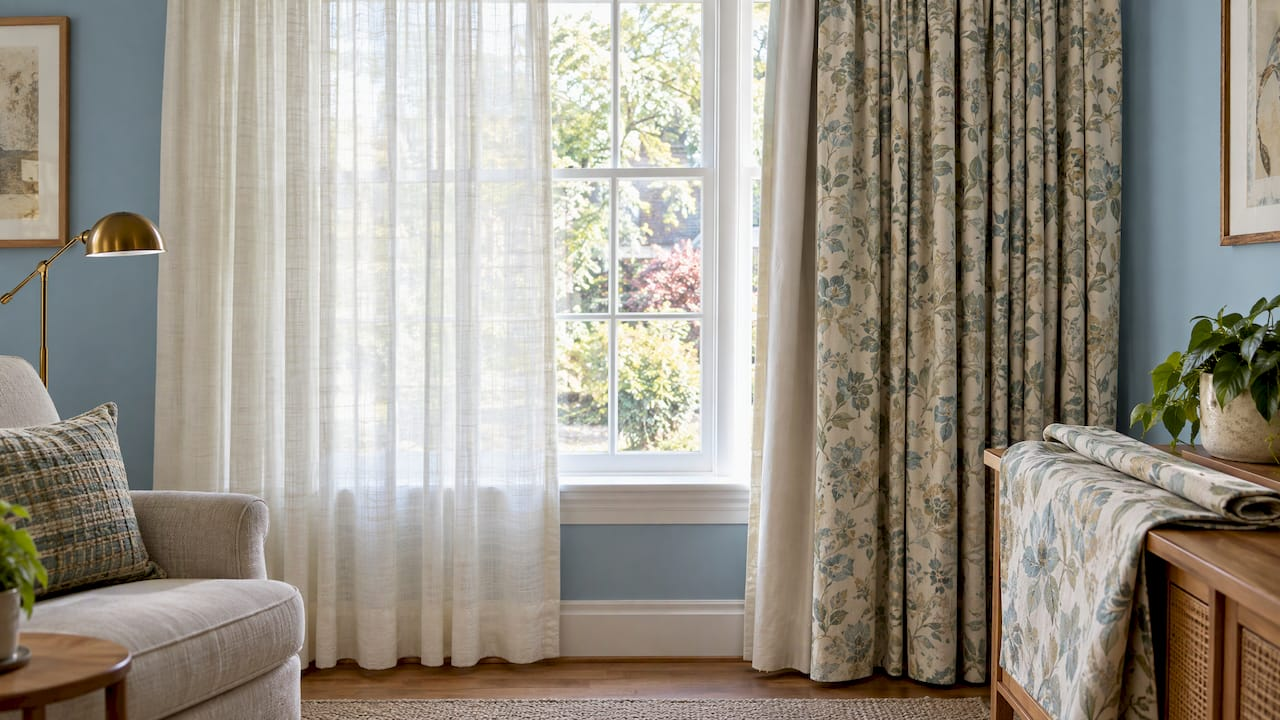
The best curtains for a south-facing window are lined, medium to light in color, hung close to the glass and cut generously enough to close fully. A white or light backing reflects heat, a tight weave softens glare, and a second layer lets you tune the light through the day. South-facing rooms receive strong sun for most daylight hours, so the fabric you choose does real work, not only decorative work.
TL;DR
- Choose lined curtains in a medium or light color. Medium-colored draperies with white plastic backings can reduce heat gain by 33 percent.
- Hang panels close to the window and make them full enough to overlap in the middle and cover the sides.
- Layer a sheer or light-filtering panel with a lined or blackout panel so you can control glare in the morning and heat in the afternoon.
- Curtains slow fading but do not stop it. Close them in direct sun and move delicate pieces out of the beam.
- Order panels at about twice the window width for a full, functional fold.
Table of Contents
- Why south-facing windows need a plan
- Fabric, color and lining
- Light-filtering, room-darkening or blackout
- When to layer curtains with another treatment
- Fit, mounting and hanging
- Protecting furniture, floors and art from fading
- Our perspective
- Choose fabric and panels for your window
- Frequently asked questions
- Sources
Why south-facing windows need a plan
A south-facing window gets sun for most of the day, and in summer the sun sits high, so the heat load is heavy. In winter the sun is lower and the same window can bring welcome warmth. That swing is why a single, fixed solution rarely works well.
The Pacific Northwest National Laboratory’s building science guide notes that properly designed overhangs or roof eaves block summer sun while allowing winter sun, and that interior shading can supplement exterior systems. It also advises combining shading technologies, with at least one operable layer per window. For most homeowners an exterior overhang is not an option, which is where the interior layer becomes the working tool.
It helps to be realistic about what curtains do. A nonprofit housing group explains that exterior shading is more effective because it stops sunlight before it reaches the glass, while interior curtains are easier and cheaper to install but less effective. Curtains still earn their place: they control glare, give privacy, soften the room and reduce how much sun reaches your floors and furniture.
The Department of Energy adds that operable window attachments depend heavily on how occupants manage them. Closed at the right time they can save energy, and left open or closed at the wrong time, depending on climate, they can increase it. The practical lesson: choose curtains that are easy to operate, and you will actually use them.
Fabric, color and lining
Color and backing
Light colors reflect more sun and absorb less heat. Consumer Reports reports that medium-colored draperies with white plastic backings cut heat gain by 33 percent, and that the result depends on fabric type and color. The Department of Energy’s research on affordable shading likewise says interior shading should be light-colored or mirror-like and should not create an air-tight pocket between the glass and the room.
In practice, that points to a light or neutral face fabric with a light-colored lining. A dark, saturated drapery fabric facing the room is fine when the side toward the glass is lined in white or ivory, since the lining takes the first hit from the sun.

Weave and weight
Thicker fabric generally insulates better and blocks more light, but weight also affects how the panel hangs and how often you will open and close it. A few useful pairings:
| Goal | Face fabric | Lining |
|---|---|---|
| Soft daylight, some privacy | Light weave such as linen-look or open embroidery | None, or a thin cotton lining |
| Glare control and a cooler room | Tightly woven solid in a light or medium tone | White or ivory lining |
| Dark room for sleep or screens | Medium to heavy solid | Blackout lining |
| Decorative accent layer | Embroidered or jacquard | Separate lining for body and sun protection |
A tight, even weave diffuses the light, while a loose weave lets more through and shows a bright, patterned glow. If the window has a view you like, a soft, lightly textured fabric keeps the room bright without the harsh glare. Our overview of how fabric affects energy efficiency at home goes deeper into fiber and weave choices.
Your windows matter too
Curtains matter less when the glass is already efficient. Efficient Window Coverings, a professional resource, notes that curtains deliver smaller energy savings on double-paned or low-e windows, because those windows already capture much of the possible savings. With newer glass, choose curtains for glare, privacy and furnishing protection first, and treat energy as a bonus.
Light-filtering, room-darkening or blackout
These three terms describe how much light passes through the fabric, and each suits a different use of a south-facing room.
Light-filtering panels let daylight through in a diffused form. They suit living rooms, dining rooms and home offices where you want brightness without a hot spot on the sofa or glare on a screen. Used alone they offer modest privacy in the day and very little at night.
Room-darkening panels block most light and leave a soft glow at the edges. They work in family rooms and bedrooms where you want a calmer, cooler atmosphere in the afternoon but do not need total darkness.
Blackout panels, or a standard fabric with a blackout lining, block nearly all light. They suit bedrooms, media rooms and nurseries. They also give the strongest shield against afternoon sun, which is why a reader in a forum discussion on this topic noted that blackout blocks both the light and the heat. Keep in mind that a blackout layer turns the room dark when closed, so most people pair it with a lighter layer.
A simple way to decide: if the room is used mainly in the daytime, start with light-filtering or a lined, light-colored drapery. If it is used mainly at night or for sleeping, start with room-darkening or blackout lining. If it serves both, plan two layers.
When to layer curtains with another treatment
Layering is the most reliable answer to a window that changes character through the day. Consider a second layer when:
- The room needs both daylight and shade. A sheer or light-filtering panel stays closed for glare control, while a lined panel on a second rod closes in the hottest hours.
- You want privacy without losing the view. A sheer layer protects privacy during the day, and the heavier layer takes over at night.
- The window is large or wall-to-wall. A shade or blind under the drapery gives you fine control of the sun angle, and the curtains frame it.
- The room doubles as a bedroom. A blackout-lined panel behind a decorative panel gives sleep-friendly darkness and a finished look.
This follows the same logic as the guidance to combine shading technologies and keep at least one operable layer. Research on cellular shades points the same way: Department of Energy-cited testing in 2023 found that cellular shades on south and east-facing windows reduced cooling loads by 9.3% and heating loads by 57%. A cellular shade beneath a pair of lined curtains is a strong combination: the shade handles insulation and the curtains handle style, softness and sound.
If you are choosing between one wide panel and two, read our guide on double curtains versus a single panel to see why fullness matters for both looks and performance.
Fit, mounting and hanging
How curtains hang matters nearly as much as what they are made of. Consumer Reports advises hanging them close to the window and, for the maximum effect, installing a cornice, sealing the sides and overlapping the panels in the middle. Not everyone wants Velcro on the wall, but the principle holds: gaps at the sides and top let sun and warm air slip past the fabric.
A few practical rules:
- Mount the rod wide and high. Extend it several inches beyond the frame on each side so the panels can stack off the glass when open, letting in the full light in winter.
- Choose a full panel. Standard ready-made panels are typically 48 to 50 inches wide, so a wide window needs more than one. Aim for about twice the width of the window for a full fold. Our standard curtain width guide explains how to calculate the number of panels.
- Let the hem just touch the floor. Curtains that just kiss the floor avoid dragging and collecting dirt, and they block the light gap at the bottom.
- Do not seal an airtight pocket. Interior shading should leave the air able to move, so avoid fabric that fits tightly against the glass with no air path.
- Measure carefully. Wrong measurements are the most common reason curtains fail to control light. See our step-by-step guide to measuring windows for curtains accurately, or the version for custom drapery.
On the question of which direction curtains face: the lined, light-colored side goes toward the glass, and the decorative side faces the room.
Protecting furniture, floors and art from fading
South-facing rooms are where rugs, wood floors and upholstery fade first. Curtains help, but they are only part of the answer.
The National Fenestration Rating Council’s factsheet states that lined curtains, draperies, shutters, tinted glass and films can reduce fading but may reduce daylight and need regular operation. The same sheet reports that clear single-pane glass reflects about 25% of solar UV, insulating glass up to 40% and low-e glass up to 74%. Its consumer guide adds that low-e coatings block 75% of the remaining UV after standard glass has done its part.

The National Park Service’s conservation guidance makes a point many homeowners miss: visible light damages materials as well as UV. It recommends closing curtains during direct sunlight and whenever rooms are unused, and moving especially light-sensitive pieces away from direct window light.
Put that together and you get a simple routine:
- Close the curtains in the hours when sun hits the floor, and when you leave for the day.
- Keep a lined layer on the window, since lining adds a second barrier for the face fabric as well.
- Rotate rugs and move favorite chairs or artwork out of the beam.
- Treat fabric on the window itself as a wearing surface: the side facing the glass takes the sun, which is another reason to line.
Our perspective
We see the same mistake often: a homeowner buys a beautiful but unlined panel for a south-facing window, and within a season the fabric is bleached at the folds and the room is still bright and warm at 3 p.m. The fabric was lovely. The plan was missing.
Our approach is to treat a south-facing window as a two-part job. First, choose a face fabric that suits the room, whether that is a refined woven pattern, a satin finish or an embroidered sheer. Second, decide how the window will be lined and layered. A light-colored lining behind a decorative face fabric gives you the look you want and a barrier that protects it.
This is why we work with samples and one-on-one design consultation. Seeing a fabric in your own light, at your own window, at your own hour of the afternoon tells you more than any product photo. Our curated fabrics are sold by the yard so that a workroom, an upholsterer or a determined DIYer can choose the weight and weave that fits, and our custom drapery service can finish the panels with the right lining and fullness.
For simpler windows, ready-made panels are a sound starting point, particularly when you pair them with a second layer for control.
Marrion
Choose fabric and panels for your window
If you are planning curtains for a sunny room, we carry designer fabrics by the yard, ready-made curtain panels and a custom drapery making service, with design consultation and installation guidance and nationwide shipping. A light neutral such as our grey poly-linen fabric can serve as a calm face fabric, while our ready-made curtain panels suit a quick update.

For fabric samples, custom work or help choosing a lining, start on our main page and tell us about your window: its size, its exposure and how you use the room. If you prefer a pleated, tailored look, see the pinch pleat panel in 100% polyester.
Frequently asked questions
What are the best window coverings for south-facing windows?
Lined curtains in a light or medium color, layered with a cellular shade or a light-filtering panel, are a strong all-round choice. Testing cited by the Department of Energy found cellular shades cut both cooling and heating loads on south and east-facing windows. Curtains add privacy, softness and a finished look on top.
Which direction should curtains face?
The lining faces the window and the finished face fabric faces the room. A white or light lining on the glass side reflects sun, as the guidance on white-backed draperies suggests. If you have reversible shades, the white side can face outward in summer.
How do I deal with a south-facing window in summer and winter?
Use an operable layer. Close curtains in the hottest hours of summer, and open them wide in winter to let the low sun warm the room. Because occupant behavior decides the outcome, choose a rod and fabric weight you will actually move every day.
Will curtains stop my furniture from fading?
They slow it, but they do not stop it. Lined curtains can reduce fading only when they are closed, so pair them with moving delicate pieces out of direct light and closing the curtains when the room is empty.
How wide should curtains be for a south-facing window?
Plan for about twice the width of the window so the fabric folds fully when closed and covers the sides. Since a standard panel is roughly 48 to 50 inches, most windows need two or more. Our curtain panel size guide shows the math.
Sources
- Shading and Solar Control for Windows and Skylights, Pacific Northwest National Laboratory
- Cellular Shades in Commercial Buildings, US Department of Energy, 2023
- Energy Savings from Window Attachments, US Department of Energy, 2013
- Window Shading, Climate Safe Housing
- Lower Your Energy Costs With Window Coverings, Consumer Reports, 2023
- Saving Lives Through Affordable Shading, US Department of Energy, 2024
- Drapes & Curtains, Efficient Window Coverings
- Solar Heat Gain Revised, National Fenestration Rating Council, 2013
- Protect Your Art and Furniture, NFRC Consumer Guide
- Museum Collections Number 2: Reducing Visible and Ultraviolet Light Damage, National Park Service, 1990
- 16 Best Curtains for Windows, The Strategist, 2026
- Curtains/blinds for south facing window, r/interiordecorating
Leave a Reply