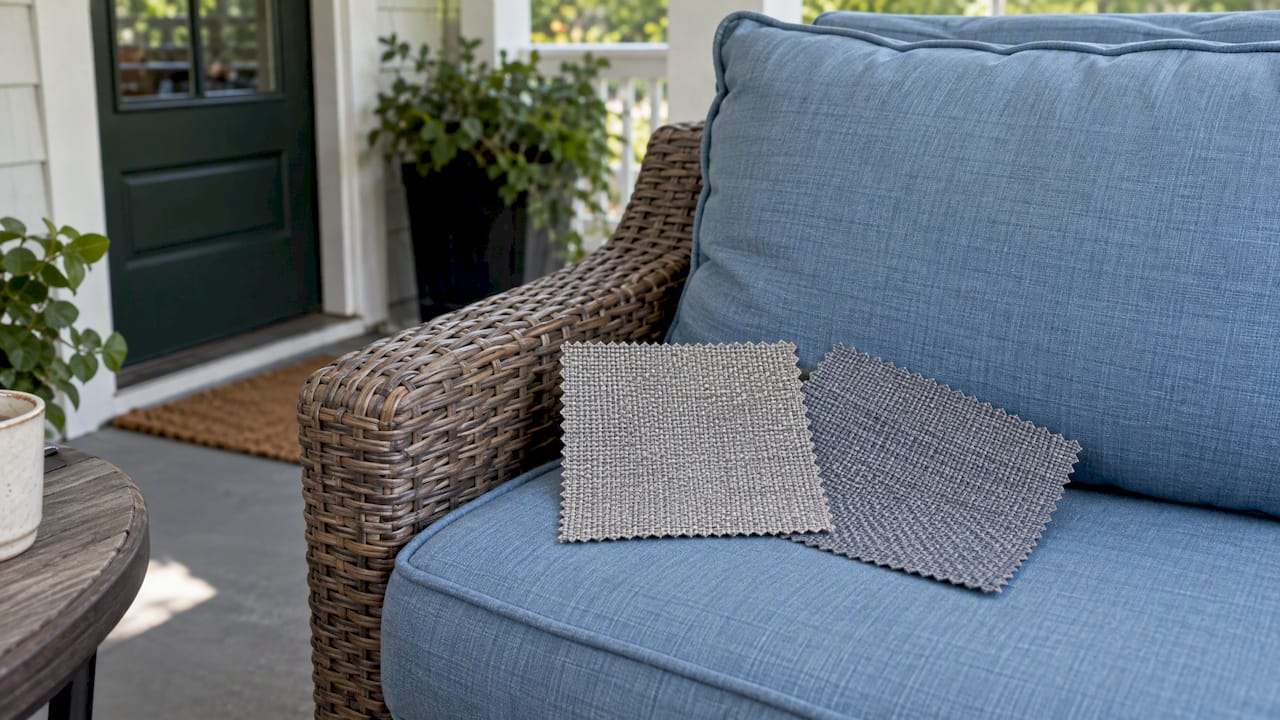
Solution-dyed acrylic is the stronger choice for fabric that stays outdoors in direct sun through full seasons. Polyester costs less, dries quickly and works well for shaded patios, covers, curtains and seasonal use. The gap between the two narrows when the polyester is also solution-dyed or UV-treated, so the label on the bolt matters as much as the fiber name.
This guide explains what solution dyeing actually changes, how the two fibers compare on fading, moisture, mildew, durability and care, and which one fits cushions, curtains, upholstery, marine canopies and utility projects. It is written for homeowners, designers and workrooms who buy fabric by the yard and want to match it to the job before cutting.
TL;DR
- Full sun, all season: solution-dyed acrylic is the recommended professional choice. Polyester suits shaded patios or seasonal use when budget is the main constraint (StitchDesk).
- Solution dyeing is the key variable: pigment is added to the fiber itself, so color runs through rather than sitting on the surface. Piece-dyed polyester fades sooner than either solution-dyed fiber.
- Neither fiber is mildew-proof: mildew grows on dirt and moisture that collect on the fabric, so regular cleaning and drying matter more than the fiber.
- Check the specs: ask for lightfastness, abrasion and water-repellency test results, not just the fiber content.
Table of Contents
- What solution-dyed actually means
- Solution-dyed acrylic vs polyester at a glance
- UV resistance and color fading
- Water, mold and mildew
- Durability, abrasion and hand
- Care and maintenance
- Which fabric for which project
- Cost and value
- Our perspective
- Ordering fabric or custom work from us
- FAQ
- Sources
What solution-dyed actually means
Most fabric is dyed after it is made. The yarn or the woven cloth goes into a dye bath, and color soaks into the fiber from the outside in. This is called piece dyeing or yarn dyeing, and it works well for indoor fabric that never meets a summer afternoon.
Solution dyeing works the other way around. Pigment is mixed into the liquid polymer before the fiber is formed, so every filament is colored from the core. Solution dyeing puts pigment inside the fiber, which makes fabric more colorfast outdoors than piece-dyed fabric. Because the color is part of the fiber, it resists sunlight, cleaning and abrasion better than a surface dye. That is the reason solution-dyed fabrics are the standard for awnings, marine canopies and high-end outdoor cushions.
Two points are often missed:
- Solution dyeing is a coloring method, not a fiber. Acrylic can be solution-dyed. Polyester can be solution-dyed. Both can also be piece-dyed. A comparison of “acrylic vs polyester” is really a comparison of typical products in each category.
- Solution dyeing improves colorfastness only. It does not make fabric waterproof, mildew-proof or tear-proof. Construction, finishes and coatings still decide those outcomes.
Solution-dyed acrylic vs polyester at a glance
| Factor | Solution-dyed acrylic | Solution-dyed polyester | Conventional (piece-dyed) polyester |
|---|---|---|---|
| Color retention in direct sun | Excellent, the usual benchmark | Good, improving with newer production | Fair to poor over several seasons |
| Hand and appearance | Soft, close to natural fibers | Smooth, sometimes slicker | Smooth, wide range of finishes |
| Water behavior | Does not absorb much; dries fast; often finished for repellency | Naturally water-resistant; dries fast | Naturally water-resistant; dries fast |
| Mildew risk | Low, but dirt and damp still allow growth | Low, same caveat | Low, same caveat |
| Typical cost | Higher | Middle | Lowest |
| Best fit | Full-sun furniture, awnings, marine canopies | Covered patios, cushions, shade structures | Shaded or seasonal use, indoor-outdoor curtains |
Treat the table as a guide to typical products. A heavy, well-finished polyester can outperform a lightweight acrylic in abrasion, and a cheap acrylic of unknown origin may not behave like a premium one.
UV resistance and color fading
Sunlight is the main enemy of outdoor fabric. Ultraviolet radiation breaks down dye molecules and, over time, the fiber itself.
Solution-dyed acrylic has long been the benchmark here. The pigment sits inside the fiber, and acrylic holds up to prolonged direct exposure without the color or the structure breaking down quickly. That is why it is the usual recommendation when furniture or an awning stays out for full seasons in direct sun.
Polyester has a split reputation. Conventional polyester is dyed with disperse dyes at high temperature, and its outdoor color life is shorter than that of acrylic. Newer solution-dyed polyesters close much of the distance and cost less, though in the harshest, sunniest exposure they generally still trail premium acrylic.
Practical reading of this:
- South- and west-facing exposure, rooftop decks, poolside, coastal sun: choose solution-dyed acrylic if the fabric will be out all season.
- Covered porches, pergolas with partial shade, cushions stored in winter: solution-dyed or UV-treated polyester is a sensible value choice.
- Dark and saturated colors fade more visibly than neutrals, whatever the fiber. If a deep navy or red will sit in full sun, that is where the extra cost of solution-dyed acrylic pays back first.
For a look at a polyester made for sun exposure, see this UV-resistant polyester upholstery fabric. For a solution-dyed acrylic option, the Fog Grey solution-dyed acrylic upholstery fabric is sold by the yard at 58 inches wide.
Water, mold and mildew
Both fibers are synthetic, so neither feeds mildew the way cotton can. Acrylic does not absorb much water, so moisture tends to bead and the fabric dries quickly. Polyester is also naturally water-resistant and quick to dry.
The catch is what lands on the fabric. Mildew needs organic material, and pollen, dust, soil and salt residue provide it. Restoration Hardware’s care guidance for outdoor upholstery makes the same point: mildew spores thrive where dirt and moisture are present, so frequent cleaning and removing wet cushions are recommended. A synthetic fiber slows the problem. It does not remove it.
The foam and batting inside a cushion matter too. A solution-dyed acrylic cover over a foam core that stays wet will still grow mildew inside. If cushions live outdoors, choose quick-drying fill and let them air out after storms.
Waterproof is a different question
Water repellent, water resistant and waterproof are three different claims. Solution dyeing says nothing about any of them. Repellency comes from a finish, and finishes wear away. Outdoor fabrics benefit from periodic re-treatment with a water-repellent finish, because washing and time reduce it. Waterproof performance usually comes from a coating or a tightly engineered construction, as in the waterproof outdoor polyester and waterproof canvas for outdoor furniture that suit covers, awnings and cushions that need to shed rain.
Durability, abrasion and hand
Color retention and physical strength are separate. Acrylic gives a soft, textile-like feel, and that softness can come with lower abrasion resistance in lightweight constructions. Polyester is a strong, resilient fiber that tolerates friction, stretching and repeated sitting well, especially in tight weaves.

If the project involves frequent use, such as dining chairs, boat seating or a commercial patio, check the abrasion rating before the fiber. Standard methods exist for this: ASTM D4157 is listed for abrasion and AATCC 22 for spray rating among the industry test methods used to evaluate textiles. A supplier that can quote these results is giving you real information. A supplier that cannot is asking you to trust the label.
What to ask before you buy
- Is the fabric solution-dyed, or only “UV-treated”? A topical UV finish is not the same as pigment built into the fiber.
- What is the lightfastness or UV exposure rating? Higher hours of tested exposure indicate longer color life.
- What is the abrasion result? Look for a stated cycle count and the test method.
- What finish is on it? Water repellent, stain release and antimicrobial finishes are all separate treatments.
- What is the width and weight? A heavier cloth at 52 to 60 inches wide often means fewer seams and a firmer finished piece.
Care and maintenance
Both fibers are easier to maintain than natural fabrics, but they are not maintenance-free.
- Brush off loose dirt and debris before it works into the weave.
- Wash with mild soap and lukewarm water, rinse thoroughly, and air dry in the open.
- For mold or mildew, Restoration Hardware recommends soaking in a 1:20 bleach-to-water solution, then washing with diluted dishwashing liquid and rinsing well. That guidance is written for its own outdoor upholstery, so check the care instructions that come with your specific fabric before using bleach, especially on dark colors and on fabric with a sewn-in finish.
- Re-treat the water-repellent finish after repeated cleaning.
- Store cushions dry when the season ends, and do not stack them wet.
Upholstered pieces that stay outdoors also collect pollen and grime that regular wiping misses. A routine built on professional upholstery cleaning guidance helps you decide what to do yourself and when a deeper clean is worth arranging.
Which fabric for which project
Outdoor cushions and furniture
For furniture in full sun through the season, solution-dyed acrylic is the safer long-term choice. For furniture on a covered porch or stored over winter, polyester gives good service for less. Olefin is a third option worth knowing, especially for stain and moisture resistance. Our buyer’s guide to olefin fabric for outdoor cushions covers how it compares.
Curtains and drapery
Outdoor curtains on a pergola, porch or cabana take sun, wind and rain. Solution-dyed acrylic holds its color best on a sun-facing side. Polyester panels are lighter, drape easily, cost less to replace and are often enough on a shaded porch. Indoor curtains behind glass also face UV, and polyester is the long-standing choice for them because it resists stretching and sagging. Ready-made options such as rod pocket curtain panels are a quick way to test a look before commissioning custom drapery.
Indoor upholstery with sun exposure
Sunrooms, window seats and sofas beside large south-facing windows fade over time even indoors. Solution-dyed acrylic or UV-resistant polyester both work. For a heavy-use piece, a solid 100% polyester upholstery fabric offers a practical balance of cost and durability.
Marine and boat canopies
Salt, constant sun and frequent wetting make marine use the toughest test. Solution-dyed acrylic is the traditional choice for canopies and bimini tops, while marine-grade vinyl-backed and coated fabrics cover seating and covers. Browse our fade-proof marine upholstery fabric for seating applications.
Utility covers and workwear
Equipment covers, tarps, tool bags and shade cloth reward strength and low cost over softness. Coated or waterproof polyester is usually the practical pick here, with solution-dyed acrylic reserved for items where appearance in the sun matters.
Cost and value
Solution-dyed acrylic costs more per yard than polyester, and the reason is the raw fiber and the production process. The question is cost over the life of the project. If a cushion cover in full sun needs replacing after two or three seasons because the color has faded, the cheaper fabric stops being cheaper. If the cushions sit in shade or come inside in October, polyester’s lower price is real savings.
A simple rule of thumb:
- Replacing often or in shade: polyester.
- Sewing once and wanting it to last in the sun: solution-dyed acrylic.
- Somewhere between: solution-dyed or UV-resistant polyester, with a sample tested on site.
Our perspective
We sell both fibers, and we do not think one is simply better. Most buyer disappointment comes from a mismatch between the fabric and the site, not from the fabric itself. A bright, saturated polyester on an unshaded deck will fade, and a premium acrylic on a sheltered porch is more fabric than the job needs.

Our advice is to start from exposure. Note how many hours of direct sun the spot gets, whether the piece is covered, whether it is stored in winter and how hard it is used. Then order a sample and leave it in that location for a week or two before committing to yardage. Colors look different outdoors than on a screen, and a sample shows you how the hand, sheen and color behave in your light.
For workrooms and upholsterers, the same logic applies to the trim, thread and foam. A fabric that resists the sun is let down by cotton thread or absorbent fill, so match the whole build to the environment.
— Marrion
Ordering fabric or custom work from us
Beautiful Windows Elgin is a fabric store in Columbia, SC, with nationwide shipping. We sell fabric by the yard, including upholstery, marine and utility textiles, along with ready-made curtains and fabric samples. We also offer a custom drapery making service with design consultation and installation guidance. Start at our fabric and drapery store to browse categories, request samples or ask about a custom project.
FAQ
Is solution-dyed acrylic better than polyester for outdoor use?
For furniture left in direct sun for entire seasons, yes: it is the recommended professional choice. Polyester is a good fit for shaded patios or seasonal use where budget matters. Solution-dyed polyester narrows the gap but usually costs less than acrylic.
Does solution-dyed fabric mean it is waterproof?
No. Solution dyeing makes the color part of the fiber and improves colorfastness, but it says nothing about waterproofing, mildew resistance or abrasion strength. Water repellency comes from finishes, which wear and need re-treating, and waterproofing comes from coatings or construction.
Can mildew grow on acrylic or polyester?
It can grow on dirt, pollen and moisture that collect on the surface, even though the fibers themselves are synthetic. Clean the fabric regularly, let it dry fully and keep wet cushions from sitting closed up. Follow the care instructions for your specific fabric before using bleach.
Which is better for outdoor curtains?
Solution-dyed acrylic keeps its color longest on a sun-facing porch or pergola. Polyester is lighter, costs less and works well where the curtains are shaded or replaced every few seasons.
Sources
- Outdoor Upholstery Fabric: Complete Professional Guide, StitchDesk
- Caring for Your Outdoor Upholstery and Cushion Inserts, Restoration Hardware
- Industry Methods and Accepted Criteria, Vartest
Leave a Reply