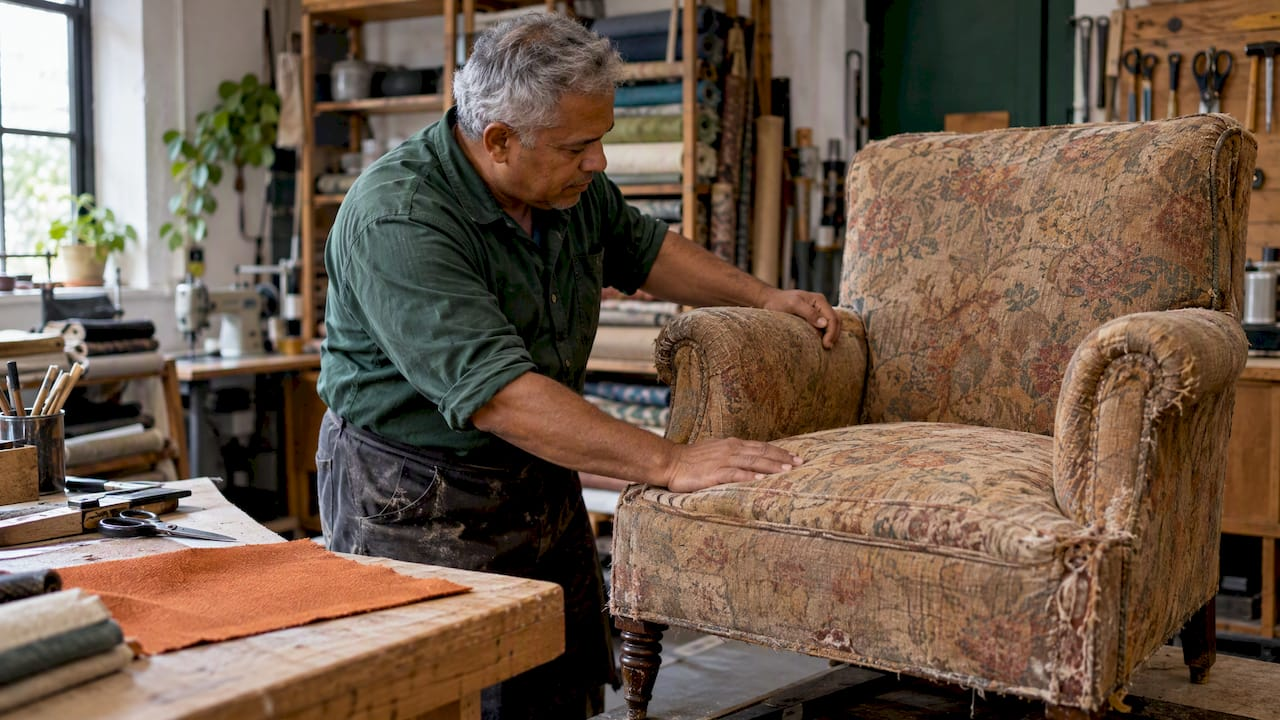
Reupholster when the frame is solid and the cost of the work stays well below the price of a comparable new piece. Replace when the frame is weak, the damage is structural, or the quote approaches what a new sofa would cost. The fabric on a piece is the easy part to change. The frame underneath decides whether the money is well spent.
This guide shows how to test a frame in five minutes, what reupholstery typically costs in the United States, how to run the numbers against a new purchase, and where fabric choice changes the result.
TL;DR
- A solid frame is the main reason to reupholster. If the piece shakes, feels light, or gives no resistance underneath, replacing it is usually the better spend.
- Reported U.S. costs run from $2,200 to $4,200 to reupholster a standard eight-foot couch, so a quote needs to be compared with the price of a comparable new sofa.
- A common rule of thumb: if reupholstery costs more than about 70% of a comparable new piece, buy new. Sentimental value or exceptional construction can override it.
- Water, fire, termite or structural damage generally points to replacement.
- A durable, well-chosen fabric is what makes the investment last, so the cover matters as much as the labor.
Table of Contents
- What reupholstering actually involves
- Step one: test the frame before you look at fabric
- What reupholstery costs in the U.S.
- Run the numbers: the 70% rule
- The cost beyond money
- Choose a fabric that justifies the work
- Our perspective on reupholstery
- Buying fabric for your upholstery project
- Quick decision guide
- How to get a reliable quote
- FAQ
- Sources
What reupholstering actually involves
To reupholster means to cover a chair or another seat with new cloth and fill it again with a soft substance, as the Cambridge English Dictionary defines it. The second half of that definition matters. A full job is more than swapping a cover.
According to The Spruce, a full reupholstery can involve stripping the piece and replacing foam, padding and sometimes springs. That is why the fabric price alone understates the project. A cheaper alternative exists for pieces with sound padding and only worn covering: a lighter recover, where the cloth is replaced and the interior is left alone. Ask any upholsterer which of the two your piece needs before comparing quotes, because the two jobs are priced very differently.

Step one: test the frame before you look at fabric
A new cover on a weak frame is money spent on a piece that will fail again. Before you collect quotes, run a quick physical check. Upholsterer Montgomery, quoted by MyDomaine, suggests three things:
- Shake an arm. A well-built piece feels solid. Movement or wobble suggests joints that are loose or poorly made.
- Feel underneath for resistance. Press into the seat and base. A good piece pushes back.
- Lift one end. Heavy usually means a hardwood frame and dense construction. A light piece suggests thinner materials.
The same guide says these are signs of high quality, and adds a plain test of attachment: if you would be sad to see the piece go, it may deserve a second life with new upholstery.
The Spruce reaches the same conclusion from the cost side. A well-constructed sofa with solid bones generally justifies reupholstery, whereas couches not built to last more than a few years may be cheaper to replace. Stitchroom co-founder Ella Hall, quoted in that article, names solid construction and structural integrity as the main reasons to invest.
Signs the frame is the problem
- The frame creaks or racks when someone sits down or stands up.
- Joints move when you shake an arm or the back.
- Springs or webbing have failed and sag in the same place after a repair.
- The piece is noticeably light and the legs or rails look thin.
Any of these tilts the decision toward replacement, however good the fabric choice is.
Damage that usually ends the question
Homes & Gardens reports that water damage, fire damage, termite damage or irreparable structural damage can make replacement preferable, and that structural integrity should be assessed before you invest in upholstery. The experts it quotes make a useful point: cosmetic damage can be covered by new fabric, but severe damage underneath cannot be restored by it. If a piece has been through a flood or has an active pest problem, do not start with a fabric swatch.
What reupholstery costs in the U.S.
Prices vary by region, fabric and the complexity of the piece, but published ranges give a workable starting point.
| Item | Reported range | Source |
|---|---|---|
| Standard eight-foot couch, complete job | $2,200 to $4,200 | The Spruce, 2024 |
| Upholstery fabric, per yard | $30 to $350, most $40 to $70 | The Spruce, 2024 |
| Fabric needed for a standard eight-foot couch | 10 to 15 yards | The Spruce, 2024 |
| Simple chair, labor only | $50 to $70 | MyDomaine, 2022 |
| Full couch, labor only | $1,200 to $1,800 | MyDomaine, 2022 |
The MyDomaine figures exclude fabric, so they are not directly comparable with The Spruce’s all-in range. They also date from 2022, and labor rates have likely moved since. Treat every number as a planning range and replace it with a written local quote.
What pushes the price up
MyDomaine lists the main drivers: the fabric, the condition of the furniture, the size and detail of the project, cushion fill, tufting, trim, nailheads and welting. Location matters too, as The Spruce notes. A tufted, skirted, heavily trimmed sofa takes far more labor than a clean-lined modern one with loose cushions. If budget is tight, simplifying the details is one of the few levers you control.
Fabric is the line you can control
The fabric is the one large cost you can buy yourself. With 10 to 15 yards needed for a standard couch, a fabric at the common $40 to $70 per yard comes to roughly $400 to $1,050 in cloth (our arithmetic from The Spruce’s figures). At the top of the $30 to $350 range, the cloth alone would exceed the labor. Many upholsterers will work with fabric you supply, which lets you compare yardage costs instead of accepting one marked-up price. Confirm this with your upholsterer first, and ask them for the exact yardage they need, since pattern repeats and the width of the roll change the number.
Run the numbers: the 70% rule
The question “what is the 2/3 rule for sofas?” usually points to a rule of thumb. A version published by StitchDesk treats reupholstery as a reason to buy new when it costs more than about 70% of a comparable new piece, and as a reason to reupholster when it costs less. The same source says higher frame quality or sentimental value can change the answer. It is a guideline, not a law, but it forces an honest comparison.

A worked example
This example is hypothetical and uses round numbers to show the method.
- You get a written quote for a full reupholstery of a three-cushion sofa: $3,000, fabric included.
- You price a new sofa of similar size and construction quality, not the cheapest one in the showroom. Say it is $3,800.
- Divide: $3,000 ÷ $3,800 is about 79%. That is above 70%, so the rule leans toward buying new.
- Now adjust for what the rule cannot see. If your sofa has a kiln-dried hardwood frame and the new one is particleboard and staples, the real comparison is against a better new sofa, which might cost $6,000. Then the ratio is 50%, and reupholstering looks like the stronger choice.
The step that people skip is step two. A comparable new piece means similar frame, similar cushion quality and similar size. Comparing a $3,000 reupholstery of a heavy hardwood sofa to a $900 flat-pack replacement will always make reupholstery look expensive, and it will not tell you which piece lasts longer.
When the math is close
If the ratio sits between 60% and 80%, the tie-breakers are practical:
- Fit. Homes & Gardens’ piece makes the point that, if a piece fits your space, reupholstering beats learning to use and adjust to something new. Dimensions, seat height and depth you already like are hard to find again.
- Lead time. Custom upholstery and new furniture orders both carry waits. Ask for current timelines.
- Delivery and disposal. A replacement means hauling out the old piece and bringing in the new one.
- Sentiment. If you would miss it, count that.
The cost beyond money
Reupholstery also keeps a piece out of the waste stream. The Washington Post frames reupholstery as a way to avoid discarding a sofa and the energy and materials needed to make and ship a replacement. Reuse is also a public priority: an EPA grant fact sheet describes an Oregon project aimed at raising reuse, repair and refurbishing of bulky furniture and household goods by 50%.
For heirlooms and antiques, the picture shifts. Homes & Gardens reports that buying new is usually cheaper than reupholstering antique furniture, but restoring an heirloom can still be the preferred route because it preserves craftsmanship and may be more sustainable. In that case the decision is about value to you, not the cost ratio.
Choose a fabric that justifies the work
Once you decide to reupholster, the cover determines how soon you will be doing it again. A weak fabric on a strong frame wastes the best part of the investment. The Washington Post’s advice is blunt in a similar vein: do not reupholster a piece that will not outlast the new fabric. The reverse is also true.
A few practical points:
- Match the fabric to the use. A family room sofa that is used daily needs a tougher cloth than a formal chair that is used a few times a month.
- Look at the rub count. MyDomaine recommends a residential double-rub rating of 20,000 to 50,000 when durability is a priority, and notes that performance fabric can repel spills and resist stains and odors.
- Think about cleaning. Households with children or pets often benefit from a smooth, tight weave, or from a vinyl that wipes clean.
- Order a sample first. Color and texture change under your own lighting, and a sample next to the frame tells you more than a screen.
Three guides on our site go deeper on these points: upholstery fabric types, how durable an upholstery fabric is, and tips for selecting upholstery fabric. If you plan to compare materials side by side, the upholstery material checklist lists what to check before you buy.
Our perspective on reupholstery
We sell fabric by the yard and work with drapery workrooms, upholsterers, designers and homeowners, so we see this decision from the supply side. The pattern is consistent: the projects that go well start with a frame that has been tested, a written quote, and a fabric chosen for the way the piece will be used. The projects that disappoint tend to start with a fabric chosen from a photograph.
Our view is that reupholstery is worth it when three things line up. The frame passes the shake and lift tests. The total quote, with fabric, sits clearly below a comparable new piece. And the fabric is rated for the real traffic the furniture will see. When one of the three is missing, we would say so, even if it means a customer buys a new sofa instead.
We also encourage ordering samples before committing to yardage. A swatch costs little compared with 10 to 15 yards of the wrong cloth, and an upholsterer can tell you quickly whether a sample suits the piece. Heavy, closely woven, hospitality-grade materials tend to suit seating that is used daily, which is why we carry them alongside decorative fabrics.
— Marrion
Buying fabric for your upholstery project
If you have decided to reupholster, we sell upholstery fabric by the yard with nationwide shipping, along with fabric samples, so you can see a material in your own room before you buy. For seating that is used every day, our hospitality grade upholstery fabric collection is the place to start. For a wipe-clean surface, there is a vinyl upholstery fabric in Dark Truffle, and a heavy-duty solid polyester suits a neutral, plain look. You can browse everything, including our custom drapery service, on our main store page.
Quick decision guide
| Your situation | Likely better choice |
|---|---|
| Solid frame, worn or outdated fabric, quote well under 70% of a comparable new piece | Reupholster |
| Solid frame, quote near or above 70%, but you love the fit and design | Reupholster, or compare closely |
| Loose joints, wobble, light weight | Replace |
| Water, fire or termite damage, or structural damage | Replace |
| Heirloom or antique with sentimental or craft value | Reupholster, regardless of cost ratio |
| Inexpensive piece not built to last several years | Replace |
How to get a reliable quote
- Test the frame yourself first using the shake, press and lift checks above.
- Photograph the piece from the front, side and back, including the underside, and note any sagging or noise.
- Ask for a written, itemized quote that separates labor, padding and foam, springs or webbing repair, trim and fabric.
- Ask whether the quote is for a full reupholstery or a recover, and what will be replaced inside.
- Ask about supplying your own fabric, and request the exact yardage needed.
- Price a true equivalent new piece with a similar frame and cushion construction.
- Divide and decide, then adjust for fit, lead time and sentiment.
FAQ
Is reupholstery worth it?
It is worth it when the frame is solid, the full cost is clearly below a comparable new piece, and you value the shape and fit. The Spruce says a well-constructed sofa with solid bones generally justifies the cost, while couches not built to last more than a few years may be cheaper to replace. If the quote nears the price of a good new sofa, weigh sentiment and sustainability against cost.
How much does it cost to reupholster a couch?
The Spruce reports $2,200 to $4,200 for a standard eight-foot couch, while MyDomaine estimates $1,200 to $1,800 for labor alone, excluding fabric. Fabric, trim, tufting, cushion fill and your location move the total. Get a written quote and ask which parts of the interior are being replaced.
What is the 2/3 rule for sofas?
The rule people usually mean is a 70% guideline: if reupholstering costs more than about 70% of a comparable new piece, buying new may make financial sense. Frame quality or sentimental value can override it. Use it as a way to structure the comparison, not as a final verdict.
What does the word reupholster mean?
To reupholster is to cover a chair or other seat with new cloth and fill it again with a soft substance, according to the Cambridge English Dictionary. In practice, that can mean a new cover only, or new padding, foam and sometimes springs underneath.
When should I replace a piece instead?
Replace it when the frame is loose or light, when water, fire, termite or structural damage is present, or when the quote exceeds what a comparable new piece costs. Cosmetic fabric damage can be fixed. A failing frame cannot be fixed with new fabric.
Sources
- REUPHOLSTER | definition in the Cambridge English Dictionary
- Your Complete Guide to Reupholstering Furniture, MyDomaine
- How Much Does It Actually Cost to Reupholster a Couch?, The Spruce
- Is it Cheaper to Reupholster Antique Furniture or Buy New?, Homes & Gardens
- How to decide whether to reupholster old furniture, The Washington Post
- Investing in America through the Bipartisan Infrastructure Law, EPA
- Is It Worth Reupholstering Furniture?, StitchDesk
Leave a Reply