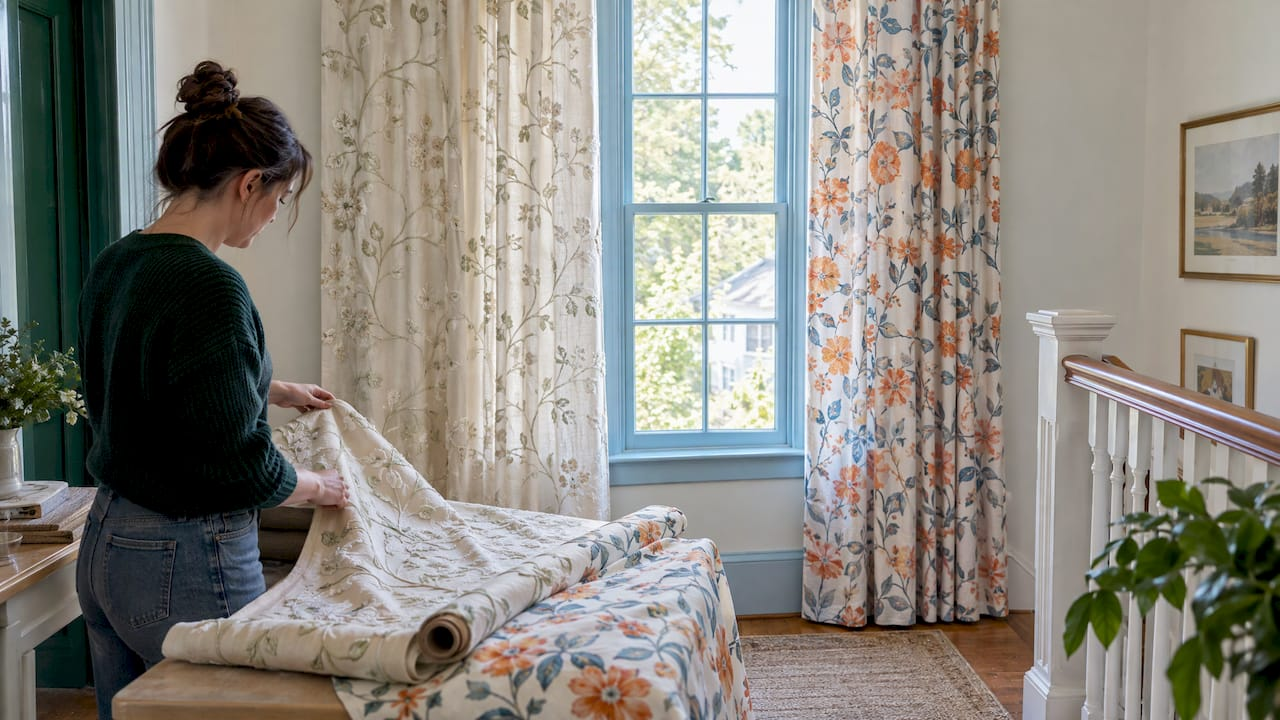
Embroidered fabric carries its pattern in stitched thread, so it has raised texture and a tailored, formal look. Printed fabric carries its pattern in dye or ink, so it suits bold, colorful, large-scale designs. For curtains, upholstery and outdoor projects, the right choice depends on how the fabric will be used, how often it will be cleaned and how much light and wear it will see.
This guide compares the two on appearance, durability, care, base fabric and cost. It also covers marine and utility uses, where the choice matters most.
TL;DR
- Embroidered fabric has stitched, textured designs. It suits formal drapery, accent pieces and rooms where depth and refinement matter.
- Printed fabric has a flat, surface-level design. It suits large motifs, multi-color patterns and rooms where a graphic look is the goal.
- Durability differs by risk: printing can fade, while embroidery can snag. Care instructions should drive the decision.
- Base fabric matters as much as the decoration. Cotton, linen and sturdy blends carry embroidery well, while very delicate fabrics do not.
- Outdoor and marine use calls for weather-resistant thread and fabric, chosen to match the expected life of the project.
Table of Contents
- What is the difference between embroidered and printed fabric?
- How they compare at a glance
- Look and feel: texture versus color
- Durability and care
- Which base fabric works best?
- Curtains versus upholstery
- Cost: what to expect
- Marine and utility use
- Our perspective
- Choose embroidered fabric and custom drapery with us
- A simple way to decide
- FAQ
- Sources
What is the difference between embroidered and printed fabric?
The difference is in how the design reaches the cloth. Embroidery applies decorative designs by stitching thread or yarn into the fabric, which can create a three-dimensional effect with threads sitting above the surface. Printing, by contrast, transfers an image to the product using ink or dye.
In practice, that gives you two different materials:
- Embroidered fabric is a base cloth with a pattern added on top in thread. You can feel the design with your fingertips, and light catches the stitches differently from the ground fabric.
- Printed fabric is a base cloth with color applied to or into the fibers. The surface stays smooth, and the design can include fine gradients, photographic detail and large repeats.
A third category sometimes enters the conversation: woven patterns such as jacquard, where the design is built into the weave itself. That is a different construction from either embroidery or printing, and it is worth considering when you want a pattern that is neither stitched on nor dyed on.
How they compare at a glance
| Factor | Embroidered fabric | Printed fabric |
|---|---|---|
| Look | Raised, tactile, formal | Flat, graphic, often more colorful |
| Best pattern scale | Moderate motifs, borders, repeating details | Large motifs, many colors, complex artwork |
| Main wear risk | Snagged or loosened threads | Fading or reduced sharpness over time |
| Care approach | Gentle washing or hand washing | Depends on dye quality and fabric; follow the label |
| Typical interior uses | Formal curtains, cushions, table linens, accents | Everyday curtains, accent pillows, bold feature windows |
| Feel | Textured | Smooth |
Treat the table as a starting point. Within each category, thread quality, dye quality, base cloth and finishing all change the result.
Look and feel: texture versus color
Embroidery adds dimension. A stitched vine, trellis or geometric border casts tiny shadows, and the pattern reads differently as daylight moves across a room. That is why embroidered sheers and drapery panels tend to look elevated in dining rooms, primary bedrooms and formal living spaces. For ideas by room, see our guide to embroidered curtain styles, and for the broader case, read why embroidered textiles suit home décor.
Printing adds range. Because ink or dye can be laid down in many colors without changing the surface, printed fabric handles large botanical murals, watercolor effects and detailed illustration well. PPAI notes that screen printing produces bold, vibrant colors and clean, sharp edges, which is the quality designers look for when a pattern needs to read from across a room.
A useful rule: choose embroidery when you want the pattern to be felt as well as seen, and printing when you want the pattern to be as large, colorful or detailed as possible.

Durability and care
Neither method is simply better. Each has a characteristic weak point, and the right choice depends on which one your project can live with.
Embroidery: strong color, watch the threads
PPAI explains that embroidery will not fade the way screen printing can, but threads can snag, pull or come loose, and that embroidered goods should be washed gently or by hand. For a curtain panel that hangs and is rarely touched, that is easy to manage. For a seat used daily by children or pets, raised stitching is a more considered choice.

The same logic applies to the base cloth. Delicate embroidered textiles are typically better placed in drapery and accessories than in hard-wearing upholstery, so reserve heavily stitched designs for window treatments, pillows and accent pieces.
Printing: strong surface, watch the light and laundering
Printed designs can lose sharpness or fade, particularly on a surface that is not suited to the process or in strong sun. Quality matters: how well the color is bonded with the fiber, and how well the process was controlled, determines how a print holds up to washing, friction and light. Windows that face south or west deserve special thought, and a lining can help protect the face fabric.
Upholstery adds its own test
For seating, decoration is only one part of durability. The Association for Contract Textiles explains that upholstery durability depends on fiber content, weave, finishes, furniture design, maintenance, cleaning and usage, and that it is measured through abrasion, seam slippage, pilling, tensile strength and other tests. The same document also cautions that abrasion results are not necessarily a reliable indicator of how long a fabric will last. Use performance ratings as one input, then consider real household use. Our articles on understanding fabric durability and fabric durability in home décor choices go deeper.
Cleaning curtains
Whichever you choose, read the care label before the first wash, and test any cleaning method on a hidden hem. Our checklist on dry cleaning versus washing curtains lists six checks to make first.
Which base fabric works best?
The decoration is only as good as the cloth underneath it.
For embroidery, PPAI lists cotton, canvas, fleece, linen and denim as strong choices, and advises against embroidering thin or delicate silk and rayon. The Embroiderers’ Guild of America adds that plain-weave fabrics suit surface embroidery, while evenweave fabrics with a regular grid suit counted-thread techniques, with linen, muslin, Aida and canvas chosen according to the stitch method and the detail wanted.
For home décor, this translates into a few practical pairings:
- Sheer or light curtains: lightweight embroidered fabrics let light through while the stitching adds interest. Georgette-type fabrics are a natural fit.
- Mid-weight drapery: cotton and poly-cotton blends hold stitching well and drape cleanly when lined.
- Accent pillows and bedding accents: embroidery on a stable blend gives texture where the fabric is handled gently.
- Upholstery: a solid, tightly woven fabric is the safer foundation for seating, with decoration kept modest.
Printed fabrics are more forgiving about base cloth, since the design does not depend on the cloth holding stitches. That is one reason printed designs appear across such a wide range of weights and fibers.
Curtains versus upholstery
Curtains and drapery are where embroidery shines. Panels hang, are rarely rubbed and are viewed from a distance and in changing light. The stitched texture makes a window feel finished, even in a simple room. Printed curtains are a good answer when you want a strong color story or an oversized pattern, and they pair well with a quiet, solid fabric elsewhere in the room.
Upholstery puts the fabric under friction. Solid or tightly woven, performance-oriented fabrics tend to be the sensible base here, and pattern can come from a modest print, a woven design or a pillow with embroidery. Our practical guide to upholstery fabric types explains the options, and our hospitality-grade upholstery collection shows fabrics built for heavier use.
If you are still deciding on an overall approach, how to choose the right fabric for drapery walks through weight, lining and fullness.
Cost: what to expect
Embroidery is generally the more labor-intensive process, which is why embroidered fabric is usually positioned as the more premium option, while printing is usually the more economical way to cover large areas in many colors. Exact prices vary with the base cloth, the density of the stitching and the quantity, so compare by the yard rather than by the method. When you are weighing custom work against ready-made, why custom drapery costs more than ready-made panels and custom drapery versus store-bought curtains explain where the difference comes from.
Marine and utility use
Outdoors, the question changes from “which looks better” to “which survives sun, salt and frequent cleaning.” Two things matter: the fabric and the thread.
In marine work, thread is the part that tends to fail first. Gore’s global engineering leader Mandy Wittenberg says it is important that thread matches the life of the fabric, and notes that many high-quality marine fabrics are designed to last 10 years with a matching warranty, while most thread is not as durable as the fabric it holds. The same article reports that A&E recommends Sunbrella embroidery thread for monogramming and intricate decorative work on marine fabrics, because of its colorfastness and weather durability.
The practical takeaways for a boat cover, cushion or cockpit enclosure:
- Choose the thread as carefully as the fabric. A weather-resistant thread protects any stitched monogram or decorative detail.
- Keep decoration simple. A small embroidered mark or name is easier to maintain than an all-over design.
- Plan for the full environment. Sun, moisture, abrasion and cleaning all act on the fabric at once.
For utility fabrics used in workrooms, covers and protective projects, the same principle holds: match the decoration method to the care conditions. A plain, durable utility fabric needs no decoration at all, and an embroidered detail can be added where a mark or label is wanted.
Our perspective
We see the same pattern with customers choosing between embroidered and printed fabric: the best result starts with the room, not the technique. Ask where the fabric will hang or sit, how much sun it will get and how it will be cleaned.
For window treatments, we favor embroidered fabric when a client wants a refined, tailored look. The texture adds depth without adding bulk, and it works with both traditional and modern rooms. Our embroidered collection is built around fabrics we consider versatile and durable, in blends such as polyester and cotton that suit drapery well.
Where a bold, large-scale pattern is the aim, a print can be the right answer, and we are glad to talk through how it will sit with the rest of the room. Our one-on-one design consultations, fabric samples and installation guidance exist so that you can see and handle the cloth before committing to yards of it.
Our advice: order a sample, hang it in the window you plan to dress and look at it in morning and evening light. That tells you more than any description.
Marrion
Choose embroidered fabric and custom drapery with us
If you have decided that stitched texture is right for your windows, our embroidered fabric for custom curtains collection is the place to start. It sits alongside fabric sold by the yard, ready-made panels and our custom drapery making service from Columbia, SC, with nationwide shipping.

You can browse specific fabrics such as the light grey embroidered poly-cotton or the embroidery georgette in tan, or head to our home page to see every category, request samples and book a design consultation.
A simple way to decide
Work through these questions in order:
- Where will it go? Windows and accent pieces suit embroidery well. Heavy-use seating is better served by a solid, durable upholstery fabric.
- How will it be cleaned? If you prefer gentle or professional cleaning, embroidery is comfortable. If you want something simple to launder, read the care label first, whichever method you choose.
- How much light will it get? Strong, direct sun argues for a lining, and for checking how a printed color holds up.
- How large is the pattern you want? Big, multi-color designs point to printing. Moderate motifs, borders and texture point to embroidery.
- What is the base cloth? Cotton, linen and sturdy blends carry embroidery best.
- Will you see it in person first? A sample settles most remaining doubts.
FAQ
Is embroidery better than print?
Neither is better in every case. Embroidery gives a durable, professional look with texture, and it does not fade the way screen printing can, though its threads can snag. Printing gives bold color and sharp, detailed graphics over large areas. Pick based on the room, the wear and the care routine.
Which fabric is better for embroidery?
Tightly woven, stable fabrics such as cotton, canvas, linen and denim are widely recommended, while thin or delicate silk and rayon are not. For home décor, cotton and poly-cotton blends are dependable choices for curtains and pillows. Stretchy fabrics can pucker, so they are a poor base for stitched designs.
Can embroidered curtains be washed?
Often yes, but gently. Embroidered goods should be washed gently or by hand, and the care label should always decide the method. Because stitching can snag, avoid rough cycles and harsh handling, and consider professional cleaning for lined or heavily stitched panels.
Is embroidered fabric good for upholstery?
It can be used, but delicate embroidered textiles are more commonly chosen for drapery and accessories than for hard-wearing seating. For sofas and dining chairs, a solid, tightly woven upholstery fabric is usually the more practical base, with embroidered pillows adding texture.
What works for outdoor or marine projects?
Choose weather-resistant fabric and a thread suited to sun and moisture, since thread often wears out before the fabric does. Keep embroidered details small and simple, and match the thread’s expected life to the fabric’s.
Sources
- A Beginner’s Guide To Four Common Decoration Methods, PPAI
- Fabric for Embroidery: The Beginner’s Guide, Embroiderers’ Guild of America
- Abrasion, Association for Contract Textiles
- Needle and thread know-how, Marine Fabricator
Leave a Reply