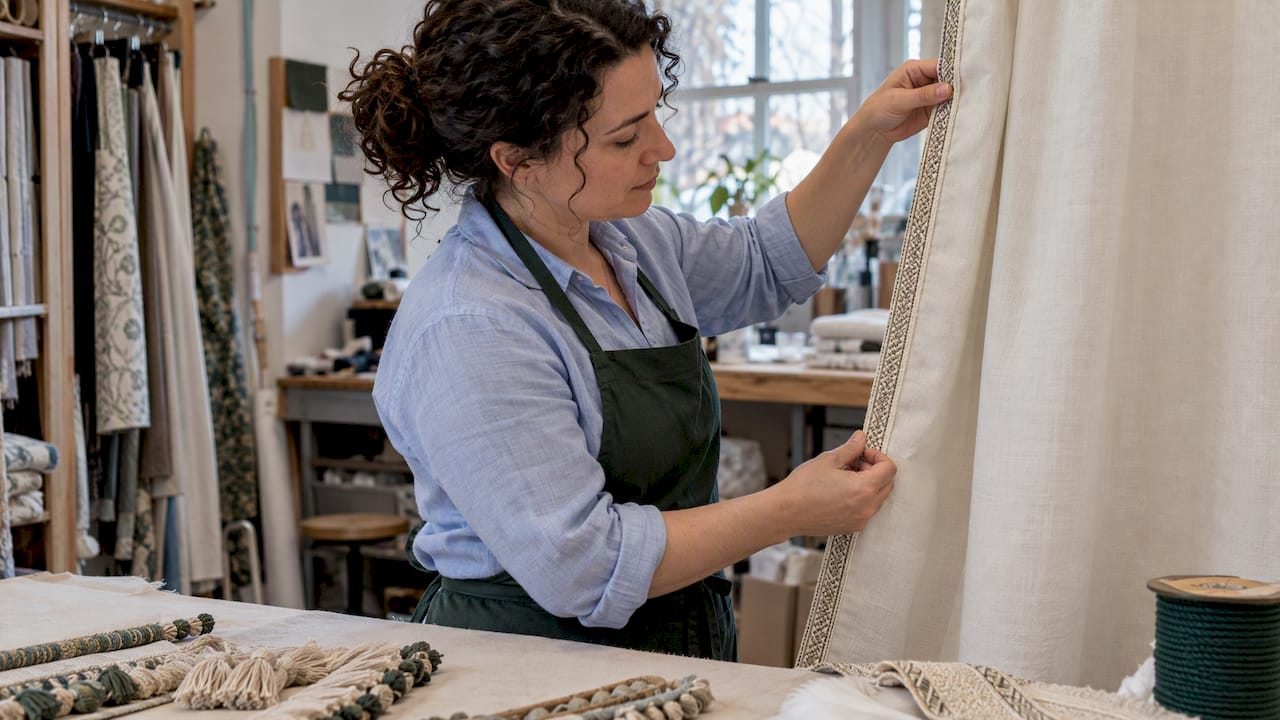
Drapery trim falls into four families: flat border tapes, fringes, cords and piping, and individual embellishments such as tassels, rosettes and frogs. Each does a different job. Tape defines an edge, fringe adds weight and movement, cord finishes a seam, and embellishments hold or accent the panel. The right choice depends on the scale of the window, the weight of the fabric and where on the panel the trim sits.
This guide covers each type, where it works best, how Greek key ribbon is applied, and the practical points that decide whether trim looks deliberate or overworked.
TL;DR
- Trim comes in four main families: border tapes, fringes, cords and piping, and embellishments. Pick the family by the job it must do.
- Match trim weight to fabric weight. Heavy bullion fringe suits large, lined panels and can overwhelm light ones.
- Place trim on the leading edge, the bottom edge or all around, and consider setting it a few inches inside the edge for a more tailored look.
- Bulky trim adds to stack-back, so plan for it when you measure and choose hardware.
- Greek key ribbon is the most requested border tape. Mock up the corners before any stitching.
Table of Contents
- What drapery trim does
- The main drapery trim types
- Where trim goes on the panel
- Greek key trim on curtains
- Scale, weight and the fabric underneath
- How trim affects stack-back and headings
- Our perspective
- Fabric and drapery services from Beautiful Windows Elgin
- A step-by-step approach to adding trim
- FAQ
- Sources
What drapery trim does
Trim, historically called passementerie, is the decorative finishing used to define edges, add weight or introduce visual movement on window treatments. Samuel & Sons’ drapery education guide describes it as a way to frame a view with leading edges or bring movement with fringe. Its catalog of passementerie runs to more than 10,000 styles, which is why a short framework helps before you start browsing.
Think of trim as having three functions:
- Definition. A band along the leading edge or hem outlines the panel against the wall and window.
- Weight. Fringe and wide borders pull the lower edge down and help a panel hang straight.
- Character. A narrow tape reads as tailored. A tasseled fringe reads as traditional. A geometric ribbon reads as classic with a graphic edge.
The main drapery trim types
Border tapes and ribbons
Border tapes are flat, woven bands, sometimes called gimp or decorator tape when narrow, and ribbon or border when wider. They are sewn flat to the face of the fabric and are the most versatile family. Widths run from a fraction of an inch to several inches, and designs include solid bands, stripes, embroidered cotton borders, jacquard patterns and geometric motifs such as Greek key.
Best for: leading edges, hems and inset frames on solid or lightly textured fabric. A tape needs a fabric calm enough to let the pattern read, so it pairs well with plain linen-look weaves, solid cotton and soft sateen finishes.
Fringes
Fringe is the broadest category. The main variants:
- Brush fringe: short, dense, cut threads on a header tape. Neat and relatively light.
- Bullion fringe: twisted, rope-like lengths that hang with real weight. Traditional and formal.
- Bead fringe: strands tipped or strung with beads. Catches light and suits accent pieces more than full-length hems.
- Chainette fringe: thin, looped or chain-style strands with a lighter, more fluid motion.
- Tassel fringe: small tassels spaced along a header for a more decorative rhythm.
Best for: hems and leading edges on lined, full-length drapery, plus pillow and ottoman edges that coordinate with the window. These categories follow the structure laid out in the Samuel & Sons guide.
Cords, piping and welting
Cord trim is a twisted or plied rope. Piping, or welting, is a cord wrapped in fabric and inserted into a seam. Both give a crisp line without adding much visible bulk. Piping in a contrasting fabric works well along the leading edge seam of a panel, in valances and in cushions made to match.
Best for: structured looks, seams, valance edges and any place where you want definition but not pattern.
Embellishments: tassels, rosettes, frogs and buttons
These are individual pieces rather than yardage. Tassels and rosettes often finish tiebacks and holdbacks. Frogs and buttons fasten or accent. Because they are applied in single places, they are the lightest way to add personality to a panel and the easiest to change later.
Best for: tiebacks, valance corners and anywhere you want a focal accent without trimming the full length.
Quick comparison
| Trim type | Visual effect | Weight added | Best placement | Pairs well with |
|---|---|---|---|---|
| Narrow tape | Tailored, crisp | Low | Inset line, leading edge | Solid and textured fabric |
| Wide border or ribbon | Graphic, classic | Low to medium | Leading edge, hem | Plain weaves, cotton, linen-look |
| Brush fringe | Soft, neat | Medium | Hem, leading edge | Lined panels |
| Bullion fringe | Formal, traditional | High | Hem of full-length drapery | Heavy, lined fabric |
| Bead or chainette fringe | Light, decorative | Low to medium | Accent hems, pillows | Sateen, jacquard |
| Cord and piping | Clean line | Low | Seams, valances | Almost any fabric |
| Tassels and rosettes | Focal accent | Low | Tiebacks, corners | Formal or traditional rooms |
Where trim goes on the panel
The Samuel & Sons guide describes three common placements, and they can be layered:
- Leading edge: the vertical edge where panels meet or face the room. It frames the opening and is the most visible line.
- Bottom edge: along the hem. It adds weight and anchors the panel to the floor line.
- All around: a full frame, usually reserved for formal rooms and wide bands.
Two placement details separate a polished result from a homemade one. First, setting a band a few inches inside the leading edge, rather than on the extreme edge, looks more deliberate and keeps the trim from blending into the wall or frame color. Second, mitered corners, where the band is folded at 45 degrees, hide the raw edge and give a continuous frame.
Greek key trim on curtains
Greek key ribbon is the trim most people have in mind when they search for trimmed curtains. The repeating geometric pattern reads as traditional but works in transitional and modern rooms too, especially in a high-contrast pairing such as navy on white or black on cream.

Two routes exist. The first is DIY on ready-made panels. In one 2016 tutorial, the author bought 7 yards of black and white Greek key trim for $35 with tax, and the full project came to roughly $80. The second is custom work. As of 2026, premium custom panels with Greek key trim are priced around $350 per panel, according to the same source. Professional workrooms usually treat trim as an add-on and often need the trim purchased alongside the drapery order.
Practical points for Greek key:
- Pattern alignment. The motif must turn cleanly at corners and meet at seams. Dry-fit the entire length with pins or tape before sewing.
- Position. For a classic look, place the band along the leading edge and hem, inset a few inches from the edge.
- Fabric choice. Solid cotton, linen-look or soft sateen lets the geometry stand out. A busy print competes with it.
- Thread. Match thread to the trim’s base tape so the stitching disappears.
The trim can also be applied with adhesive for no-sew projects, but for panels that will be washed, dry-cleaned or handled often, stitching holds up better.
Scale, weight and the fabric underneath
The common mistake is treating trim as an afterthought. The Samuel & Sons guide says scale must balance with the window and the panel. A heavy bullion fringe can overwhelm small, light panels, yet it adds useful structure to large lined traditional drapery.
Use these checks:
- Trim weight versus fabric weight. Trim that is too heavy can cause uneven hanging or distortion over time. A sheer or lightweight cotton needs a tape or light brush fringe, not bullion.
- Trim width versus panel width. A very wide ribbon on a narrow panel leaves little plain fabric. Keep a visible field of fabric.
- Lining. Lined panels support heavier trim and hide the back of stitching.
- Care. Check whether the trim can be cleaned the same way as the fabric. Mixed fibers can shrink or bleed differently.
For help with the fabric itself, our guides on how to choose the right fabric for drapery and curtain fabric types cover weight, drape and function.
How trim affects stack-back and headings
Thick fringe or a heavy ribbon border increases the width of the panel when it is fully open. That means more wall space beside the window, so account for it while measuring and selecting hardware, not after the panels arrive. Our article on how much room drapery stack-back needs walks through the measurement.

The heading, the finished top of the panel, interacts with trim as well. Per Studio Matrx’s heading reference, fullness typically ranges from 1.5x to 2.5x the window width: triple pinch pleats sit around 2.2x to 2.5x and rod pocket can be as low as 1.5x. Wave or ripple fold needs a track system built for it. More fullness means more fabric, which means more trim if you carry it along the leading edge, so the heading you pick changes the trim quantity you order. Our explainer on drapery fullness helps you calculate it.
Heading and trim pair like this:
| Heading | Character | Trim that suits it |
|---|---|---|
| Pinch pleat | Structured, traditional | Leading edge band, bullion or brush fringe on the hem |
| Pencil pleat | Soft, versatile gathers | Narrow tape, hem band, light brush fringe |
| Rod pocket | Casual, gathered | Narrow tape or piping; avoid heavy fringe |
| Eyelet or grommet | Modern, smooth | Inset tape along the leading edge |
| Wave or ripple fold | Clean S-curve | Minimal: a thin hem band or no trim |
If you are still choosing a style, common curtain styles and our curtain style selection process are good starting points.
Our perspective
We work with fabric every day, and the most common trim problem we see starts with the fabric, not the trim. A trim that looks refined on a swatch card can look heavy on a lightweight panel, or lost on a patterned one. So we recommend choosing the fabric and the heading first, then selecting the trim to suit them.
Our practical rules are simple. Keep a plain field of fabric visible. Choose one trim family per panel rather than layering three. Match the trim’s care requirements to the fabric. And measure with the trim included, because stack-back and total yardage both change once it is added.
For interior designers and workrooms, a sample of the base fabric next to the trim, viewed at the window in daylight, settles most questions before a cut is made. For homeowners, the same approach prevents costly corrections. Trim is a finishing detail, and it works best when it is planned from the first measurement.
— Marrion
Fabric and drapery services from Beautiful Windows Elgin
Trim looks its best on a good base. We sell designer fabric by the yard, including cotton, embroidered and upholstery fabric, along with ready-made curtain panels and a custom drapery making service, all shipped nationwide from Columbia, SC. If you are adding a border to store-bought panels, our pencil pleat drapery panels and pinch pleat panels give you a clean base to work from. If you would rather have the full treatment made for you, our custom drapery making service includes design consultation and installation guidance. For a sense of timelines, read how drapery workrooms handle 6 to 8 week custom projects.
A step-by-step approach to adding trim
- Choose the fabric and heading. Settle weight, color and fullness first.
- Pick the trim family. Tape for definition, fringe for weight, cord for seams, embellishments for accents.
- Order a sample. Look at fabric and trim together in the room’s actual light.
- Calculate yardage. Measure the length of each edge to be trimmed, add extra for mitered corners and pattern matching, and multiply by the number of panels.
- Mock it up. Pin or tape the trim in position, step back and check scale, inset distance and corner alignment.
- Sew. Use thread matched to the trim’s base tape. Miter corners to hide raw edges.
- Hang and check. Confirm the panel hangs evenly and that the stack-back fits your wall space.
FAQ
What are the most common types of drapery trim?
The four main families are border tapes or ribbons, fringes (brush, bullion, bead, chainette and tassel), cords and piping, and single embellishments such as tassels, rosettes and frogs. Tape and brush fringe are the easiest to live with. Bullion fringe suits large, formal, lined panels.
Where should trim go on a curtain?
Most often along the leading edge, the hem, or both. A full frame all around is more formal. Setting a band a few inches in from the edge usually looks more intentional than placing it right on the edge.
Can I add Greek key trim to ready-made curtains?
Yes. Many people stitch or glue Greek key ribbon onto standard panels, and one published DIY project came to about $80 in total. Mock up the corners and pattern alignment first, and sew the trim if the panels will be cleaned often.
Does trim change how much space curtains need when open?
Yes. Thick fringe and heavy ribbon borders add bulk and increase stack-back, so allow extra wall space beside the window and factor it in when choosing hardware.
Sources
- Samuel & Sons drapery education guide
- DIY Greek Key Curtains, DIY Decor Mom
- Curtain Pleats and Headings, Studio Matrx
Leave a Reply