TL;DR:
- Curtain panel opacity determines how much light a fabric blocks and the privacy level it provides. Selecting the correct opacity depends on room function, fabric weight, fiber, weave, and lining, with blackout panels offering the most light blockage. Proper installation and layered design ensure optimal light control and aesthetic appeal in each space.
Curtain panel opacity is defined as the percentage of light a curtain fabric blocks, directly controlling how much natural light enters a room and how much privacy the panel provides. Understanding what is curtain panel opacity matters because the wrong choice leaves a bedroom too bright at dawn or a living room feeling like a cave at noon. The industry recognizes five standard opacity bands ranging from sheer at 3–15% light blockage to blackout at 97–100%, giving homeowners a reliable framework for every room in the house. Fabric weight measured in GSM, fiber type, weave density, and lining all shape real-world performance beyond what any marketing label promises.
What are the different types of curtain panel opacity?
Curtain opacity explained through five functional bands gives homeowners a clear starting point. Each band carries a defined light-blockage range, a typical fabric family, and a natural home application.
Sheer (3–15% light blocked). Sheer panels made from linen voile or fine polyester let almost all daylight pass through. They soften glare without sacrificing brightness, making them ideal for sunlit living rooms or breakfast nooks where privacy is secondary to atmosphere.
Semi-sheer (15–50% light blocked). Semi-sheer fabrics diffuse light rather than block it. They create a soft, even glow and offer partial privacy during the day, though anyone standing close to a window from outside can still see silhouettes after dark.
Light-filtering (40–85% light blocked). Mid-weight woven fabrics in this range balance natural light and daytime privacy well. Living rooms benefit most from this category, where a 40–70% blockage keeps the space bright while reducing glare on screens.
Room-darkening (60–99% light blocked). These panels use tightly woven or coated fabrics to cut most incoming light. They work well in guest bedrooms and home offices where full darkness is not required but strong light reduction is.
Blackout (97–100% light blocked). Blackout panels rely on dense weaves, foam backings, or triple-weave constructions to block nearly all light. Bedrooms, nurseries, and media rooms are the primary applications.

| Opacity type | Light blocked | Privacy level | Typical fabric | Best room |
|---|---|---|---|---|
| Sheer | 3–15% | Low | Linen voile, polyester sheer | Living room, sunroom |
| Semi-sheer | 15–50% | Partial | Lightweight cotton, gauze | Dining room, hallway |
| Light-filtering | 40–85% | Moderate | Mid-weight linen, cotton blend | Living room, kitchen |
| Room-darkening | 60–99% | High | Tightly woven polyester | Guest bedroom, office |
| Blackout | 97–100% | Maximum | Triple-weave, foam-backed | Bedroom, nursery, media room |
Pro Tip: Request a fabric sample and hold it up to a bright window before ordering. A sample test in your actual room light reveals true opacity far better than any product description.
How do fabric properties affect curtain panel opacity?
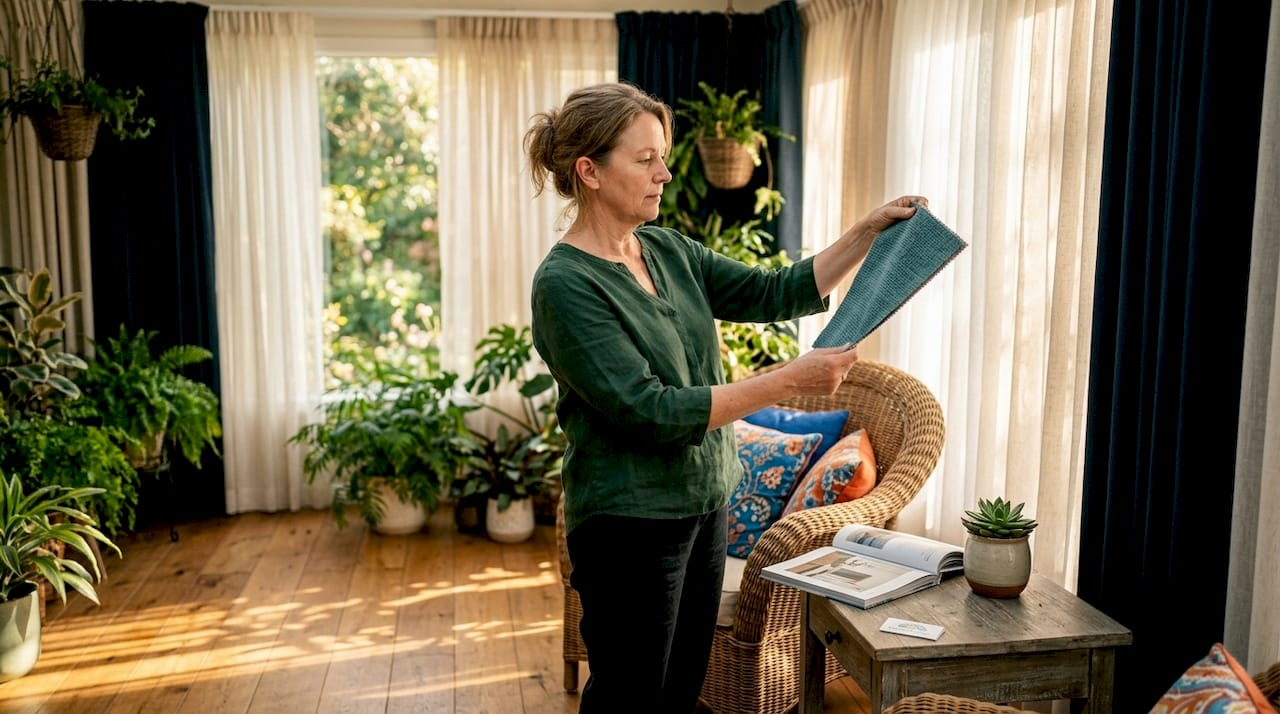
Fabric weight, measured in grams per square meter (GSM), is the most reliable proxy for curtain opacity. Typical curtain fabrics range from 80–350 GSM, with heavier weights blocking more light and holding their shape better over time. A 120 GSM linen panel reads as light-filtering, while a 280 GSM jacquard satin panel from Beautifulwindowselgin performs closer to room-darkening without any added backing.

Understanding fabric weight in home décor helps homeowners move past marketing labels and evaluate actual performance. Fiber composition matters too. Natural fibers like cotton and linen have an open weave structure that allows more light penetration than tightly spun polyester at the same GSM. Weave density compounds this effect: a plain weave at 200 GSM transmits more light than a sateen or jacquard weave at the same weight because the interlocking pattern closes the gaps between threads.
Color also affects curtain panel light transmission in a way most homeowners overlook. Darker colors absorb more light and reduce transmission even in lighter fabrics. A charcoal gray semi-sheer will block more light than a white semi-sheer made from the same fabric at the same GSM.
Lining is the single most effective upgrade for any panel. A standard cotton lining adds one opacity category to most fabrics. A blackout lining, which uses a foam or acrylic coating, can push a mid-weight decorative fabric into true blackout territory. Blackout linings also improve thermal performance and protect the face fabric from UV degradation.
- Check the GSM specification, not just the opacity label, before purchasing any curtain fabric.
- Confirm the fiber content and weave type, since polyester sateen outperforms cotton plain weave at equal weight.
- Factor in color: darker shades add effective opacity without changing the fabric structure.
- Ask whether a lining is included or available, and specify blackout lining for high-performance needs.
- Review the manufacturer’s technical data sheet rather than relying on category names like “room-darkening,” which vary significantly across suppliers.
Pro Tip: When ordering fabric by the yard from Beautifulwindowselgin, ask for the GSM specification and weave type. Those two numbers tell you more about real-world opacity than any product category name.
What are the practical differences between room-darkening and blackout curtains?
The gap between room-darkening and blackout curtains is smaller in marketing copy than it is in a dark bedroom at 6 AM. Blackout curtains block 97–100% of light, while room-darkening panels allow 5–10% light ingress around seams and edges under typical installation conditions. That 5–10% difference sounds minor but produces a visible glow around the curtain perimeter that wakes light-sensitive sleepers.
The distinction matters most in three room types. Bedrooms for shift workers or young children need true blackout performance. Media rooms benefit from blackout panels to eliminate screen glare. Nurseries require consistent darkness to support infant sleep schedules. Guest bedrooms and home offices, where occasional light is acceptable, perform well with room-darkening panels at a lower cost.
Room-darkening panels: strengths and limitations
- Cost less than blackout panels of comparable size and fabric quality
- Drape more naturally because they use fewer coatings and backings
- Offer a wider range of decorative fabrics and textures
- Allow 5–10% residual light, which suits most daytime-use rooms
- Less effective for shift workers or anyone requiring complete darkness
Blackout panels: strengths and limitations
- Block 97–100% of light when properly installed with minimal side gaps
- Provide maximum privacy at all hours
- Add measurable thermal insulation, reducing heat loss through windows
- Can feel heavier and stiffer due to foam or triple-weave construction
- Require precise mounting to eliminate edge light leakage
Installation quality determines whether a blackout panel actually performs at its rated level. Mounting the rod 4–6 inches beyond the window frame on each side eliminates side light leakage. An outside mount positioned close to the ceiling reduces top-gap light. Overlapping panels at the center by at least 2 inches prevents the center seam from becoming a light channel.
How to choose the right curtain opacity for each room
Room function is the primary filter for selecting curtain fabric opacity levels. Bedrooms require 95–100% light blockage for quality sleep, while living rooms perform best with 40–70% blockage that preserves natural brightness without glare.
- Living room. Choose light-filtering or semi-sheer panels. They maintain a bright, open feel during the day and provide enough privacy for evening use when interior lights are on.
- Bedroom. Select blackout or high-end room-darkening panels. Pair them with blackout advantages for sleep by mounting the rod wide and high to seal edge gaps.
- Kitchen. Light-filtering panels work well. They allow natural light for cooking tasks while reducing direct sun on food preparation surfaces.
- Home office. Room-darkening panels reduce screen glare without creating a fully dark environment that feels oppressive during work hours.
- Nursery or child’s bedroom. Blackout panels are the clear choice. Consistent darkness supports longer and more regular sleep for infants and young children.
Layering is the most flexible solution for rooms with changing needs. Sheer plus blackout layering gives homeowners full daytime brightness by drawing back the blackout panel while maintaining privacy through the sheer, then full darkness at night by closing both. This approach also suits east-facing bedrooms that receive intense morning light.
Thermal performance adds another reason to prioritize opacity. Heavier, lined panels reduce heat transfer through windows, lowering heating and cooling costs. Curtain lining cuts heat loss measurably, making opacity selection a practical energy decision as well as an aesthetic one. Fabrics that contribute to home energy efficiency pay back their cost over time through reduced utility bills.
Pro Tip: Measure your window and add at least 12 inches to the width when ordering panels. Wider panels stack away from the glass more fully, reducing side light leakage and improving the effective opacity of any curtain type.
Key takeaways
Curtain panel opacity is the single most important specification to confirm before purchasing any curtain fabric, because the label alone does not guarantee the performance your room requires.
| Point | Details |
|---|---|
| Five opacity bands | Sheer to blackout covers 3–100% light blockage, each suited to specific rooms. |
| GSM drives performance | Fabric weight (80–350 GSM) predicts opacity more reliably than marketing category names. |
| Installation affects results | Blackout panels lose 5–10% effectiveness without proper rod placement and panel overlap. |
| Lining upgrades any fabric | A blackout lining pushes mid-weight decorative fabric into near-blackout performance. |
| Layer for flexibility | Pairing sheer and blackout panels gives full control from bright daylight to complete darkness. |
The detail most homeowners miss when specifying curtains
I have reviewed hundreds of curtain specifications over the years, and the most common mistake is treating the opacity category as a finished decision. A homeowner selects “blackout,” orders the fabric, and then wonders why morning light still creeps around the edges. The category is a starting point, not a guarantee.
Drape quality and opacity must be balanced together. A foam-backed blackout fabric that hangs stiff and flat looks institutional in a well-designed bedroom. The better approach is a quality mid-weight woven fabric with a separate blackout lining. You get the drape and texture of a refined decorative fabric with the light control of a true blackout panel.
The second mistake is skipping the technical data. Most homeowners read the product name and move on. Asking for the GSM, fiber content, and weave type before ordering takes two minutes and eliminates most performance surprises. Suppliers who cannot provide those numbers are selling on aesthetics alone, which is not enough information for a considered purchase.
Opacity also interacts with layered textures and fabric combinations in ways that affect the final look as much as the light control. A sheer linen layer in front of a blackout panel creates depth and visual warmth that a single heavy panel cannot replicate. Getting both the function and the aesthetic right requires thinking about the two layers as a system, not as separate purchases.
— Marrion
Beautifulwindowselgin fabrics for every opacity need
Selecting the right opacity starts with access to fabrics specified by weight, fiber, and construction rather than by marketing category alone.

Beautifulwindowselgin carries a curated collection of designer drapery fabrics sold by the yard, including jacquard satins, embroidered textiles, and structured wovens with published GSM ratings. Each fabric is available with guidance on appropriate lining choices, so homeowners can build panels that perform at the opacity level their room actually requires. Custom drapery services include professional measurement support through the window treatment measurement service, which accounts for rod placement, panel width, and overlap to maximize light control. Nationwide shipping and design consultation are available for every order.
FAQ
What is curtain panel opacity in simple terms?
Curtain panel opacity measures the percentage of light a curtain fabric blocks, ranging from 3% for sheer fabrics to nearly 100% for blackout panels. It determines both the brightness of a room and the level of privacy the curtain provides.
What is the difference between room-darkening and blackout curtains?
Blackout curtains block 97–100% of light, while room-darkening curtains allow 5–10% light ingress around seams and edges. The practical difference is most noticeable in bedrooms where any residual light disrupts sleep.
How does fabric weight affect curtain opacity?
Heavier fabrics, measured in GSM, generally block more light because denser weaves leave fewer gaps for light to pass through. Curtain fabrics range from 80–350 GSM, with higher weights corresponding to greater opacity and better drape durability.
Can I increase the opacity of an existing curtain panel?
Adding a blackout lining to an existing panel is the most effective way to increase its opacity without replacing the face fabric. A blackout lining can raise a light-filtering panel into room-darkening or blackout performance territory.
Which curtain opacity level is best for a bedroom?
Bedrooms perform best with blackout or high-end room-darkening panels that block 95–100% of light. Proper installation, including a rod mounted wide and high above the window frame, is equally important for achieving full darkness.
Recommended
- What Is a Blackout Curtain Panel? A 2026 Guide – Fabric Store in Columbia, SC | Drapery Making Services
- Curtain Lining Fabric – Light Control & Added Privacy – Fabric Store in Columbia, SC | Drapery Making Services
- What Is a Patterned Curtain Panel? A Complete Guide – Fabric Store in Columbia, SC | Drapery Making Services
- Why Compare Curtain Panel Sizes: A 2026 Sizing Guide – Fabric Store in Columbia, SC | Drapery Making Services