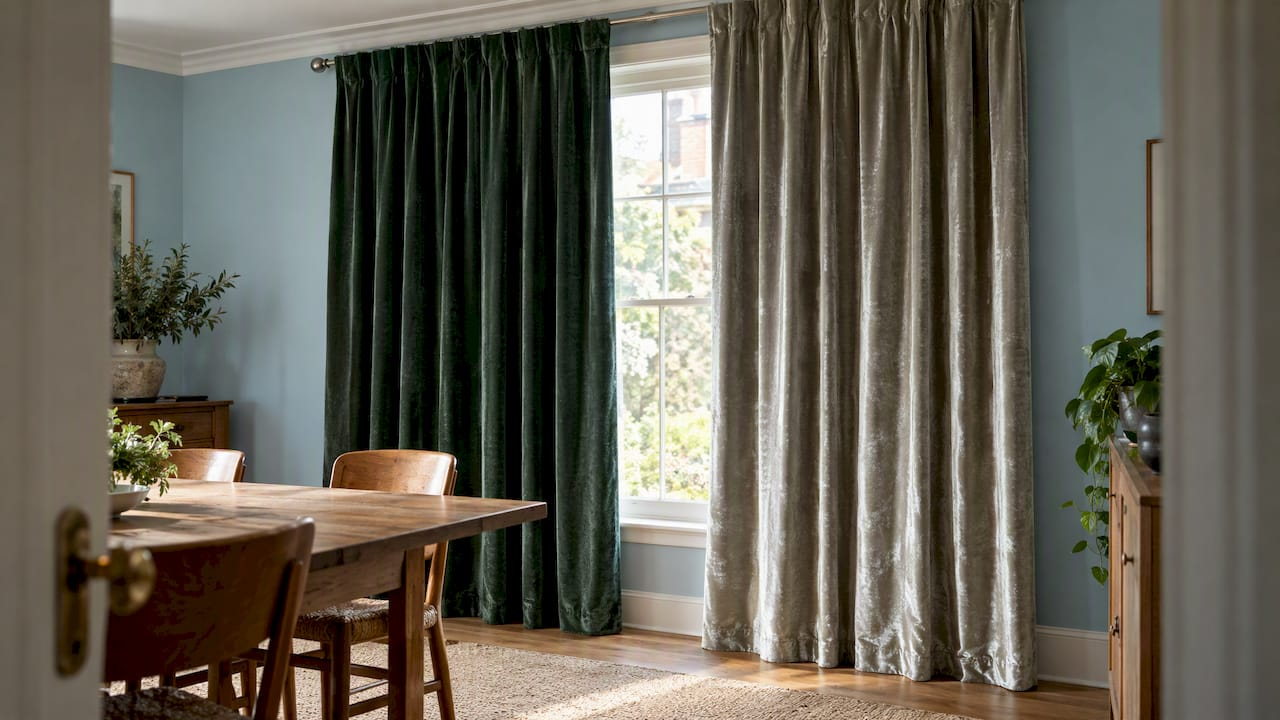
Cotton velvet is matte, soft and breathable, with a quiet, traditional look. Polyester velvet is denser, a little shinier and tougher, and it resists wrinkles and wear better. For curtains in a formal room, cotton often looks more refined. For a sofa or a high-traffic chair, polyester usually holds up longer. The right choice depends on where the fabric will hang or sit, how much sun and use it will see, and how you plan to clean it.
This guide compares the two on appearance, drape, durability, comfort and care. It then applies the comparison to curtains, upholstery and marine or utility projects.
TL;DR
- Cotton velvet has a matte surface and a softer, more natural hand. Polyester velvet has a smoother, slightly glossier surface and a plusher feel.
- Polyester is the stronger choice for abrasion, wrinkle resistance and color retention. Cotton is more breathable but can crease, lint and mildew.
- For curtains, both work. Polyester velvet can be heavy and full-bodied, and cotton velvet gives a more traditional, subdued finish.
- For sofas, check the fabric’s abrasion rating and the manufacturer’s cleaning code rather than relying on fiber alone.
- Velvet is never a fabric to soak. Spot clean according to the cleaning code, and test a hidden corner first.
Table of Contents
- What makes velvet velvet
- Appearance and feel
- Durability, wrinkles and fading
- Breathability and comfort
- Which is better for curtains
- Which is better for sofas and chairs
- Marine and utility use
- Cleaning and care
- Perspective: how we advise customers
- Ready to choose a fabric
- FAQ
- Sources
What makes velvet velvet
Velvet is defined by its construction, not its fiber. CottonWorks describes velvet as a pile fabric woven with two or more ground and pile warps, with a pile shorter than 1/8 inch. That short, dense pile is what catches light and gives velvet its depth of color.
Because the construction is the same, the fiber decides the rest: how the surface reflects light, how heavy the cloth feels, how it handles heat and moisture, and how it ages. Cotton is a natural fiber spun from short staple lengths. Polyester is a synthetic filament, and that difference shapes everything below.
Yarn type matters as well. CottonWorks notes that filament yarns tend to be smoother, more lustrous and more uniform, while spun yarns tend to be softer, less lustrous and more absorbent. Polyester velvet is commonly made from filament yarns, and cotton velvet from spun yarns. That is the reason polyester looks sleeker and cotton looks softer.

Appearance and feel
Cotton velvet has a matte, slightly dry surface. Color looks deep rather than shiny, and the pile tends to show a gentle, even nap. It reads as traditional and understated, which suits classic, transitional and farmhouse interiors.
Polyester velvet has a smoother surface with more sheen. It often feels plusher and denser under the hand. Higher-end polyester velvets look rich and uniform. Lower-quality ones can look glossy in a way some designers describe as cheap, especially in a large window where light rakes across the whole panel.

A quick way to judge is to hold a sample at an angle to a window. If the pile shows a hard, plastic-like glare, it will read the same on a wall of drapery. A softer, shadowed shift in color is the sign of a more refined surface in either fiber.
Weight and drape
Polyester velvet is not automatically stiff or thin. In a 2026 Wirecutter blackout curtain test, a 100% polyester velvet curtain was described as having a subtle sheen and a heavy, satisfying drape, with each 48-by-84-inch panel weighing 4.5 pounds. That shows what a well-woven, well-finished polyester velvet can do for drapery.
Cotton velvet usually has a more structured, slightly firmer fall. It folds into deep, crisp pleats when lined and interlined, which is why it has been a staple of formal drapery. Lightweight velvets in either fiber hang more fluidly and suit softer styles. Weight per yard and the construction of the backing matter more than the fiber label alone.
Durability, wrinkles and fading
The New Mexico State University extension guide Selecting Fabrics for Home Furnishings gives a clear fiber-level picture:
| Property | Cotton | Polyester |
|---|---|---|
| General strength | Durable and launders well | Strong and easy-care |
| Wrinkles | May crease and wrinkle unless specially finished | Resists wrinkles |
| Abrasion | Moderate | Resists abrasion, stretching and shrinking |
| Color | Dyes easily | Dyes easily and holds color well |
| Weak points | May lint, and is subject to mildew | May pill and attract lint |
This is a general fiber comparison, and a specific velvet’s backing, pile density and finish change the result. Still, it explains the pattern most buyers see: polyester velvet looks newer for longer under heavy use, while cotton velvet shows its age sooner but often ages with a softer, lived-in look that many people like.
Finishing can narrow the gap
Cotton does not have to wrinkle badly or lose color. Cotton Incorporated reports that liquid-ammonia mercerization improves cotton’s sheen, hand and drape, reduces shrinkage, and improves wrinkle resistance, tensile strength, dimensional stability and color retention. If a cotton velvet has been treated this way, it will outperform an untreated one. Ask for finishing details when you order.
Breathability and comfort
Cotton absorbs moisture and lets air move through the cloth, so it feels cooler against skin and is the more comfortable choice for seating in warm rooms. Polyester is a synthetic fiber that absorbs very little moisture, so it can feel warmer on a hot day and may feel clammy against bare skin. For a decorative pillow or a window panel, this rarely matters. For a sofa that someone sits on in shorts in July, it can.
One caution applies to cotton: moisture absorbed by fabric that stays damp can lead to mildew, which the NMSU guide lists as a cotton weakness. Keep cotton velvet away from damp walls, bathrooms and poorly ventilated corners.
Which is better for curtains
Velvet curtains do more than decorate. They block drafts, soften sound and darken a room. Our guide to velvet drapery covers those benefits in detail. For the fiber choice, think in terms of expected wear and care, a point also raised in this overview of decorative treatments for finishing a room.
Choose cotton velvet when:
- The room is formal, such as a dining room or a primary bedroom, and a matte, traditional surface suits the style.
- The panels will be lined and hung on a traditional rod with generous fullness.
- The window is not in direct all-day sun, and the room stays dry.
Choose polyester velvet when:
- The curtains will be opened and closed daily, or sit near a doorway where they get handled.
- You want a heavy, full-bodied hang with fewer wrinkles after shipping or storage.
- Pets, children or strong light make color retention a priority.
Both fibers benefit from lining. A lining protects the velvet from sun, adds body and helps the panel hang straight. If you are weighing velvet against another fabric entirely, see velvet versus linen curtains, or browse the wider curtain fabric types list.
Custom or ready-made
Velvet is heavy, and the cost of a mistake is higher than with lighter fabrics. Custom drapery lets you set the fullness, lining, header style and length to the window. Ready-made panels are quicker and suit standard windows. Either way, measure the rod width and the floor-to-rod height before you decide, and allow for the weight of velvet on the hardware.
Which is better for sofas and chairs
For upholstery, polyester velvet is usually the practical choice, because its abrasion resistance and strength suit seating. Cotton velvet can work for a chair that sees light use, but it is more likely to crush, lint and show wear at the arms and seat.
A sofa fabric is more than its fiber content, so check these specifications before you buy:
- Abrasion rating. Upholstery fabrics are commonly tested by double rubs. Ask the seller for the rating and the test method used, and compare it with your household’s use.
- Fabric weight. Heavier cloth generally holds up better on a frame that is used every day.
- Cleaning code. Manufacturers label upholstery with W, S, S-W or X. A Virginia Tech extension publication explains that W means water-based foam spot cleaning, S means a water-free solvent, S-W allows either, and X means vacuuming or light brushing only.
- Backing and construction. The pile construction affects how velvet behaves in use. The Smithsonian’s Museum Conservation Institute notes that W-weave velvets are more stable than V-weave velvets.
A 100% polyester velvet can be a good sofa fabric if it passes those checks. Our upholstery fabric types guide goes through the other options, and the hospitality grade upholstery collection shows durable textiles built for heavy use.
Marine and utility use
Velvet is a decorative fabric, and neither cotton nor polyester velvet is a standard choice for open-deck marine work. Pile traps moisture, and cotton in particular is subject to mildew. For outdoor or marine applications, look for fabrics made for the job and check four things: UV resistance, water and mildew resistance, abrasion performance and colorfastness. Synthetic, solution-dyed or vinyl-coated textiles are the usual starting point, rather than any velvet.
If you want a velvet look inside a cabin, camper or enclosed utility space, polyester is the more forgiving fiber because it does not absorb water the way cotton does. Keep it out of direct sun and away from standing moisture, and ask the seller what the fabric has been tested for before you order.
Cleaning and care
Velvet needs a gentler routine than flat-weave fabrics, for both fibers.
- Vacuum regularly with a soft brush attachment, moving with the nap.
- Treat spills at once. The Virginia Tech publication notes that pile fabrics can absorb spills into the base if they are not treated promptly, which makes them hard to remove. Blot, never rub.
- Follow the cleaning code printed on the fabric or tag.
- Avoid soaking. The Museum Conservation Institute warns that moisture can affect the pile’s finish, causing it to flatten and distort permanently.
- Test first. Try any cleaner on a hidden seam or offcut.
For drapery, steam from a distance rather than pressing with an iron, and consider professional cleaning for lined or interlined velvet panels, since lining and face fabric can shrink differently.
Perspective: how we advise customers
We sell fabric by the yard and make custom drapery, so the same question comes up often: which velvet will still look right in five years? Our answer starts with the room, not the fiber. A dry, formal room with a good lining suits cotton velvet well. A busy family room, a sofa or a window that is opened every day usually calls for polyester velvet, because it keeps its shape and color under use.
We also encourage ordering samples first. A velvet sample shows the sheen, the pile direction and the weight in your own light, which no product photo can do. If you are unsure, tell us about the window, the use and the care you are willing to give it, and we will suggest a fiber and a lining that fit.
— Marrion
Ready to choose a fabric
Our store carries designer fabrics by the yard, cotton and upholstery fabrics, ready-made curtain panels and a custom drapery making service from Columbia, SC, with nationwide shipping. Our velvet fabric collection covers upholstery and window curtains, and our cotton fabric collection suits traditional curtains. For custom panels, start from our drapery making service.

If you want a lighter, ready-to-hang option, see our ready-made curtain panels.
FAQ
Is cotton velvet better than polyester velvet?
Neither wins in every case. Cotton velvet is matte, breathable and traditional, while polyester velvet is tougher, more wrinkle-resistant and holds color well. Pick cotton for formal, low-traffic rooms and polyester for daily-use curtains and seating.
Is 100% polyester velvet good for a sofa?
It can be, since polyester resists abrasion, stretching and shrinking. Check the abrasion rating, fabric weight and cleaning code before you buy. It can feel warmer than cotton in hot weather.
Which is more breathable, polyester or cotton?
Cotton. It absorbs moisture and lets air move through the cloth, while polyester absorbs very little and can feel warm. For a window panel the difference is minor, but for seating it can affect comfort.
Can you wash velvet?
Usually not in a machine. Moisture can flatten and distort the pile permanently, so follow the cleaning code and spot clean gently. For large items such as lined drapes, professional cleaning is the safer route.
Sources
- Complex Woven Fabric Designs, CottonWorks
- Textile Yarns, CottonWorks
- A World of Ideas, Cotton Incorporated
- Selecting Fabrics for Home Furnishings, New Mexico State University
- The 4 Best Blackout Curtains of 2026, Wirecutter
- Upholstered Furniture, Virginia Tech
- Museum Conservation Institute, Smithsonian
Leave a Reply