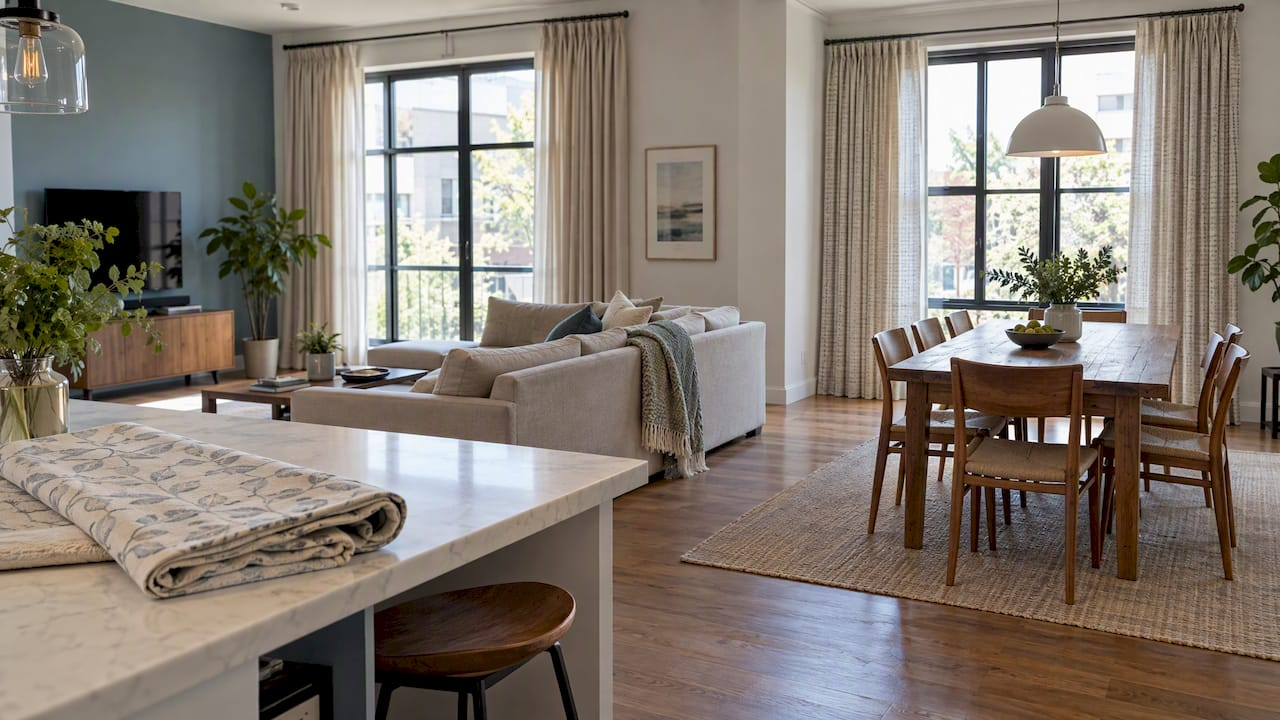
In an open floor plan, curtains should read as one family, not one identical set. Choose a shared palette, a consistent hanging height and length, and fabrics of related weight. Then let each zone vary in opacity, pattern or texture to suit how it is used. The kitchen, dining area and living room are seen together, so the window treatments are judged together too.
This guide covers how to decide what matches and what varies, how to choose fabric for each zone, how to mix patterns without visual noise, and how to hang everything so the space feels connected.
TL;DR
- Aim for curtains that complement each other rather than match. Share at least one color and one fabric weight across every zone.
- Keep hanging height, header style and floor-length hems consistent, because the eye reads those lines across the whole room.
- Choose opacity by function: light-filtering where you live and dine, blackout only where light control matters.
- Mix one pattern scale at a time, and let solids and texture do the quiet work around it.
- Order fabric samples first and view them at different times of day before you cut yardage.
Table of Contents
- Start by looking at the whole room, not one window
- Should curtains match across zones?
- Choosing fabric and opacity by function
- Mixing patterns and textures without visual noise
- Length, height and hanging style
- Using drapery to define zones
- A worked example
- Our perspective
- Fabrics and curtains to start with
- Common mistakes in open plans
- FAQ
- Sources
Start by looking at the whole room, not one window
Stand at the far end of the space and look toward the windows. In a closed-plan home, each room has its own curtains and nobody compares them. In an open plan, you see the kitchen window, the dining bay and the living room slider in one glance. That sightline is your real design brief.
Before choosing anything, list the windows and doors you can see from your main vantage point. Note the following for each one:
- The direction it faces and how much sun it gets.
- What happens in front of it: cooking, eating, watching TV, working.
- Its width and height, and whether it sits on a wall of glass or a single opening.
- What color and texture surround it: cabinets, paint, a sofa, a rug.
This list tells you where curtains must do real work and where they are mainly a design element. It also shows you which windows are close enough to each other that their fabrics will be compared.
Should curtains match across zones?
They do not need to match, but they should clearly belong together. Designer Tennille Wood has said that window treatments need not be identical throughout a house, but in open-concept homes they should complement and work together. Designers also describe the goal as a space that feels collected rather than matched, with a shared sensibility that lets each zone keep its own personality.
In practice, “complement” means choosing a few things that stay constant and a few that are free to change.
| Keep consistent | Free to vary |
|---|---|
| Color family or undertone (warm or cool) | Exact shade, within that family |
| Hanging height and rod placement | Rod finish, if the metals are compatible |
| Hem length (floor-length throughout) | Header style, if the fullness looks similar |
| Fabric weight and drape | Opacity and lining |
| Overall level of formality | Pattern, texture or solid |
A useful test: photograph the room from your main vantage point and convert the photo to black and white. If the curtains still look like they belong to the same room in terms of weight and value (light versus dark), the color details are easy to fine-tune. If one set looks heavy and another looks wispy, the mismatch is in the fabric, not the color.
Three reliable approaches
Same fabric, different treatment. Use one fabric in the living and dining areas, with different headers or one panel style swapped for another. This is the safest route and works well when the windows are close together.
Same color, different fabric. Choose a solid in the dining area and a subtly textured or embroidered cloth in the same color in the living room. The color holds the space together and the texture adds interest.
Related colors, different patterns. Pick two or three colors from a rug or artwork and distribute them across the curtains, with one pattern in each zone at a different scale. This takes more care, but gives the most personality.

Choosing fabric and opacity by function
The functional differences between zones are where open floor plans often go wrong. A kitchen needs washable, easily handled cloth. A media corner may need strong light control. A dining area facing the street may need privacy at night. Matching the fabric type to the job lets you vary opacity without breaking the look.
Designers often let light control guide choices room by room, such as sheer linen drapes in a bedroom and blackout drapes in a media room. The same logic applies within one open space.
- Living area: light-filtering or medium-weight fabric with a soft hand. If glare on the television is a problem, add a lining or a layered shade rather than switching to a heavier cloth that no longer matches the rest.
- Dining area: medium-weight cloth that holds its shape. This is often the best place for a pattern or embroidery, since it is where the eye settles.
- Kitchen: short or lightweight treatments are often easier to manage near cooking, and washable fabrics are worth the thought. A woven solid in the same color family keeps the line continuous.
- Home office nook or media corner: this is where blackout or room-darkening lining earns its place. Our guide to blackout lining options room by room explains how to choose, and our comparison of blackout versus room darkening helps you decide how dark a zone really needs to be.
Lining is the quiet tool here. Lined panels in different opacities can look identical from the front, so the face fabric stays coordinated while the function changes behind it.
Walls of glass need a lighter hand
Large expanses of glass are common in open plans, and covering them in full-fullness drapery can use a great deal of fabric. For those walls, designers often suggest leaner treatments such as solar blinds or Roman shades to avoid the clutter of hundreds of yards of fabric. A good compromise is to run a shade for daily light control and add stationary side panels in the room’s main curtain fabric, so the glass wall still ties to the rest of the plan.
If you want to combine shades and curtains, see how to layer window treatments for style, function and comfort.
Mixing patterns and textures without visual noise
Open plans magnify busyness because there are no walls to give the eye a break. A few habits keep a mix of patterns calm.
Limit yourself to one dominant pattern in view. If your sightline includes two windows with patterned curtains, make one clearly the leader by size or contrast, and keep the other quieter in scale or color.
Vary scale, not everything. A large-scale pattern next to a small-scale one reads as deliberate. The same applies to rugs: stylists advise varying either pattern or texture, but not both at once. The same principle works for curtains. If the patterns differ, keep the textures similar. If the fabrics differ in texture, keep the colors close.
Use texture as the connector. Solid fabrics with visible weave, such as a slubbed poly-linen blend, keep a room interesting without adding a pattern. A neutral textured solid next to an embroidered panel is a pairing that rarely fails.
Repeat a color three times. One color should appear in at least three places across the room, including something other than the curtains: a pillow, a rug, a piece of art. That repetition is what makes different curtains feel intentional.
Trim as a unifier. Adding fabric trim to drapery can take a feature to the next level. In an open plan, a single trim color repeated on curtains in different fabrics is an effective way to link them.
Sample before you commit. Pattern and texture are hard to judge from a photograph. Hold swatches side by side, in daylight and at night, from the distance you will actually see them. Our tips on window treatment fabric for homeowners cover what to check in a sample.

Length, height and hanging style
The most noticeable consistency in an open plan is the line of the hem and the rod. When curtains in adjoining areas hang at different heights, the room looks unfinished, even if the fabrics are well chosen.
- Hang all rods at the same height wherever the architecture allows. Mounting them high, closer to the ceiling than the window frame, adds height and keeps the line continuous.
- Take curtains to the floor. Wood advises taking them to the floor and cutting them off there, noting that the puddle look is out. A clean, floor-grazing hem in every zone is simple to specify and makes the space look tailored.
- Keep headers related. Pinch pleats, rod pockets and grommets can coexist, but a very casual header next to a formal one will separate the zones. If you mix, choose headers of similar fullness.
- Plan for functional exceptions. Over a kitchen sink, a shorter treatment is practical. Keep the same fabric or color as the floor-length panels nearby so the shorter piece reads as a planned variation.
For ready-made options, our ready-made curtain panels are a quick way to cover standard openings. For non-standard heights or wide spans, custom work gives you a consistent hem across different window sizes.
Using drapery to define zones
Curtains do more than dress windows in an open plan. In open-concept spaces, drapery can define a room-within-a-room and cordon off the kitchen when desired, adding privacy and softness within angular architecture. That makes it one of the few tools that can create separation without building a wall.
If you try this approach, a few points help:
- Use fabric weight that moves easily. Panels that need to be drawn daily should glide on the track or rod.
- Match the interior-facing fabric to the zone it faces, because in some positions the panel will be seen from both sides.
- Plan the stack-back, the space panels occupy when open, so they do not block a walkway or cabinet.
- Keep the color in the same family as the window treatments elsewhere, so the divider looks like part of the system.
A worked example
Imagine a combined kitchen, dining and living space with five openings: a kitchen window over the sink, a dining bay with three windows, and a living room slider with two flanking windows. The walls are warm white and the sofa is a soft gray.
- Common thread: warm gray and cream, floor-length hems at the same rod height in the dining and living areas.
- Dining bay: an embroidered fabric in a light neutral, lined for privacy at night, as the one patterned element in view.
- Living room: a solid in a textured gray-cream blend, with a roller or Roman shade behind it on the slider for glare control.
- Kitchen: a short panel in the same solid as the living room, in a washable cloth.
- Accent: the same trim color on the dining and living panels, plus pillows in the embroidery’s accent color.
Nothing matches exactly, yet the colors, weights and lines all agree. That is the standard to aim for.
Our perspective
Open floor plans ask more of window treatments than any other layout. Every fabric decision is visible from every other zone, so the best results come from planning the whole space first and ordering yardage second.
At Beautiful Windows Elgin, we work with designers, homeowners and drapery workrooms, and the pattern we see is consistent: the projects that succeed start with samples. We encourage customers to hold two or three fabrics against the actual rug, sofa and walls before committing. Our selection of designer fabrics by the yard is curated so that textures and colors work together across a room, which makes pairing a solid with an embroidery or a texture with a quieter weave straightforward.
We also believe that one-on-one guidance saves time. A design consultation can settle questions about lining, header style and rod height before the first cut is made, and our installation guidance helps keep the hems and heights consistent across zones. We would rather help you get the plan right than sell you more fabric than you need.
Marrion
Fabrics and curtains to start with
If you are coordinating several windows, begin with samples from one collection so you can see how the colors and weaves sit side by side. Our embroidered fabric for custom curtains is a good place to look for the one patterned element in a zone, and our modern fabric collection offers calmer solids and textures for the surrounding windows. For tailored results across different window sizes, our custom drapery making service handles measuring, sewing and installation guidance, and you can start at Beautiful Windows Elgin.

We ship nationwide, so you can order samples and yardage from anywhere in the country.
Common mistakes in open plans
- Choosing each window separately. Decide the palette and hem line first, then fit each window into it.
- Letting one zone’s function drive the whole look. A blackout need in the media corner does not mean every window needs heavy cloth. Use lining to solve it quietly.
- Mixing too many headers. Two header styles is plenty.
- Ignoring the light at night. Fabrics that look light and airy by day can look dark and flat under lamps. Check samples in the evening.
- Skipping the rug and upholstery. Curtains coordinate with what is on the floor and the furniture, not only with the wall color.
For more on how treatments affect comfort as well as looks, see our article on the role of window treatments in home comfort.
FAQ
Do all curtains in an open floor plan need to be the same color?
No. They should share a color family or at least one repeated color, but the exact shades can differ. Designers describe the goal as a collected look rather than a matched set, so a solid in one zone and a related pattern in another is fine.
Can I use different curtain styles in the kitchen and living room?
Yes, if the fabric weight, color family and hanging height stay related. A shorter, washable panel in the kitchen can pair with floor-length panels in the living area when both use the same color or cloth.
What curtain length works best across an open space?
Floor-length is the most consistent choice, with the hem just touching or grazing the floor. A designer quoted in a window covering guide advises cutting curtains off at the floor rather than puddling them. Exceptions, such as a short panel over a sink, look planned when they share color with the longer ones.
How do I mix patterns without making the room feel busy?
Make one pattern the leader in your sightline and keep others quieter in scale or color. Vary either pattern or texture between neighboring fabrics, not both at once, and repeat one color in at least three places around the room.
Should I order samples before buying fabric?
Yes. Look at swatches next to your rug, sofa and wall color, in morning light and under evening lamps. It is the most reliable way to confirm that fabrics will work together before you buy yardage.
Sources
- HOW TO DRESS UP WINDOWS (Summer 2018)
- How to Use Custom Window Treatments to Pull a Room Together
- 49 Designer Window Treatments for 2026
- Why You Should Never Skip Curtains, According to Top Designers
- This Designer’s Clever Trick Will Transform Any Living and Dining Room
Leave a Reply