TL;DR:
- Jacquard fabric features patterns woven directly into the textile, offering durability and structural depth. Invented by Joseph Marie Jacquard in 1804, the loom automates complex patterns through punched cards, transforming textile production. It is made from various fibers like cotton, silk, and linen, suitable for upholstery and drapery, with a permanence that surpasses printed fabrics.
Jacquard fabric is defined as a textile whose patterns are woven directly into the fabric structure, not printed on the surface or applied through embroidery. This weaving method, made possible by the Jacquard loom invented by Joseph Marie Jacquard in 1804, produces dimensional woven motifs that are integral to the cloth itself. The result is a fabric with refined texture, lasting pattern clarity, and a structural depth that surface treatments simply cannot replicate. For anyone selecting textiles for drapery, upholstery, or apparel, understanding what jacquard fabric is means understanding a weaving principle, not a single fiber or finish.
What is jacquard fabric and how does the loom work?
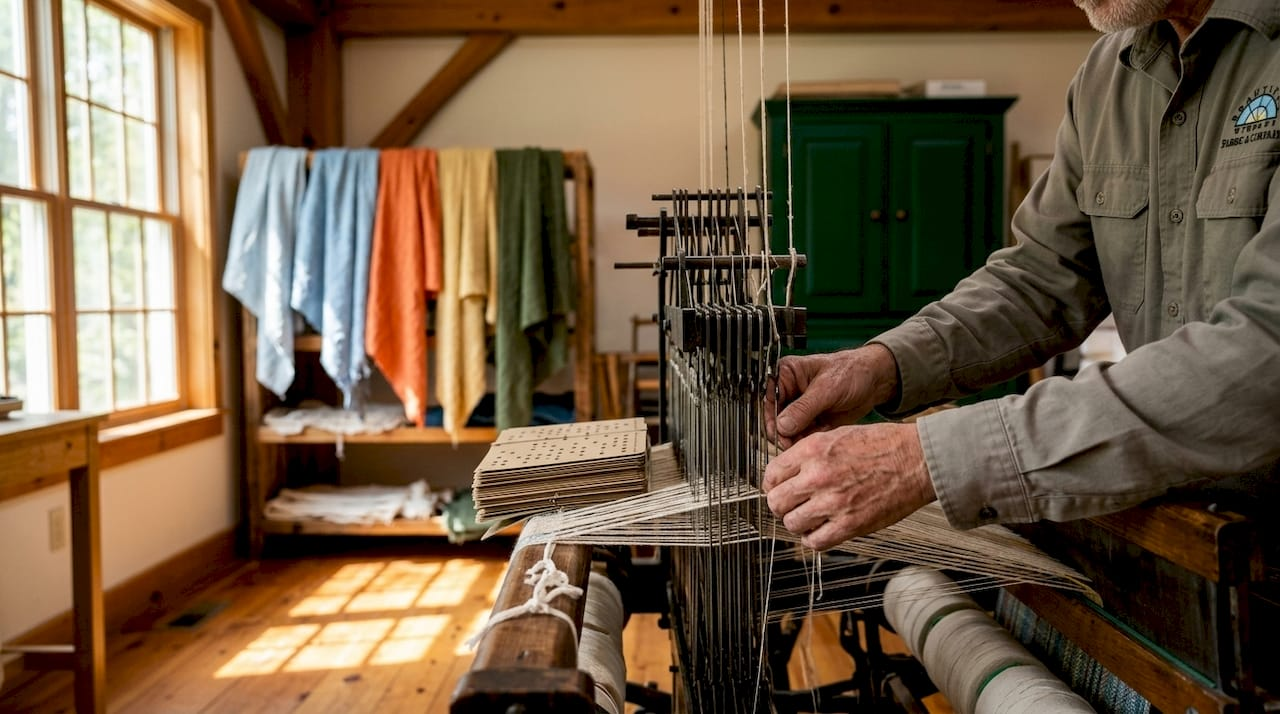
The Jacquard loom operates by controlling individual warp threads independently, allowing each thread to be raised or lowered in a precise sequence to form complex patterns. Joseph Marie Jacquard’s key contribution was the punched-card control system, which encoded weaving instructions onto cards with holes that directed thread movement automatically. Before this invention, producing patterned silk required a skilled assistant called a draw boy to manually lift threads, a slow and error-prone process. The punched-card mechanism replaced that labor and made consistent, repeatable complex patterns achievable at scale.
The speed of adoption tells the story clearly. By 1812, approximately 11,000 Jacquard looms were operating in France alone. That figure reflects how decisively the loom solved a real production problem in the textile industry. The ability to automate intricate pattern weaving transformed silk production from a luxury craft into a scalable industry, and the same principle governs modern electronic Jacquard looms today.
The technical process of creating jacquard fabric follows a structured sequence:
- A designer creates the pattern, which is then translated into a grid representing individual warp and weft thread intersections.
- The grid data is encoded, historically onto punched cards and today into digital files read by computerized loom heads.
- During weaving, the loom head raises specific warp threads at each pass of the weft, building the pattern row by row.
- The interplay of raised and lowered threads creates the dimensional motif embedded in the fabric’s structure.
- The finished cloth carries the pattern as part of its weave, not as a coating or overlay.
This process is what separates the jacquard weave definition from simpler flat weaves like plain weave or twill. In those methods, all warp threads follow the same sequence. In jacquard weaving, each thread can follow a unique path, enabling florals, geometrics, and figurative designs with fine detail.
Pro Tip: When evaluating jacquard fabric samples, hold the cloth up to light. A well-woven jacquard will show pattern depth and shadow variation that a printed fabric cannot produce, because the texture is structural, not decorative.

What are the main types of jacquard fabric?
Jacquard fabric can be made from cotton, silk, linen, and fiber blends, with the fiber choice determining hand-feel, weight, and appropriate application. The jacquard weave definition applies equally to all of them. What changes is the character of the finished cloth.

Cotton jacquard is soft, breathable, and relatively easy to care for, making it a practical choice for bedding, lightweight curtains, and casual upholstery. Silk jacquard carries a natural luster and a fluid drape that has made it the traditional choice for formal drapery and ceremonial garments. Linen jacquard offers a textured, matte surface with good weight, well suited to structured window treatments and furniture upholstery. Polyester and blended jacquards combine the visual complexity of the weave with improved durability and reduced cost, which is why they appear frequently in commercial upholstery and ready-made drapery.
Two fabrics are often confused with jacquard: damask and brocade. Damask is a specific type of jacquard fabric, typically woven in a single color with the pattern visible through contrasting light reflection between the face and reverse of the cloth. Brocade is also woven on a Jacquard loom but incorporates supplementary weft threads that create a raised, embossed effect, often in metallic or contrasting colors. Both are subsets of jacquard weaving, not separate categories.
| Fiber | Texture | Common uses |
|---|---|---|
| Cotton | Soft, matte, breathable | Bedding, lightweight curtains, casual upholstery |
| Silk | Smooth, lustrous, fluid | Formal drapery, evening wear, decorative pillows |
| Linen | Textured, matte, structured | Structured drapes, furniture upholstery |
| Polyester blend | Smooth to textured, durable | Commercial upholstery, ready-made window treatments |
| Wool blend | Warm, dimensional | Heavy drapery, upholstered seating |
Pro Tip: For drapery projects, a silk or linen jacquard delivers the most refined result, but a quality polyester blend jacquard will hold its pattern and color longer in rooms with strong sunlight. Check the fabric type guide before committing to a fiber for window treatments.
What are the key advantages of jacquard fabric?
The most significant benefit of jacquard fabric is pattern permanence. Because the design is woven into the fabric structure, jacquard patterns are more durable and fade-resistant than printed or embroidered alternatives. A printed pattern sits on the surface of the fiber and degrades with washing, sunlight, and abrasion. A woven pattern is the fabric itself, so it does not peel, crack, or wash away.
The structural nature of jacquard weaving also affects how the fabric performs over time. Durability, snag risk, and drape all depend on weave depth and fiber rather than surface treatment. This means testing and selecting jacquard fabric requires attention to the weave structure, not just the visual pattern. A tightly woven cotton jacquard will resist pilling and maintain its shape through years of use in upholstery. A loosely woven silk jacquard will drape beautifully but requires more careful handling.
The key performance advantages of jacquard fabric include:
- Pattern permanence. Woven motifs do not fade, crack, or separate from the base cloth the way printed designs do.
- Textural dimensionality. The raised and recessed areas of the weave create a tactile surface that adds visual depth to any interior application.
- Structural strength. The interlocking of warp and weft threads across a complex pattern produces a cloth with good tensile strength, particularly in cotton and linen versions.
- Versatility across applications. The same weaving method produces fabrics suitable for formal drapery, casual upholstery, bedding, and tailored garments.
- Design precision. Fine motifs, including detailed florals and geometric repeats, can be reproduced consistently across large yardage.
“The defining quality of jacquard fabric is not its appearance alone but the fact that its appearance and its structure are the same thing. You cannot separate the pattern from the cloth.”
For interior designers and homeowners selecting decorative fabric options for high-use areas, this structural integrity is the practical argument for choosing jacquard over printed alternatives. A sofa upholstered in jacquard will look the same in ten years as it did on day one, provided the fiber is appropriate for the application.
How are production innovations changing jacquard weaving today?
Traditional jacquard preparation is labor-intensive, and that labor cost has historically constrained design ambition. Conventional jacquard preparation limits pattern repeats to approximately 3.5 inches due to the complexity and cost of encoding each new motif. For handloom weavers in particular, this restriction has meant repeating existing designs rather than developing new ones.
Recent technological advances are changing that constraint. Improved preparation technologies now enable motif sizes of 30 to 40 inches, a significant expansion that opens up large-scale botanical prints, architectural patterns, and panoramic designs that were previously impractical on handlooms. These advances also reduce material waste during setup, which lowers the cost per yard for complex designs.
The cost of original jacquard design remains a real factor for producers. Original motif design costs can reach approximately Tk 1,00,000 per design, which explains why many weavers reuse existing pattern graphs rather than commissioning new ones. This cost dynamic shapes the market: original jacquard designs at scale command premium pricing, while repeat-pattern production keeps costs accessible.
| Production factor | Traditional jacquard | Modern jacquard |
|---|---|---|
| Pattern repeat size | Up to approximately 3.5 inches | Up to 30 to 40 inches |
| Design encoding | Manual punched cards | Digital loom programming |
| Setup labor | High, limiting new designs | Reduced through digital preparation |
| Waste in setup | Significant | Reduced with digital workflows |
| Cost for original designs | High, often reused | Still significant but more scalable |
Electronic Jacquard looms now read digital files directly, eliminating the physical punched card entirely. This shift has made it practical for smaller studios and custom fabric producers to offer original designs without the prohibitive setup costs of traditional preparation. For buyers of premium drapery and upholstery fabrics, this means more design variety at accessible price points than was possible even a decade ago.
Key takeaways
Jacquard fabric’s defining advantage is structural: its patterns are woven into the cloth itself, making them permanent, dimensionally textured, and more durable than any surface-applied design.
| Point | Details |
|---|---|
| Core definition | Jacquard fabric has patterns woven into its structure, not printed or embroidered on top. |
| Loom origin | Joseph Marie Jacquard invented the punched-card loom in 1804, enabling automated complex pattern weaving. |
| Fiber variety | Cotton, silk, linen, and blends are all used; fiber choice determines texture, weight, and best application. |
| Durability advantage | Woven-in patterns resist fading and wear far better than printed alternatives, making jacquard ideal for upholstery and drapery. |
| Production evolution | Digital loom programming now enables large-scale motifs and reduces setup costs compared to traditional punched-card methods. |
Jacquard fabric: where craft and engineering meet
I have worked with a wide range of textiles over the years, and jacquard fabric consistently occupies a category of its own. What strikes me most is that it is simultaneously a technical achievement and an art form. The punched-card mechanism that Joseph Marie Jacquard developed in 1804 is, by any measure, a precursor to programmable computing. Charles Babbage studied it directly when developing his Analytical Engine. That lineage matters because it tells you something about the precision required to produce a quality jacquard cloth.
My practical advice for buyers is this: do not evaluate jacquard fabric by pattern alone. Run your hand across the surface and feel whether the texture is genuinely dimensional or whether it reads flat. A well-woven jacquard has a tactile quality that a printed imitation cannot replicate. For drapery applications specifically, check the window treatment fabric tips before selecting a weight, because jacquard’s structural density affects how it hangs and how it responds to lining.
The enduring relevance of jacquard fabric is not nostalgia. It is the fact that no cheaper or faster method has yet produced the same combination of pattern permanence, textural depth, and structural integrity. That is a strong argument for choosing it when the application demands quality.
— Marrion
Explore jacquard fabrics at Beautifulwindowselgin

Beautifulwindowselgin offers a curated selection of premium jacquard fabrics for drapery and upholstery projects, sold by the yard with nationwide shipping from Columbia, SC. Whether you are an interior designer sourcing material for a custom installation or a homeowner planning a window treatment refresh, the collection includes jacquard satin, woven damask, and multi-color upholstery textiles suited to a range of design directions. Browse the designer drapery fabric collection for premium jacquard options, or explore the full upholstery and drapery range for multi-color textiles. Design consultations and fabric samples are available to support your selection process.
FAQ
What is jacquard fabric in simple terms?
Jacquard fabric is a textile with patterns woven directly into its structure using a specialized loom. The design is part of the cloth itself, not a print or embroidery applied afterward.
How is jacquard fabric different from brocade or damask?
Damask and brocade are both types of jacquard fabric, woven on a Jacquard loom. Damask uses a single color with pattern visible through light reflection, while brocade adds supplementary threads for a raised, multi-color effect.
Is jacquard fabric durable enough for upholstery?
Yes. Because jacquard patterns are structurally integrated into the weave rather than surface-applied, they resist fading and wear well in upholstery applications, particularly in cotton and linen versions.
What fibers are used to make jacquard fabric?
Jacquard fabric is produced in cotton, silk, linen, wool, polyester, and blended fibers. The fiber determines the hand-feel, weight, and best use, while the jacquard weaving method applies equally across all of them.
Does jacquard fabric require special care?
Care requirements depend on the fiber, not the weave. Silk jacquard typically requires dry cleaning, while cotton and polyester jacquard are often machine washable. Always check the care label, and consider professional upholstery care for high-value pieces.
Recommended
- Brocade fabric | Luxurious Woven Multi-Purpose Fabric – Fabric Store in Columbia, SC | Drapery Making Services
- Decode designer fabric terminology: a guide for homeowners – Fabric Store in Columbia, SC | Drapery Making Services
- Art Deco Fabric – Eccentric Geometric Prints by the Yard – Fabric Store in Columbia, SC | Drapery Making Services
- Understanding embroidered fabric: Custom décor guide – Fabric Store in Columbia, SC | Drapery Making Services