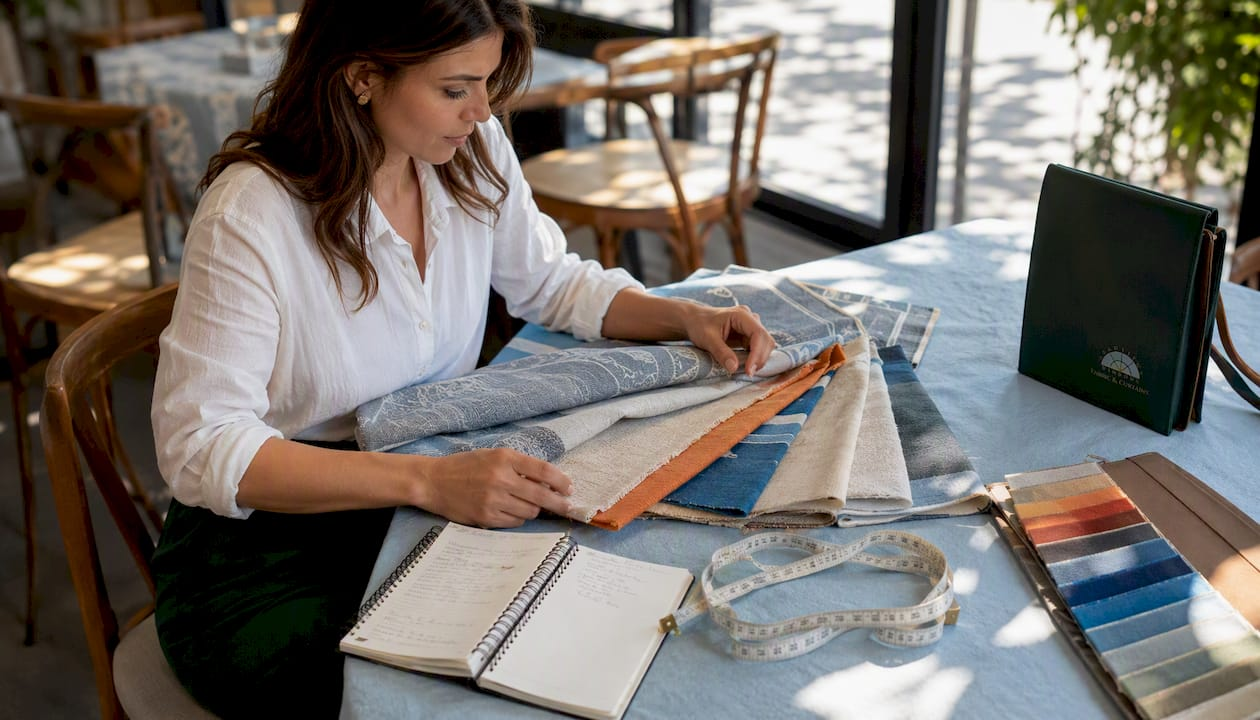
Before you approve a single yard of fabric, run through these six non-negotiable checks: cleaning code (W, S, WS, or X), abrasion rating in double rubs, usable width and pattern repeat, backing type, dye lot number, and a physical swatch test around the tightest corner of the piece. Miss any one of them and you risk a fabric that stains permanently, seams that slip, or a reorder that arrives in a noticeably different shade.
Here is the full upholstery fabric checklist to run before you commit to cutting:
- Cleaning code: Confirm W, S, WS, or X on the spec sheet. Never assume.
- Abrasion rating: Match double-rub count to intended use (under 15,000 for decorative, 15,000+ for residential, 100,000+ for commercial).
- Usable width: Verify the actual sewable width, typically 54" or 60", not the selvage-to-selvage total.
- Pattern repeat: Record both vertical and horizontal repeat measurements before calculating yardage.
- Backing type: Identify whether the fabric has a coated, interlined, or no backing, and how it affects sewing behavior.
- Dye lot number: Write it on the job file. Reorders from the same SKU can produce a visibly different shade.
- Swatch test: Sew a seam with your planned thread and pull it around the tightest corner before cutting the full piece.
- Intended use: Define who uses the piece (kids, pets, high traffic, formal) before selecting a fabric family.
- Yardage math: Add extra for pattern repeat, nap direction, and a repair buffer.
- Lead time: Confirm production and shipping timelines before promising a completion date.
- Cost range: Establish a per-yard budget by grade before requesting samples.
Pro Tip: Ask the seller for the full spec sheet, not just the swatch. A spec sheet lists rub count, cleaning code, usable width, repeat, and fiber content in one document. If the seller cannot provide one, treat that as a red flag.
Table of Contents
- What are the main upholstery material families?
- Natural upholstery fabrics: what you need to know about cotton, linen, wool, and leather
- Why synthetic and performance fabrics often make more sense for busy households
- Specialty textures and what they mean for installation and wear
- How fabric construction affects fit, durability, and sewability
- How do double-rub counts and abrasion tests actually work?
- What do the cleaning codes W, S, WS, and X actually mean?
- A step-by-step decision flow for choosing the right upholstery fabric
- How to order swatches, calculate yardage, and plan your timeline
- Pro tips and the most common mistakes upholsterers make
- Key Takeaways
- What the shop checks before cutting: a note on how Beautifulwindowselgin advises customers
- Beautifulwindowselgin makes fabric selection straightforward for upholstery projects
- Useful sources and further reading
What are the main upholstery material families?
Every upholstery fabric belongs to one of four broad families: natural fibers, synthetics, blended textiles, and specialty or performance finishes. Understanding which family a fabric belongs to tells you immediately what trade-offs to expect before you ever touch a swatch.
Natural fibers (cotton, linen, wool, leather) offer comfort, breathability, and a refined hand feel. They tend to age gracefully in low-traffic settings but are more vulnerable to staining, fading, and moisture than engineered alternatives.

Synthetics (polyester, olefin, solution-dyed acrylic, microfiber) are built for durability and cleanability. Most carry higher double-rub counts and resist staining at the fiber level when solution-dyed, making them the practical choice for family rooms, rental properties, and commercial settings.
Blended textiles combine natural and synthetic fibers to balance aesthetics with performance. A cotton-polyester blend, for example, retains the soft hand of cotton while gaining wrinkle and abrasion resistance from the polyester content.
Specialty and performance finishes include solution-dyed acrylics for outdoor use, marine vinyl, and fabrics with engineered stain barriers applied at the mill. These are not just marketing categories; the construction method materially changes how the fabric performs under real-world conditions.
Experts consistently recommend starting with the use case — who uses the piece and what abuse it will face — before selecting a fabric family. Aesthetics come second.
| Family | Best For | Watch Out For |
|---|---|---|
| Natural fibers | Formal rooms, low-traffic accents | Staining, fading, moisture sensitivity |
| Synthetics | Family rooms, pets, high traffic | Can feel less luxurious; breathability varies |
| Blends | Versatile residential use | Performance varies by fiber ratio |
| Performance/specialty | Outdoor, commercial, heavy residential | Higher cost; some feel stiffer |
Natural upholstery fabrics: what you need to know about cotton, linen, wool, and leather
Natural fibers reward careful placement. Put them in the right setting and they look exceptional for years. Put them in the wrong one and they show wear within months.
Cotton
Cotton is soft, breathable, and takes dye well, which is why it appears in so many printed and woven upholstery patterns. Its durability is moderate; tightly woven cotton canvas or duck cloth holds up better than a loose plain weave. The practical limitation is staining. Cotton absorbs liquids quickly, and oil-based stains in particular are difficult to remove without a solvent cleaner. Most cotton upholstery fabrics carry a W or WS cleaning code, though you should always verify with the spec sheet. Avoid cotton on pieces used daily by children or pets unless the fabric has a mill-applied stain treatment.
Linen
Linen has a distinctive texture and a natural luster that reads as refined in formal living rooms and accent chairs. It is stronger than cotton by fiber weight but wrinkles and pills more readily under friction. Linen is also prone to fading in direct sunlight, so placement near south- or west-facing windows shortens its lifespan noticeably. For rooms with significant sun exposure, pairing linen upholstery with UV-blocking window treatments extends the fabric’s color life considerably. Linen typically carries an S or WS cleaning code; water alone can leave tide marks.
Wool
Wool is the most durable of the common natural fibers for upholstery. Its natural crimp gives it resilience, meaning it bounces back from compression better than cotton or linen. Wool also resists flame naturally, which matters in contract settings. The trade-offs are cost, dry-clean requirements (usually an S code), and susceptibility to moth damage if stored improperly. For a formal sofa or a statement chair that sees moderate use, wool is a sound investment. For a piece that a dog sleeps on, it is not.
Leather
Leather occupies its own category. Top-grain and full-grain leather are durable, develop a patina over time, and clean easily with a damp cloth. Bonded leather, which is a composite of leather scraps and polyurethane, looks similar initially but tends to peel and crack within a few years. Always ask whether the leather is full-grain, top-grain, corrected-grain, or bonded before purchasing. Leather carries no standard cleaning code in the W/S/WS/X system; follow the manufacturer’s conditioning and cleaning protocol instead. Price ranges for leather upholstery fabric vary widely by grade, from entry-level corrected-grain at roughly $15–$30 per square foot to full-grain hides at $50 and above.
Why synthetic and performance fabrics often make more sense for busy households
Performance fabric is a technical designation, not a marketing phrase. It describes textiles engineered specifically for high abrasion resistance, easy cleaning, and, in many cases, resistance to staining at the fiber level rather than just at the surface.

Polyester and polyester blends
Polyester is the workhorse of residential upholstery. It resists pilling, holds color well, and is available across a wide range of textures, from smooth weaves to velvet-like pile fabrics. Woven polyester typically achieves double-rub counts well into the heavy-residential range. The breathability trade-off is real; polyester traps heat more than natural fibers, which matters in warm climates or for pieces used for long periods.
Solution-dyed acrylic
Solution-dyed acrylic is the standard for outdoor and high-UV-exposure applications. The dye is introduced during fiber production rather than applied afterward, so color is locked into the fiber itself. This construction gives solution-dyed fabrics superior fade resistance compared to piece-dyed alternatives. Sunbrella is the most widely recognized brand in this category. For any piece near a window or used outdoors, solution-dyed acrylic is the technically correct choice.
Microfiber
Microfiber upholstery fabric is tightly woven from ultra-fine polyester or nylon fibers, which gives it a suede-like hand and makes it resistant to liquid penetration. Spills bead on the surface rather than absorbing immediately, which buys time for cleanup. Microfiber typically carries a W or WS cleaning code and performs well in homes with children. The main limitation is that it can attract pet hair and lint, and some grades pill under heavy friction.
Marine and outdoor fabrics
Marine-grade vinyl and solution-dyed performance weaves are built for moisture, mildew, and UV exposure. They are the correct choice for patio furniture, boat interiors, and any piece that will be exposed to the elements. Verify that the fabric carries a UV-lightfastness rating alongside its abrasion rating; a high double-rub count alone does not confirm fade resistance.
Pro Tip: When evaluating any performance fabric, ask the supplier specifically whether the stain resistance is engineered into the fiber (solution-dyed or olefin construction) or applied as a mill finish. Mill-applied finishes wear off with cleaning over time; fiber-level resistance does not.
Specialty textures and what they mean for installation and wear
Velvet, chenille, jacquard, embroidered fabric, and faux leather each bring a distinct visual quality to a piece. They also each bring specific installation and maintenance considerations that a plain woven fabric does not.
Velvet
Velvet has a directional pile that must run consistently across all panels of a piece. Reversing the pile direction on adjacent panels creates a visible color shift, even with the same dye lot. Velvet also shows crush marks from sitting and from the sewing process itself. Performance velvet, woven from solution-dyed polyester or a high-twist yarn, retains the look while offering significantly better abrasion resistance than traditional silk or cotton velvet.
Chenille
Chenille’s looped pile construction gives it a soft, textured hand, but the loops can snag on sharp objects and the fabric tends to fray at cut edges. High-twist chenille, where the pile yarn is more tightly wound, resists snagging better and holds its shape through more cleaning cycles. Seam allowances on chenille typically need to be wider than standard, and edges benefit from a serged or bound finish.
Jacquard
Jacquard fabrics are woven with a pattern built into the structure of the cloth rather than printed on the surface. This makes the pattern durable and reversible in some constructions. The trade-off is pattern matching: a large jacquard repeat can add 20–30% to the total yardage requirement on a complex piece. Jacquard weaves also tend to have a looser structure at the back, which can contribute to seam slippage under tension if the fabric lacks a backing.
Embroidered fabrics
Embroidered upholstery fabric carries thread work on top of a base cloth. The embroidery threads are vulnerable to snagging and abrasion, so embroidered fabrics are best reserved for accent pieces, headboards, and low-traffic decorative chairs rather than everyday seating. Seam placement should avoid embroidered motifs wherever possible to prevent thread distortion at stress points.
Faux leather
Faux leather (polyurethane or PVC coated fabric) offers the look of leather at a lower price point and with a W cleaning code in most cases. Quality varies considerably. Higher-grade faux leather has a textile backing that prevents cracking and peeling; lower-grade versions delaminate within a few years under regular use. Always check the backing and ask for a flex test result if the supplier can provide one.
How fabric construction affects fit, durability, and sewability
The face of a fabric tells you how it looks. The construction tells you how it will behave on the frame, under tension, and through years of use. Backing and construction are often as decisive as the face fabric when evaluating suitability for a shaped cover.
Weave structure
Plain weaves are stable and resist seam slippage. Satin and sateen weaves have longer float threads that give a smooth, lustrous surface but are more prone to snagging and seam slippage under tension. Twill weaves, like denim, are diagonal and offer a good balance of durability and drape. Loose or open weaves require a backing to prevent distortion during sewing and stapling.
Pile and nap
Pile fabrics (velvet, chenille, cut velvet) have a directional nap that must be oriented consistently across all panels. The standard convention is pile running downward on vertical surfaces and toward the front on horizontal ones, though some designers prefer the opposite for a richer color appearance. Mark the nap direction on every cut panel before moving them to the sewing table.
Backing types
A coated backing (acrylic or latex applied to the reverse) stabilizes the fabric, reduces seam slippage, and makes it easier to staple to a frame without the fabric pulling through. The trade-off is reduced drape and, in some cases, difficulty with adhesive bonding if the coating is incompatible with the adhesive. An interlined backing adds a layer of woven or non-woven material between the face and the frame, which improves body and insulation. Unbacked fabrics drape more naturally but require more careful handling during cutting and sewing.
Construction checklist to verify on the spec sheet:
- Weave type and thread count
- Pile direction and height (if applicable)
- Backing type and composition
- Seam slippage test result (ASTM D4034 or equivalent)
- Stretch and recovery behavior (especially for tight-wrapped corners)
Pro Tip: Cut a 6-inch square of the candidate fabric and pull it on the bias. If the weave distorts significantly or the backing separates from the face, the fabric will cause problems at curved seams and tight corners.
How do double-rub counts and abrasion tests actually work?
Abrasion resistance is the single most cited durability metric in upholstery, and it is also one of the most misunderstood. Two test methods dominate the industry: Wyzenbeek and Martindale.
Wyzenbeek (ASTM D4157) drags a piece of cotton duck or wire mesh back and forth across the fabric under a set load. Each back-and-forth motion counts as one double rub. The test continues until the fabric shows noticeable wear or thread breakage.
Martindale (ASTM D4966) uses a circular abrading motion with a wool or abrasive cloth. It is the standard in European markets and tends to produce higher cycle counts than Wyzenbeek for the same fabric, so the two numbers are not directly comparable.
Recommended thresholds for common use cases:
| Use Case | Wyzenbeek Double Rubs | Notes |
|---|---|---|
| Light / decorative | Under 15,000 | Accent chairs, headboards, low-traffic pieces |
| General residential | 15,000+ | Everyday sofas, dining chairs, family rooms |
| Heavy residential | 30,000+ | Homes with kids, pets, or frequent use |
| Commercial / contract | 100,000+ | Offices, hospitality, rental properties |
A few important caveats. Abrasion tests measure resistance to rubbing only; they say nothing about stain resistance, UV fade, pilling, or seam slippage. A fabric rated at 50,000 double rubs can still stain permanently if it carries the wrong cleaning code for the spill type. Always read the rub count alongside the cleaning code and the fiber content, not in isolation.
When reviewing a spec sheet, confirm which test method produced the rating. A Martindale count of 30,000 is not equivalent to a Wyzenbeek count of 30,000. If the spec sheet does not specify the method, ask before ordering.
What do the cleaning codes W, S, WS, and X actually mean?
The cleaning code system is the manufacturer’s instruction for how to clean the fabric without causing permanent damage. Using the wrong method, water on an S-coded fabric, for example, can cause shrinkage, water marks, or color bleed that no professional can reverse.
| Code | Meaning | Safe Cleaning Method |
|---|---|---|
| W | Water-based cleaner | Use water-based upholstery shampoo or foam; avoid solvents |
| S | Solvent-based cleaner | Use dry-cleaning solvent; avoid water entirely |
| WS | Water or solvent | Either method is safe; test in a hidden area first |
| X | Vacuum only | No liquid cleaners of any kind; professional cleaning only |
Step-by-step spill response:
- Identify the cleaning code on the spec sheet or the manufacturer’s tag before touching the spill.
- Blot the spill immediately with a clean, dry cloth. Do not rub; rubbing spreads the stain and pushes it deeper into the pile.
- Test your chosen cleaner in an inconspicuous area (under a cushion or on the back panel) and allow it to dry fully before proceeding.
- Apply the appropriate cleaner in small amounts, working from the outside of the stain toward the center.
- Blot dry and allow the area to air dry completely before replacing cushions or sitting on the piece.
- For X-coded fabrics, stop at step 2 and contact a professional upholstery cleaner.
Pro Tip: Record the cleaning code on the job file and communicate it to the client in writing at handoff. A client who uses a water-based cleaner on an S-coded fabric will blame the fabric, not the cleaning method. One line of documentation prevents that conversation.
A step-by-step decision flow for choosing the right upholstery fabric
The most common mistake in fabric selection is choosing a fabric for how it looks before confirming it can handle the intended use. Starting with the use case and working toward aesthetics produces better outcomes than the reverse. This practical selection guide walks through the full process.
- Define the use case. Who uses the piece? Daily family seating, a formal accent chair, outdoor furniture, or a commercial waiting room each require a different durability threshold and cleaning code preference.
- Set the minimum double-rub threshold. Use the table in the durability section as your baseline. Add a safety margin of 10,000–15,000 double rubs above the minimum for pieces that will see heavier-than-average use.
- Choose a cleaning code preference. Homes with young children or pets benefit most from W or WS codes. Formal rooms where spills are rare can accommodate S or even X codes on accent pieces.
- Check backing, width, and repeat. Confirm usable width (54" or 60" is standard), identify the backing type, and record the vertical and horizontal pattern repeat before calculating yardage.
- Order a physical swatch. Request a hand sample large enough to wrap around the tightest corner of the piece. Sew a test seam with your planned thread and check for pucker, seam slippage, and stretch behavior.
- Record dye lot and order with a buffer. Note the dye lot number on the job file. Add extra yardage for pattern repeat, nap direction, and a repair reserve.
Before you approve cutting, confirm:
- Spec sheet in hand with rub count, cleaning code, width, and repeat
- Dye lot recorded on the job file
- Swatch test completed (seam stack, corner wrap)
- Yardage calculation includes repeat and nap additions
- Lead time confirmed with the supplier
How to order swatches, calculate yardage, and plan your timeline
Ordering the wrong amount of fabric is one of the most expensive mistakes in an upholstery project. The three variables that most affect yardage totals are pattern repeat, nap direction, and usable width.
Swatch ordering steps:
- Request a physical hand sample, not a digital image. Color rendering on screens varies significantly from the actual fabric.
- Ask for the full spec sheet alongside the swatch: rub count, cleaning code, usable width, vertical and horizontal repeat, fiber content, and dye lot.
- Request lab test reports for abrasion, pilling, colorfastness, and flame retardancy when ordering larger quantities or for commercial projects.
Yardage calculation rules:
- Start with the cut yardage required for the piece based on its dimensions.
- Confirm the usable width. A fabric listed at 60" may have a usable width of 56" after selvages are removed.
- Add yardage for vertical repeat: divide the cut length of each panel by the vertical repeat and round up to the next full repeat.
- Add yardage for horizontal repeat on pieces where panels must align across seams.
- Add extra for nap direction if the fabric has a directional pile; all panels must be cut in the same orientation.
- Add a safety buffer of at least half a yard per yard of fabric ordered for complex pieces, and more for large pattern repeats.
Timeline and budget checklist:
- Sample lead time: typically 3–7 business days for domestic suppliers.
- Production and shipping lead time: confirm before promising a completion date; custom or imported fabrics can run 4–8 weeks.
- Price by grade: upholstery fabric is commonly priced by grade (A through F or equivalent), with Grade A fabrics starting around $15–$25 per yard and specialty or designer grades running $50 and above.
- Reserve extra yardage for future repairs; reordering the same SKU later may produce a non-matching dye lot.
Pro tips and the most common mistakes upholsterers make
Field experience reveals a consistent set of errors that cost time, money, and client relationships. Most of them are preventable with a short checklist run before the order is placed.
Pro Tip: Always sample-wrap the tightest corner of the piece before cutting. Sew a seam with the actual thread, welt cord, and zipper tape you plan to use, then pull it around that corner under tension. Pucker or slippage at this stage means the fabric will fail on the finished piece.
Common mistakes and their fixes:
- Assuming fabric width without measuring. Usable width varies by manufacturer and even by colorway. Always confirm the actual sewable width before calculating yardage, not the nominal width on the label.
- Skipping repeat math. A 24-inch vertical repeat on a sofa can add 3–5 yards to the total requirement. Calculate it before ordering, not after the fabric arrives short.
- Not recording the dye lot. Dye-lot differences are visible side by side. Record the dye lot on every job file and order extra yardage for repairs, because a reorder from the same SKU may not match.
- Ordering by aesthetics alone. A fabric that looks perfect in the showroom but carries a 12,000 double-rub rating will not survive a family room. Verify the rub count against the intended use before approving.
- Skipping the spec sheet for COM (customer-owned material). When a client supplies their own fabric, insist on a spec sheet before cutting. Without it, you cannot verify the cleaning code, rub count, or backing behavior, and any failure becomes a dispute.
Expert pre-cut checklist (copy into your order sheet):
- Spec sheet received and filed
- Rub count verified against use case
- Cleaning code recorded
- Usable width confirmed
- Dye lot recorded
- Pattern repeat calculated and added to yardage
- Nap direction marked on all cut panels
- Seam stack and corner wrap test completed
- Client sign-off on fabric and cleaning code
Key Takeaways
Choosing the right upholstery fabric requires verifying the cleaning code, abrasion rating, usable width, pattern repeat, backing type, and dye lot before a single yard is cut.
| Point | Details |
|---|---|
| Match rub count to use | Under 15,000 for decorative, 15,000+ for residential, 100,000+ for commercial. |
| Always verify the cleaning code | W, S, WS, or X determines safe cleaning; using the wrong method causes permanent damage. |
| Record dye lot on every job | Reorders from the same SKU can produce a visibly different shade; extra yardage covers repairs. |
| Calculate yardage with repeat and nap | Pattern repeat, nap direction, and usable width are the three variables that most affect totals. |
| Beautifulwindowselgin for samples and selection | Beautifulwindowselgin offers fabric samples by mail, spec verification, and nationwide shipping for upholstery projects. |
What the shop checks before cutting: a note on how Beautifulwindowselgin advises customers
The checklist in this guide reflects the same sequence Beautifulwindowselgin applies when advising customers on fabric selection. Before any fabric is approved for cutting, the standard pre-cut checks include confirming the spec sheet is in hand, verifying the rub count against the stated use case, recording the dye lot, and completing a swatch wrap test on the tightest corner of the piece. These are not optional steps; they are the difference between a finished piece that performs as expected and one that fails within a season.
Beautifulwindowselgin’s sample-by-mail service exists specifically to support this process. Customers receive physical hand samples they can test against their furniture, their lighting, and their cleaning routine before committing to a full order. The curated selection of upholstery and drapery fabrics includes spec sheets with rub count, cleaning code, and width data, so the verification steps in this guide can be completed before the order is placed.
For customers who are uncertain about yardage calculations or pattern repeat math, Beautifulwindowselgin’s consultation service walks through the numbers before the order goes in. The goal is straightforward: no surprises at the cutting table.
Beautifulwindowselgin makes fabric selection straightforward for upholstery projects
Selecting upholstery fabric is a technical decision, and the cost of getting it wrong, whether that means a fabric that stains, seams that slip, or a reorder that does not match, falls on the buyer. Beautifulwindowselgin removes that risk by combining a curated selection of quality upholstery textiles with the ordering support that most fabric retailers do not offer.

The store’s upholstery fabric collection includes jacquard, embroidered, solid, and performance textiles sold by the yard, each with spec sheet data available so you can verify rub count, cleaning code, and usable width before ordering. Physical fabric samples ship nationwide, giving you the hand sample you need to run the swatch tests described in this guide. For projects where yardage math or pattern repeat calculations are uncertain, the consultation service provides the numbers before the order is placed.
To get started, have your furniture dimensions, intended use case, and preferred cleaning code ready. Then browse the upholstery fabric collection or contact Beautifulwindowselgin directly to request samples and spec sheets for the fabrics on your shortlist.
Useful sources and further reading
The references below support the data, test methods, and ordering guidance in this guide. Each is worth bookmarking if you work with upholstery fabric regularly.
- How to Choose Upholstery Fabric: A Practical Guide — explains performance fabric construction and why solution-dyed fibers differ from mill-finished alternatives.
- Upholstery Fabric Types: A Practical Guide — Beautifulwindowselgin’s in-depth breakdown of fabric families and best uses.
- Upholstery Fabric Buying Process: A Homeowner’s Guide — step-by-step ordering and measurement guidance for homeowners and DIY upholsterers.
- How to Choose Upholstered Fabrics for Your Home — lifestyle-aligned selection guidance from Beautifulwindowselgin’s design team.
Recommended
- Tips for Selecting Upholstery Fabric: A Practical Guide – Fabric Store in Columbia, SC | Drapery Making Services
- Defining upholstery materials: A practical guide for homes and designe – Fabric Store in Columbia, SC | Drapery Making Services
- Upholstery Fabric Types: A Practical Guide for 2026 – Fabric Store in Columbia, SC | Drapery Making Services
- Upholstery Fabric Checklist: A Practical Guide – Fabric Store in Columbia, SC | Drapery Making Services