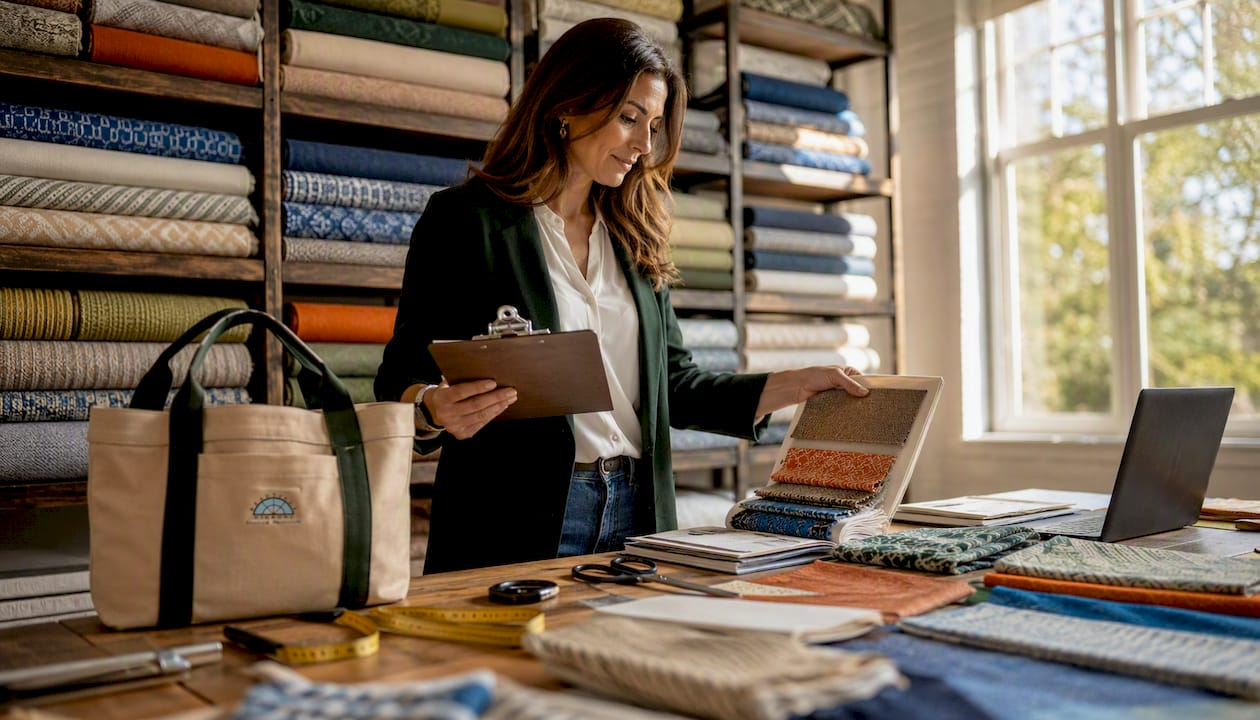
For workrooms and commercial upholstery projects, the short list starts with four fabric families: high-performance polyester with engineered stain finishes, solution-dyed acrylic, vinyl or marine vinyl, and worsted-wool blends for corporate seating. Every order should meet a minimum heavy-duty abrasion threshold, carry a disclosed cleaning code, and arrive with a flammability certificate. These are not optional details on a spec sheet. They are the baseline that separates a fabric that holds up through a production run from one that fails at the seam or the first cleaning.
Before committing to a roll, require the following from any supplier:
- Abrasion rating: high Wyzenbeek or Martindale cycles suitable for commercial seating
- Cleaning code: W, S, WS, BC, or bleach-cleanable, clearly labeled
- Flammability certification: relevant standards such as NFPA 260 (Class I) or California TB 117-2013 at minimum; TB 133 for institutional seating
- ACT compliance: Look for the ACT voluntary performance guidelines logo or test-method references on the datasheet
- Roll width, dye-lot number, and confirmed lead time: in writing, before production begins
Pro Tip: Order at least three swatches from the same dye-lot you intend to purchase. Compare them under both natural and artificial light, and request the spec sheet and lead-time confirmation in the same email. This single step catches most dye-lot and availability problems before they reach the cutting table.
Table of Contents
- What does “commercial-grade” actually mean for workroom upholstery?
- What specs should you check on every technical datasheet?
- Which fabric families perform best in workroom applications?
- How do construction, fiber content, and backing affect upholsterability?
- How do pattern repeat and fabric width affect yardage planning?
- What do cleaning codes mean in practice, and how long will the fabric last?
- What should your procurement checklist include before placing a production order?
- Beautifulwindowselgin supports workrooms with fabric, samples, and specification guidance
- Key Takeaways
- The case for matching spec to frame, not chasing the highest number
- Standards, test methods, and reference sources to consult before you buy
What does “commercial-grade” actually mean for workroom upholstery?
The term “commercial-grade” is used widely by suppliers, but it has a precise technical meaning when applied to contract and workroom upholstery. A fabric earns that designation by passing a defined set of performance tests, not simply by being sold to a business.
The ACT voluntary performance guidelines are the most widely recognized standard in the U.S. contract textile market. They cover heavy-duty abrasion, colorfastness to light and crocking, flammability, and physical properties. A fabric that meets ACT guidelines for heavy-duty upholstery has been independently verified against those thresholds, not just self-certified by the manufacturer.
The practical difference between commercial-grade and residential-grade fabric shows up in three areas:
- Abrasion resistance: — Residential fabrics typically target 15,000–25,000 Wyzenbeek double rubs. Commercial seating starts at 30,000 and heavy-duty workroom applications generally require 100,000 or more double rubs or Martindale cycles, consistent with ACT certification standards for heavy-duty upholstery.
On a spec sheet, look for the ACT logo, explicit test-method references (ASTM D4157 for Wyzenbeek, ISO 12947 for Martindale), and a cleaning code label. A supplier who cannot provide these on request is not a reliable workroom partner.
Spec sheet signal: A fabric listed as “contract-grade” without a disclosed rub count, cleaning code, or flammability test reference has not been verified to any standard you can hold a supplier to.
What specs should you check on every technical datasheet?
The datasheet is the single most important document in a workroom fabric order. Reading it correctly takes less than five minutes and prevents the majority of costly substitutions and cleaning failures.

| Spec field | Acceptable minimum | Red flag |
|---|---|---|
| Wyzenbeek abrasion | 100,000+ double rubs (heavy-duty) | No test result listed |
| Martindale abrasion | 100,000+ cycles (heavy-duty) | Result below 30,000 cycles |
| Colorfastness to light | Grade 4 or higher (AATCC 16) | Grade 3 or below |
| Colorfastness to crocking | Grade 4+ wet and dry | Wet crocking below Grade 3 |
| Cleaning code | W, S, WS, BC, or bleach-cleanable | No code listed |
| Flammability | NFPA 260 Class I or TB 133 | “Passes TB 117” only, no open-flame test |
| Backing | Nonwoven, scrim, or acrylic | Foam-only backing (complicates sewing) |
| Width | 54 inches minimum | Under 48 inches (yield loss increases) |
Some high-performance synthetics exceed 100,000 double rubs and include a nonwoven moisture barrier backing with bleach-cleanable options, as seen in contract-grade products like Carnegie’s Primary fabric. That combination, high abrasion plus a moisture barrier plus bleach tolerance, represents the upper tier of workroom specification and is appropriate for healthcare, hospitality, and high-traffic office seating.
Pro Tip: When a supplier lists only Martindale results and you need Wyzenbeek equivalency (or vice versa), ask for both. The two tests use different methods and the results are not directly interchangeable. A fabric with 50,000 Martindale cycles does not automatically equal 50,000 Wyzenbeek double rubs.
Which fabric families perform best in workroom applications?
Choosing the right upholstery fabric types for a specific workroom application comes down to matching the fabric’s strengths to the demands of the finished piece. No single family wins across every use case.
High-performance polyester with engineered finishes is the most versatile workroom option. It accepts stain-block and moisture-barrier coatings readily, achieves high rub counts, and is available in a wide range of weights and textures. The trade-off is that heavily coated versions can feel stiff and may resist adhesive bonding during installation.
Solution-dyed acrylic (the category that includes Sunbrella-style contract textiles) is the preferred choice where UV exposure, outdoor use, or frequent bleach cleaning is required. Sunbrella Contract markets these textiles specifically for healthcare, hospitality, education, and workplace settings, highlighting bleach-cleanable cleaning methods for high-hygiene environments. The weakness is a slightly coarser hand compared to woven polyester.
Vinyl and marine vinyl are the correct specification for booths, banquettes, and any seating exposed to moisture, food service, or heavy soiling. They clean with a damp cloth, resist most solvents, and require no flammability certificate in most applications because they are inherently flame-retardant. The limitation is breathability: vinyl is not appropriate for task seating where users sit for extended periods.
Worsted-wool blends occupy a different tier. An industry blog notes that worsted wool offers drape, handle, and professional appearance that high-grade synthetics cannot replicate, making it the preferred choice for corporate task seating and executive lounge chairs. Camira’s Penta Worsted Wool, for example, is independently certified to 70,000+ Martindale cycles and classified for heavy-duty upholstery under ACT guidelines, demonstrating that some worsted-wool blends meet ACT requirements at this Martindale rating even if not reaching the synthetic-heavy 100,000+ mark. The cost per yard is higher, and wool requires dry-cleaning or solvent-only (S-code) maintenance.
Protected or pigmented leather is durable and ages well in executive seating, but it requires consistent conditioning, is sensitive to sharp edges during installation, and carries a significant cost premium over fabric alternatives.
Use-case mapping:
- Office task chairs and panel seating: high-performance polyester or worsted-wool blend
- Café booths and restaurant banquettes: vinyl or bleach-cleanable performance fabric
- Healthcare and education seating: solution-dyed acrylic or bleach-cleanable synthetic
- Hospitality lounge seating: worsted-wool blend or protected leather
- Outdoor or covered patio seating: solution-dyed acrylic
How do construction, fiber content, and backing affect upholsterability?
A fabric’s performance on the finished piece depends as much on how it is built as on what it is made from. Weave structure, backing type, and applied finishes each affect how the material behaves during cutting, sewing, and stapling.

Weave and stretch behavior. Plain weaves are the most stable and easiest to work with on curved frames. They stretch predictably and hold a staple line cleanly. Pile fabrics (velvet, chenille) compress at seams and require careful direction matching; they also show pull marks if over-stretched. Jacquard weaves carry a pattern woven into the structure, which means the pattern cannot be hidden at seams and must be matched precisely, adding yardage and labor. For tactile texture and pattern guidance that translates well to upholstery seam planning, the principle is consistent: the more complex the surface, the more critical the layout.
Backing types. A nonwoven backing improves dimensional stability and makes the fabric easier to staple without fraying. Scrim backings add body without significant stiffness. Foam-backed fabrics are problematic in workroom settings: the foam layer can compress unevenly under staples, complicate sewing machine feed, and delaminate over time with cleaning. Acrylic or latex backings are common on contract fabrics and generally perform well.
Finishes and their tooling implications. Solution-dyed fibers carry color through the yarn, so surface abrasion does not reveal a lighter core. Topically applied stain blocks (fluorochemical or silicone-based) can reduce adhesive bond strength, which matters when using contact cement for foam attachment. Moisture barriers add weight and may require a heavier needle and thread. Always test a swatch with your adhesive and thread before committing to a production run.
Pro Tip: Professional upholsterers prefer solid colors for heavily curved pieces because directional patterns and textures are difficult to match at seams and can distort when stretched. Reserve large-scale repeats and directional weaves for flat or gently curved panels where layout control is straightforward.
How do pattern repeat and fabric width affect yardage planning?
Width and repeat are the two variables that most directly affect cutting yield and material cost. Getting them wrong at the estimate stage is one of the most common sources of budget overruns in production workrooms.

| Fabric width | Pattern repeat | Extra yardage to budget |
|---|---|---|
| 54 inches, no repeat | None | 5% for seams and waste |
| 54 inches, small repeat | Vertical and horizontal | 10–15% |
| 54 inches, large repeat (12–24 inches) | Vertical and horizontal | 20–30% |
| Under 48 inches, any repeat | Any | Add 15–20% on top of repeat allowance |
A 54-inch width is the workroom standard for upholstery. Narrower goods (48 inches or less) reduce yield on wide pieces like sofa backs and seat cushions, requiring additional seaming that adds labor and affects appearance. Fabrics under 48 inches wide are generally not suitable for production commercial seating without a significant cost adjustment.
For pattern matching, the key numbers on the spec sheet are the vertical repeat and the horizontal repeat. A 24-inch vertical repeat on a dining chair seat means you are effectively paying for a full repeat per cut piece, regardless of the actual seat depth. On a production run of 20 chairs, that waste compounds quickly.
Ordering tips to avoid dye-lot problems:
- Order all yardage for a project from a single dye-lot, confirmed in writing
- Add a minimum 10% overage to your calculated yardage for any patterned fabric
- Request the dye-lot number on the packing slip and verify it against the order confirmation before cutting
- For multi-phase projects, ask the supplier to reserve additional yardage from the same lot
The upholstery fabric buying process for production orders differs from residential purchasing precisely because dye-lot continuity and yardage accuracy are non-negotiable at scale.
What do cleaning codes mean in practice, and how long will the fabric last?
Cleaning codes are not suggestions. They define the chemistry the fabric’s finish is designed to tolerate, and using the wrong method can strip a stain-block coating, cause color migration, or delaminate a backing.
- W (water-based cleaner): Use water-based upholstery shampoo or foam. Do not use solvents. Suitable for most performance polyesters.
- S (solvent-based cleaner): Use dry-cleaning solvent only. Water can cause shrinkage or staining. Typical for worsted-wool blends and some natural fibers.
- WS (water or solvent): Either method is safe. The most flexible code for in-situ cleaning.
- BC or bleach-cleanable: A diluted bleach solution (typically 1:10 bleach to water) is safe for disinfection. Sunbrella Contract fabrics and similar solution-dyed acrylics commonly carry this designation, making them the preferred choice for healthcare and food-service environments.
Repairability varies by construction. Fabrics with acrylic or nonwoven backings can usually be patched by cutting a replacement panel and re-stapling. Foam-backed or heavily laminated fabrics are harder to repair cleanly because the backing does not cut or fold as precisely. Vinyl can be heat-welded for small tears, which extends its useful life considerably.
Realistic lifecycle expectations for high-traffic commercial seating:
- High-performance polyester: 7–10 years with regular cleaning
- Solution-dyed acrylic: 8–12 years in sun-exposed or high-hygiene settings
- Vinyl: 5–8 years before surface cracking becomes visible
- Worsted-wool blend: 10–15 years in office seating with periodic professional cleaning
Pro Tip: For bleach-cleanable fabrics, always test the dilution ratio on a hidden area first. Even fabrics rated for bleach cleaning can show color shift at concentrations above the manufacturer’s recommended ratio.
What should your procurement checklist include before placing a production order?
A complete workroom order requires more than a fabric name and a yardage count. The following checklist covers every document and confirmation a workroom should have in hand before cutting begins.
Documents to require with every order:
- Full technical spec sheet (fiber content, weight, width, construction)
- Abrasion test report (Wyzenbeek ASTM D4157 or Martindale ISO 12947, with result)
- Cleaning code, clearly labeled
- Flammability certificate (NFPA 260, TB 117-2013, or TB 133 as applicable)
- Colorfastness results (light and crocking)
- Backing description and composition
- Roll width confirmed in inches
- Dye-lot number and available quantity
- Lead time in writing, with a confirmed ship date
- Minimum order quantity and return/sample policy
Sample request template (copy and send to supplier):
Supplier-side commitments worth insisting on in writing: consistent dye-lots across the full order, a written availability window (not just “in stock”), and a clear policy for defective or off-spec rolls. Industry procurement guidance consistently recommends confirming dye-lot and lead times in writing before committing to roll orders, particularly for multi-piece installations where color consistency is visible across pieces.
Pro Tip: When a project spans multiple phases, ask the supplier to set aside reserved yardage from the same dye-lot at the time of the first order. Most suppliers will hold stock for 30–60 days with a deposit, which eliminates the most common cause of mid-project color mismatch.
Beautifulwindowselgin supports workrooms with fabric, samples, and specification guidance

Workrooms sourcing fabric for production runs face two recurring problems: dye-lot inconsistency and lead-time surprises. Beautifulwindowselgin addresses both directly. As an online fabric retailer based in Columbia, SC, with nationwide shipping, Beautifulwindowselgin sells upholstery and drapery fabrics by the yard, offers fabric samples before production commitment, and provides design consultations for professionals who need specification support.
The fabric selection includes upholstery-weight textiles suited to commercial applications, from structured jacquard weaves to durable utility fabrics, available in the color families and weights workrooms actually need. For professionals who want to verify color and hand before ordering yardage, the sample service removes the guesswork from remote purchasing. Nationwide shipping means consistent access regardless of location.
To browse available upholstery fabrics by the yard, request swatches, or discuss a production order, visit the upholstery fabric collection and use the design consultation option to confirm specifications before committing to a roll.
Key Takeaways
For workroom fabric orders, the non-negotiable combination is a verified abrasion rating, a disclosed cleaning code, a flammability certificate, and dye-lot confirmation in writing before any cutting begins.
| Point | Details |
|---|---|
| Minimum abrasion threshold | Require 100,000+ Wyzenbeek double rubs or appropriate Martindale cycles for most commercial synthetic upholstery. For high-end wool blends, a Martindale rating of 70,000+ cycles may be considered sufficient under ACT guidelines. |
| Cleaning code is mandatory | Demand W, S, WS, BC, or bleach-cleanable on the spec sheet; no code means no verified cleanability. |
| Flammability certificate required | NFPA 260 Class I or California TB 133 for institutional seating; TB 117-2013 alone is insufficient for most contract applications. |
| Dye-lot and lead time in writing | Confirm dye-lot number, available quantity, and ship date before production begins to prevent mid-run color mismatch. |
| Beautifulwindowselgin for sourcing | Beautifulwindowselgin sells upholstery fabrics by the yard with sample service and nationwide shipping, supporting workrooms through specification and ordering. |
The case for matching spec to frame, not chasing the highest number
The instinct in a production workroom is to specify the highest rub count available and call it done. That approach is understandable, but it creates its own problems. Fabrics engineered for extreme abrasion resistance, particularly those with heavy laminate backings or dense coatings, are often the hardest to sew, the least forgiving on curved frames, and the least comfortable for end users who sit in the finished piece for hours at a time.
Professional guidance makes this point clearly: over-specifying abrasion resistance can make upholstery difficult and compromise comfort or appearance. A worsted-wool blend at 70,000 Martindale cycles is the right specification for an executive chair. A 150,000-double-rub vinyl is the right specification for a diner booth. Neither is universally correct.
At Beautifulwindowselgin, the approach to workroom fabric selection starts with the frame and the use case, not the spec sheet. When a client is matching a large-repeat jacquard across a set of dining chairs, the conversation shifts to yardage planning and dye-lot continuity rather than abrasion thresholds alone. When the application is healthcare seating, bleach-cleanability moves to the top of the list. The spec sheet matters, but it is a tool for confirming a choice already grounded in the application, not a substitute for that judgment.
The most common mistake is treating fabric selection as a purchasing decision rather than a design and production decision. Choosing fabric too early, before the frame dimensions, foam profile, and seam layout are defined, leads to costly mismatches that no rub count can fix.
Standards, test methods, and reference sources to consult before you buy
Before writing a specification or accepting a delivery, workrooms should be familiar with the primary standards and where to verify them.
- ACT Voluntary Performance Guidelines: the U.S. contract textile industry’s benchmark for heavy-duty abrasion, colorfastness, flammability, and physical properties; look for the ACT logo on supplier datasheets
- Sunbrella Contract upholstery: an example of a supplier product page that lists rub counts, cleaning codes, backings, and widths as standard disclosures, useful as a reference for what a complete datasheet should include
- ASTM D4157: the Wyzenbeek abrasion test method; cite this when requesting test reports from suppliers
- ISO 12947: the Martindale abrasion test method; the international standard most European and some U.S. suppliers reference
- NFPA 260: the U.S. flammability standard for upholstered furniture components; Class I is the minimum for most contract applications
- California TB 117-2013: smolder-resistance standard for filling materials; required in California and widely adopted nationally
- California TB 133: open-flame test for institutional seating (healthcare, correctional, public assembly); required for many government and healthcare contracts
- Beautifulwindowselgin upholstery fabric guide: a practical starting point for reviewing fabric families and options available by the yard, with guidance on selecting materials for workroom and commercial projects
Recommended
- Upholstery Fabric Types: A Practical Guide for 2026 – Fabric Store in Columbia, SC | Drapery Making Services
- Tips for Selecting Upholstery Fabric: A Practical Guide – Fabric Store in Columbia, SC | Drapery Making Services
- How to Choose Upholstered Fabrics for Your Home – Shop Designer Fabrics by the Yard | Curtains & Drapery
- Upholstery Fabric List: A Complete Guide for 2026 – Fabric Store in Columbia, SC | Drapery Making Services