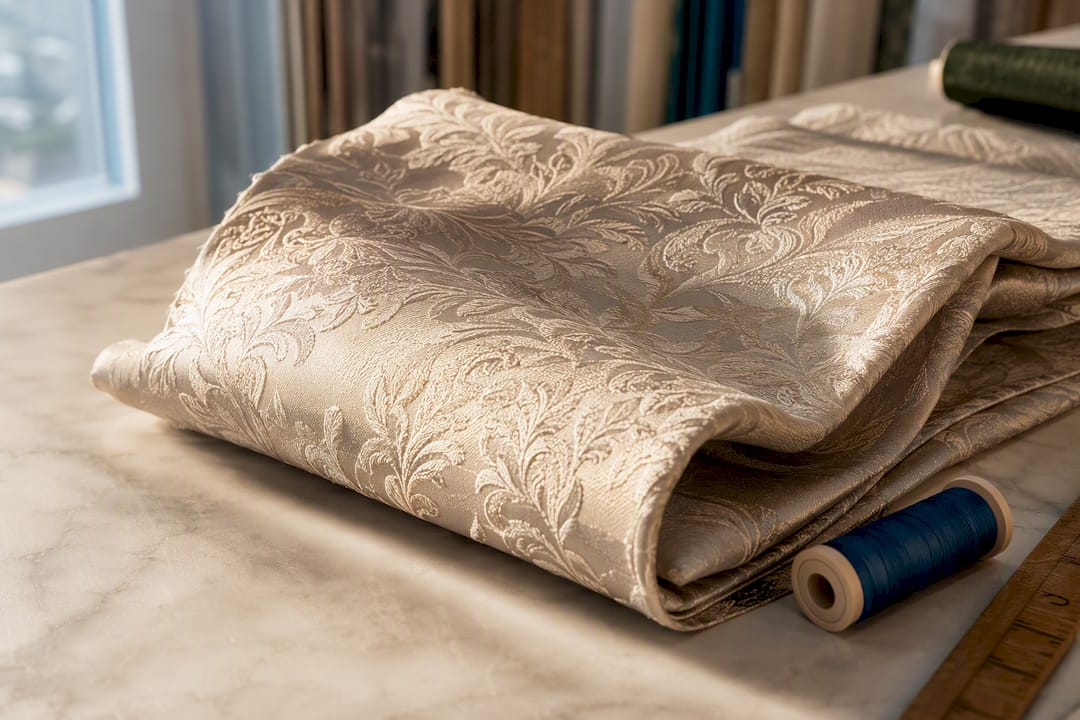
Jacquard satin belongs in four places: eveningwear and tailored fashion, formal home décor like drapery and bedding, upholstery on select furniture, and small accessories or craft trims. The right application always comes down to two variables, fiber content and fabric weight, since a lightweight silk blend that drapes beautifully on a gown will wear out fast on a sofa cushion.
TL;DR:
- Heavier jacquard satin is better suited for upholstery and heavy drapery, while lightweight versions are ideal for spring and summer apparel.
- Silk jacquard satin offers superior hand-feel and breathability, but polyester blends provide better wrinkle resistance and easier maintenance.
- Pattern scale and yardage calculations are critical to achieving proper alignment and avoiding waste in home décor and upholstery projects.
- Always test fabric samples at home, in natural daylight, to confirm pattern appearance and sheen before purchasing full yardage.
- Proper care includes dry cleaning for silk blends, gentle hand washing or delicate cycles for polyester, and careful storage to maintain pattern integrity.
Table of Contents
- Fashion and Apparel Uses for Jacquard Satin
- Home Décor: Drapery, Bedding, and Window Treatments
- Upholstery and Durability: When to Use Jacquard Satin on Furniture
- Accessories, Trims, and Craft Projects
- How to Choose the Right Jacquard Satin for Your Project
- Care, Cleaning, and Maintenance
- Workshop-Tested Tips From Marrion and Beautiful Windows Elgin
- Balancing Aesthetics and Long-Term Durability
- Shop Jacquard Satin Samples and Custom Drapery at Beautiful Windows Elgin
- Sources
Fashion and Apparel Uses for Jacquard Satin
Jacquard satin earns its place in eveningwear and bridal collections because of what happens when light hits it. The satin weave gives the surface its characteristic sheen, while the jacquard technique, developed by Joseph Marie Jacquard, weaves the motif directly into the cloth rather than printing it on top. That produces a pattern with real dimension, one that shifts subtly as the wearer moves, and it holds a bodice or A-line skirt with more structure than a plain satin ever could.
Weight determines the rest of the decision. A lightweight jacquard satin suits blouses, soft skirts, and unlined jackets where drape matters more than rigidity. Midweight versions, often blended with a bit of stretch or a firmer backing, work better for structured jackets, fitted bodices, and pieces that need to hold a silhouette without a boned understructure. According to JacquardWorks, modern jacquard satin now spans both formal eveningwear and everyday pieces, largely because fiber blending has widened what the fabric can handle.
Silk jacquard satin still leads on hand-feel and breathability, which is why bridal makers reach for it first. Polyester-blend jacquard satin trades a little of that luxury feel for wrinkle resistance and easier care, a fair trade for anyone making a piece that needs to survive travel, long events, or repeated wear.
A few practical notes for garment builders:
- Use jacquard satin as the outer fabric when you want the pattern visible and the sheen doing the visual work.
- Reserve it as lining only for structured pieces (blazers, coats) where a hint of pattern peeks through at the cuff or lapel.
- Lightweight jacquard satin suits spring and summer apparel, while heavier constructions perform better as outerwear layers or cold-weather pieces.
- Always underline sheer or loosely woven jacquard satin to prevent seam show-through on fitted garments.
Home Décor: Drapery, Bedding, and Window Treatments
Formal rooms are where jacquard satin does its best work in a home. The woven pattern reads clearly from across a room, unlike a printed fabric that can flatten out under certain light, and the subtle sheen gives curtain panels a finished, tailored look that plain cotton or linen can’t match. Sewport’s overview of jacquard construction notes that the technique produces durable, reversible designs, which matters for drapery since both the room-facing and window-facing sides can look intentional rather than accidental.

Light control is the one thing jacquard satin doesn’t handle on its own. Pair it with a blackout or thermal lining if the room needs real darkness or insulation, since the base fabric alone won’t block much daylight. For bedding, jacquard satin shows up most often in duvet covers and decorative shams rather than fitted sheets, where its slightly firmer hand and improved wrinkle resistance make more sense than in something pressed against skin all night.
A short checklist for ordering:
- Match pattern scale to window size. Small motifs suit café curtains and shorter panels; larger medallions need floor-length drapes to register properly.
- Order extra yardage on any project with a repeating motif, so panels align at the seams instead of breaking the pattern mid-window.
- Choose a heavier jacquard satin, closer to the 389-gsm range, for full-length formal drapery that needs body and fold definition.
- Check the fiber blend before ordering bedding. Cotton or Tencel blends breathe better against skin than pure polyester versions.
Upholstery and Durability: When to Use Jacquard Satin on Furniture
Not every jacquard satin belongs on a chair. Decorative, lightweight versions built for garments or throw pillows will pill and fray under regular sitting pressure, while heavier jacquard constructions, particularly polyester or poly-blend versions, hold up to the abrasion and repeated flexing that upholstery demands. Sewport recommends synthetic or heavy-fiber jacquard specifically for high-traffic furniture, since these blends resist wear without losing the dimensional pattern that makes jacquard worth choosing in the first place.
Three questions decide whether a given bolt is upholstery-grade:
- What’s the fiber content? Polyester and polyester blends resist abrasion and hold color better under sun exposure than natural fibers alone.
- How much traffic will the piece see? A formal accent chair in a rarely used living room can carry a lighter jacquard satin than a family room sofa.
- How large is the pattern repeat? Big motifs need careful seam placement and extra yardage, which is where a practical upholstery fabric guide earns its keep before you cut anything.
Pro Tip: Bring a fabric swatch to the piece itself before committing to yardage. Drape it over the arm or cushion in the room’s actual light, since jacquard’s sheen can look completely different under a showroom fixture than it does at home.
For anything with a large-scale motif or a piece being reupholstered professionally, hand the pattern-matching decision to an experienced upholsterer. Misaligned seams on a patterned sofa are far more noticeable, and far harder to fix after the fact, than a small miss on a curtain hem.

Accessories, Trims, and Craft Projects
Small-scale projects are where jacquard satin gets to be the star without a big yardage commitment. Clutches, neckties, hair accessories, and piping trim all benefit from the fabric’s structure and sheen, and designers frequently choose jacquard satin for lining boxes and luggage precisely because the woven pattern signals quality in a way printed fabric can’t fake.
A few uses worth trying:
- Piping and trim for pillows or garment edges, where a contrasting jacquard pattern adds detail without overwhelming the piece.
- Table overlays and sashes for event décor, since a half-yard or yard goes a long way visually.
- Structured linings inside handbags or jewelry boxes, where durability matters more than breathability.
- Hair bows, cummerbunds, and other small accessories that showcase the pattern up close.
Because jacquard weaves can fray at the edges, seal raw edges with a narrow zigzag stitch or fray-check liquid before assembling anything small. Pinking shears alone won’t hold up through repeated handling.
How to Choose the Right Jacquard Satin for Your Project
Selection mistakes almost always trace back to skipping one of four checks.
- Confirm fiber content first. Polyester blends deliver durability and easier care; silk or cotton blends deliver a more luxurious hand and better breathability, at the cost of more careful handling.
- Match weight to end use. Light apparel calls for a soft hand and drape; upholstery and heavy drapery call for a denser, sturdier weave.
- Account for pattern repeat before you order. Large motifs need extra yardage for alignment, and requesting a sample yard first lets you check how the repeat lands on your actual project dimensions.
- Ask about finishes for high-use settings. Stain-resistant or flame-retardant finishes matter for hospitality or contract upholstery projects, and not every jacquard satin bolt carries them standard.
Skipping the sample step is the most common regret sewists and designers report, since jacquard’s pattern and sheen can shift noticeably between a screen photo and the actual bolt.
Care, Cleaning, and Maintenance
Always start with the care label, since fiber content changes the rules significantly. Silk jacquard satin generally needs dry cleaning to preserve both sheen and pattern definition, while polyester blends often tolerate a gentle hand wash or delicate machine cycle in cold water.
- Steam rather than press directly when possible, and use a low setting with a press cloth on any silk-blend piece to avoid flattening the woven texture.
- Blot stains immediately rather than rubbing, and test any spot cleaner on a hidden seam allowance first.
- For upholstered jacquard satin, vacuum regularly and address spills the moment they happen rather than letting them set.
- Store finished garments and yardage rolled rather than folded to prevent permanent crease lines along the pattern.
Pro Tip: Hang or roll jacquard satin drapery panels for at least a day before final hemming. The fabric can relax slightly after shipping, and hemming too early sometimes leaves panels uneven once they settle.
Workshop-Tested Tips From Marrion and Beautiful Windows Elgin
Order swatches before committing to yardage, and check pattern scale in natural daylight rather than under artificial store lighting. Installers most often go wrong on pattern direction and underordering yardage for repeats. Beautiful Windows Elgin helps avoid both with sample orders, measurement guidance, custom drapery work, and nationwide shipping.

Balancing Aesthetics and Long-Term Durability
Polyester-blend jacquard satin suits everyday interiors better than delicate silk, which I’d still reserve for a formal gown rather than a family room’s curtains. Durability wins when the room gets daily use.
— Marrion
Shop Jacquard Satin Samples and Custom Drapery at Beautiful Windows Elgin
Beautifulwindowselgin gives you a faster, more informed path to the right jacquard satin than guessing from a screen photo ever will. Every selection point covered above, fiber content, weight, pattern scale, has a real answer once you’re holding an actual swatch in your own room’s light.

Beautiful Windows Elgin’s curated jacquard satin collections cover both apparel-weight and heavier drapery-grade options, and sample orders let you test sheen and pattern scale before committing to yardage. For projects that need pattern matching across wide panels or upholstery pieces, the window treatment measurement service walks you through accurate yardage and seam planning so panels align the first time. Browse the designer drapery fabric collection or request swatches today to see how jacquard satin looks in your own space before you cut a single yard.
Sources
- What is Jacquard Fabric: Properties, How its Made and Where | Sewport
- Jacquard Fabric applications from fashion to home decor — JacquardWorks (2026)
- Where is Jacquard Satin Fabric Used? – Yutai
- Joseph Marie Jacquard — Wikipedia