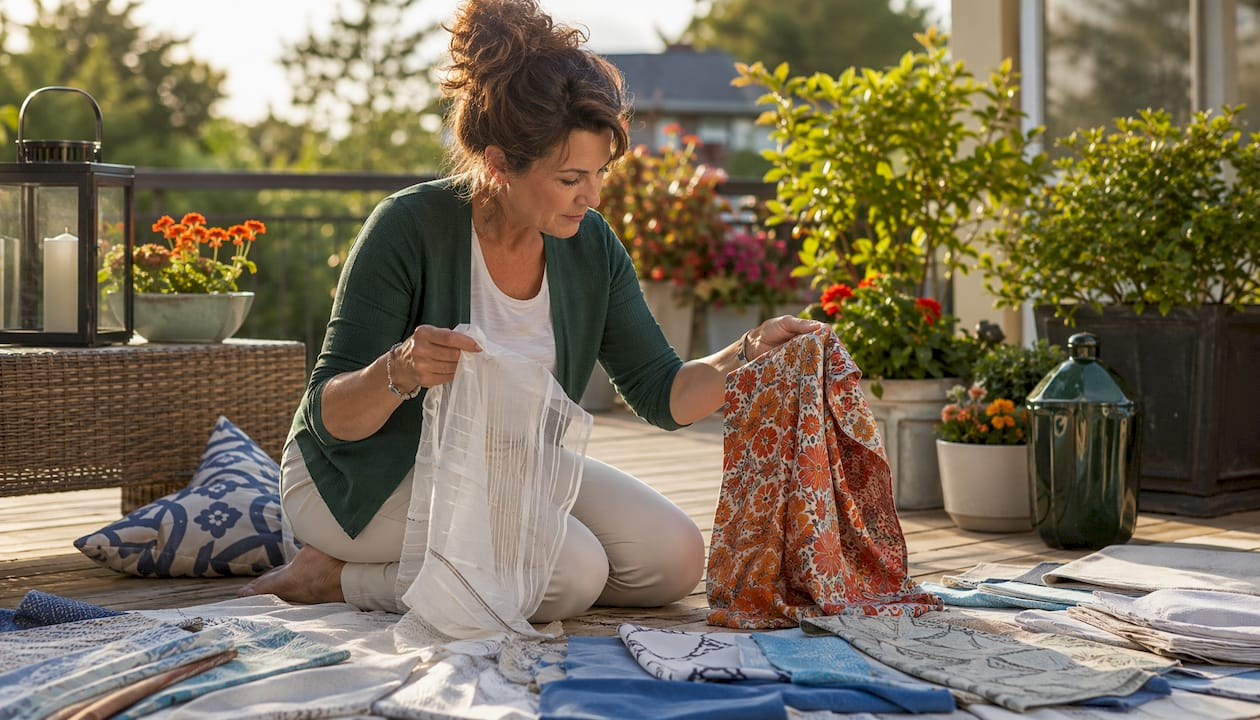
For most homeowners, a cotton-linen blend delivers the best overall balance of light control, durability, and easy care. That said, the right fabric depends on the room’s function first. Here is a quick shortlist to guide your decision before you read the full breakdown:
- Best for blackout and privacy: Velvet or blackout-lined cotton/polyester
- Best for bright sunrooms and casual living spaces: Linen or sheer voile (layered)
- Best for kid- and pet-friendly rooms: Polyester or cotton-polyester blend
- Best budget option: Polyester or mill-weight cotton
- Best luxury look: Linen, silk, or jacquard satin
- Best for easy care: Polyester blend or pre-washed cotton
How to use this list: These recommendations assume standard US window sizes (typically 48"–84" drop), common heading styles (pinch pleat or rod pocket), and the option to add a standard lining. Jump to any fabric section below for pros, cons, care, and cost details.
Table of Contents
- What does the curtain fabric comparison list tell you about each material?
- Side-by-side curtain material comparison
- How do you choose the right curtain fabric for your window?
- What lining and blackout options should you consider?
- How do you care for and clean different curtain fabrics?
- Which fabric works best in each room?
- Why does “hand” matter more than photos when choosing curtain fabric?
- Key Takeaways
- The fabric choice most homeowners get wrong
- Beautifulwindowselgin makes custom drapery straightforward
- Useful sources and further reading
What does the curtain fabric comparison list tell you about each material?
Every fabric in this guide is assessed across the same set of criteria: how it looks and hangs, how it performs for light control and privacy, how long it lasts, and how much effort it takes to maintain. The goal is a clear, side-by-side reference you can use whether you are ordering samples online or standing in a fabric store.
Cotton
Cotton is the most versatile natural fiber for window treatments. It takes dye evenly, so it is available in the widest range of colors and prints, from bold geometrics to subtle florals. Heavier cotton weaves such as cotton sateen or cotton twill offer good privacy and light reduction without lining; lighter cotton muslin or voile reads more like a sheer.

Pros: Breathable, widely available, accepts prints well, machine washable, relatively affordable.
Cons: Can fade in direct sunlight over time, prone to shrinkage if not pre-washed, creases more than polyester.
Best rooms: Bedrooms, children’s rooms, kitchens, bathrooms, and any space where a neat, structured look is preferred.
Care: Machine wash cold, gentle cycle; tumble dry low or line dry; iron while slightly damp on a medium setting.
Typical cost: Low to medium. Cotton is one of the most accessible natural fibers by the yard.
Lining note: A lined cotton curtain is very effective for full blackout. Lining improves drape, protects the face fabric from UV fading, and increases insulation and privacy, making it a near-universal upgrade for finished drapery.

Linen
Linen diffuses bright sun, creating a soft glow rather than blocking it. Its slightly textured, relaxed fall suits contemporary, Scandinavian, and coastal interiors particularly well. Linen is one of the strongest natural fibers, and its durability actually improves with age and washing.

Pros: Beautiful natural drape, breathable, improves with age, suits casual and designer-look rooms equally.
Cons: Creases easily (that rumpled look is part of its character), costs more than cotton, lighter weaves offer limited privacy on their own.
Best rooms: Living rooms, dining rooms, sunlit bedrooms, and any space where a relaxed, understated aesthetic is the goal.
Care: Machine wash on a gentle cycle or dry clean; lay flat or line dry; iron on a linen setting while damp.
Typical cost: Medium to high.
Lining note: Line linen for added insulation and privacy, especially in north-facing rooms. Interlining adds body and warmth without sacrificing the fabric’s characteristic fall.
Pro Tip: For a high-impact pooling effect with linen, order at least 6 extra inches of drop beyond the floor. Linen’s relaxed hand pools gracefully, but the fabric needs that extra length to settle into soft, deliberate folds rather than a bunched hem.
Silk and faux silk
Silk is the formal luxury choice: lustrous, jewel-toned, and unmatched for a grand living room or a traditional setting. It is also the most demanding fabric in this list. Silk fades and weakens in direct sunlight, so it should always be lined and kept off the brightest south- or west-facing windows.
Pros: Unmatched sheen and drape, elevates any room’s formality, available in rich saturated colors.
Cons: Delicate, sun-sensitive, expensive, usually requires dry cleaning, not suitable for humid rooms.
Best rooms: Formal living rooms, dining rooms, and bedrooms away from direct sun exposure.
Care: Dry clean only; never machine wash or steam aggressively.
Typical cost: High.
Lining note: Always line silk. A blackout or thermal lining protects the face fabric from UV degradation and extends the curtain’s life considerably.
Faux silk (typically polyester with a satin finish) replicates the sheen at a fraction of the cost and is far more durable, though the hand and drape do not match the real thing.
Velvet
Velvet adds warmth, depth, and superior light-blocking when paired with blackout lining. Its pile creates a dense, insulating layer that absorbs sound as well as light, making it the traditional choice for home theaters and formal bedrooms. Velvet’s weight means it falls in clean, heavy folds with minimal effort.
Pros: Exceptional light blocking, superior thermal and acoustic performance, rich visual weight, dramatic appearance.
Cons: Holds dust, typically requires dry cleaning, heavy weight demands sturdy rods and brackets, can feel oppressive in warm or humid rooms.
Best rooms: Bedrooms, media rooms, north-facing living rooms, and any space where warmth and drama are priorities.
Care: Dry clean; brush pile gently with a soft brush between cleans; avoid steam directly on the pile.
Typical cost: Medium to high.
Lining note: A blackout lining behind velvet achieves near-total darkness. The combined weight requires a heavy-duty rod rated for the panel weight.
Polyester and polyester blends
Polyester is durable, resists wrinkling and fading, and can be engineered with finishes such as flame-retardant or blackout backing, making it the practical workhorse of the curtain fabric world. It is the go-to choice for rentals, children’s rooms, and any window where low maintenance outweighs luxury feel.
Pros: Fade-resistant, shrink-resistant, machine washable, widely available, lowest cost per yard, accepts engineered finishes well.
Cons: Less breathable than natural fibers, cheaper versions can look plasticky, hand-feel is less refined than cotton or linen.
Best rooms: Children’s rooms, rental properties, kitchens, bathrooms, and any high-traffic window.
Care: Machine wash cold; tumble dry low; little or no ironing needed.
Typical cost: Low.
Lining note: Polyester panels with a bonded blackout backing are a cost-effective all-in-one solution for bedrooms and nurseries.
Sheer and voile
Sheers, voile, chiffon, and organza soften and diffuse sunlight and are best used layered with heavier drapes for privacy and insulation. On their own, they offer almost no privacy at night when interior lights are on. Their value is in softening a window’s appearance and filtering harsh direct sun during the day.
Pros: Lightweight, airy, diffuses glare without blocking daylight, inexpensive, easy to layer.
Cons: Minimal privacy, no insulation, delicate weave can snag, requires careful washing.
Best rooms: Living rooms, sunrooms, dining areas, and layered behind heavier panels in bedrooms.
Care: Machine wash on a delicate cycle; line dry; low iron or no iron (check label).
Typical cost: Low.
Lining note: Not typically lined; layering with a heavier panel achieves both the soft daytime look and evening privacy.
Blackout-coated fabrics
Blackout fabrics use either a tight triple weave or a bonded foam/acrylic backing to achieve near-total light blockage, improving sleep quality in bedrooms and performance in home theaters. The blackout quality comes from the construction or coating, not the face fiber, so blackout panels are available in cotton, polyester, and blended face fabrics.
Pros: Near-total light blockage, available in many face fabrics and colors, adds thermal insulation.
Cons: Heavier than unlined panels, foam-backed versions can crack over time with repeated washing, limited drape softness.
Best rooms: Bedrooms, nurseries, home theaters, and any room with east- or west-facing windows.
Care: Follow face fabric care instructions; foam-backed panels are often spot-clean only to preserve the coating.
Typical cost: Low to medium depending on face fabric.
Jute and eco fibers
Jute, hemp, and bamboo-blend fabrics bring a natural, textured aesthetic to window treatments. They are heavier and stiffer than cotton or linen, which limits their drape options, but they work well as Roman shades or flat-panel treatments where structure is an advantage.
Pros: Sustainable sourcing, distinctive natural texture, good for structured treatments.
Cons: Stiff hand limits drape styles, can be scratchy, limited color range, not suitable for humid rooms (jute absorbs moisture).
Best rooms: Living rooms and home offices where a natural, earthy aesthetic is the goal.
Care: Spot clean or dry clean; avoid prolonged moisture exposure.
Typical cost: Medium.
Jacquard and woven patterns
Jacquard weaves (including brocade and damask) create pattern through the weave structure itself rather than printing. This produces a refined, dimensional surface that reads as high-end in formal rooms. Pattern repeat and fabric width materially affect yardage calculations; always confirm the vertical repeat and standard width (commonly 54–60 inches) before ordering, and add extra yardage for matching across panels.
Pros: Pattern is woven in, so it does not fade or peel; adds visual richness; available in a range of weights.
Cons: Pattern repeat increases yardage needs and cost; heavier jacquards require sturdy hardware; dry clean recommended for most.
Best rooms: Formal living rooms, dining rooms, and master bedrooms.
Care: Dry clean for most jacquard weaves; check label for lighter jacquard-cotton blends.
Typical cost: Medium to high.
Side-by-side curtain material comparison
Ratings below use Low/Medium/High. Visual weight describes how the fabric reads in a room: a lightweight sheer has low visual weight; velvet has high visual weight. Note that adding a lining or interlining upgrades insulation and light control by at least one level for most fabrics.
| Fabric | Best for | Light control | Privacy | Insulation | Durability | Ease of care | Typical cost | Drape/visual weight |
|---|---|---|---|---|---|---|---|---|
| Cotton | Everyday rooms, prints | Medium | Medium | Low–Medium | Medium | Easy | Low–Medium | Medium |
| Linen | Casual, sunlit rooms | Low–Medium | Low–Medium | Low | High | Moderate | Medium–High | Soft/Medium |
| Silk | Formal rooms | Low–Medium | Low–Medium | Low | Low | Difficult | High | Fluid/Low–Medium |
| Faux silk | Formal look, lower budget | Low–Medium | Low–Medium | Low | Medium | Moderate | Medium | Fluid/Medium |
| Velvet | Bedrooms, media rooms | High | High | High | Medium | Difficult | Medium–High | Heavy/High |
| Polyester | Rentals, kids’ rooms | Medium | Medium | Low–Medium | High | Easy | Low | Medium |
| Sheer/Voile | Layering, sunrooms | Low | Low | Very Low | Low–Medium | Easy | Low | Airy/Very Low |
| Blackout-coated | Bedrooms, nurseries | Very High | Very High | Medium–High | Medium | Moderate | Low–Medium | Heavy/High |
| Jute/Eco | Structured treatments | Medium | Medium | Low | Medium | Moderate | Medium | Stiff/Medium |
| Jacquard | Formal, statement rooms | Medium–High | Medium | Medium | Medium–High | Moderate–Difficult | Medium–High | Rich/High |
| Cotton-poly blend | All-purpose, family homes | Medium | Medium | Low–Medium | High | Easy | Low–Medium | Medium |
Adding a lining changes several columns. A standard lining raises insulation and privacy by one level; a blackout lining raises light control to Very High; an interlining (flannel) raises insulation to High and adds significant visual weight and drape quality.
How do you choose the right curtain fabric for your window?
Design experts recommend starting fabric selection with room orientation and function before aesthetics, because that choice changes ideal fabric weight more than color does. Use this checklist before you order a single yard.
- Identify the room’s primary function. Is the window in a sleeping space, a work area, a social room, or a utility space? Function determines whether light control, privacy, or easy care ranks first.
- Note window orientation. North-facing rooms benefit from heavier fabrics like velvet, while south-facing rooms suit lighter fabrics such as linen. East-facing windows get strong morning sun; west-facing windows get intense afternoon heat. Both benefit from fade-resistant fabrics or a protective lining.
- Assess your privacy needs. Street-level windows need more opacity than second-floor windows. Sheer layers work for daytime privacy on upper floors; blackout or velvet is more appropriate at ground level.
- Consider acoustic and thermal goals. Velvet and interlining reduce sound transmission noticeably. Thermal linings and heavy fabrics reduce drafts and heat loss around single-pane windows.
- Set a realistic budget. Include fabric, lining, heading tape, and hardware. A standard 48" x 84" pair of drapes in cotton or polyester typically falls in a low-to-medium cost range for fabric alone; silk or jacquard with interlining can reach a high cost range before labor.
- Confirm care constraints. If dry cleaning is not practical, eliminate silk, velvet, and most jacquards from your shortlist.
Questions to ask your supplier before ordering:
- What is the fabric width? (Most drapery fabrics run 54–60 inches wide; narrower widths mean more seams.)
- What is the vertical pattern repeat, if any?
- What is the fabric weight (GSM) and recommended heading fullness ratio?
- Is lining compatible, and what lining does the supplier recommend?
- What are the manufacturer’s cleaning codes?
Pro Tip: For a curtain fabric buying guide approach to yardage, always add 10–15% extra when working with a patterned fabric. A 12-inch vertical repeat on a 96-inch drop panel can require nearly a full extra repeat per panel to align the pattern across a pair.
What lining and blackout options should you consider?
Most curtains benefit from lining: it improves finish, privacy, and warmth. The type of lining you choose determines how much of that benefit you get.
- Standard lining (cotton sateen or polyester): Adds body, improves drape, protects the face fabric from UV fading, and provides a modest privacy and insulation upgrade. Suitable for most rooms where full blackout is not required.
- Thermal interlining (flannel): A flannel layer sewn between the face fabric and lining. This is the standard for high-end drapery because it stabilizes the face fabric, boosts insulation, and improves the curtain’s fall and fullness. It adds noticeable weight, so hardware must be rated accordingly.
- Blackout lining (foam-backed or bonded acrylic): Achieves near-total light blockage. Ideal for bedrooms, nurseries, and home theaters. Foam-backed versions are effective but can crack with repeated machine washing; bonded acrylic versions are more durable.
- Sound-dampening interlining: A denser interlining used in media rooms and home offices to reduce ambient noise. Less common but genuinely effective when combined with floor-to-ceiling panels.
When to upgrade your hardware: Interlining and blackout lining add significant weight. A standard tension rod rated for lightweight sheers will not support a velvet panel with interlining. For heavy treatments, use a traverse rod or a wall-mounted rod with brackets rated for the combined panel weight.
When a full blackout curtain is not practical (rental restrictions, budget, or aesthetic preference), a separate blackout blind mounted inside the window recess achieves the same light-blocking result without altering the face curtain.
How do you care for and clean different curtain fabrics?
Fabric-specific care is the single most common area where homeowners shorten the life of their curtains. Always check the manufacturer’s cleaning code and whether the lining is washable before choosing a cleaning method, because many face fabrics are delicate while linings may be machine washable.
Cotton and cotton-poly blends:
- Machine wash cold, gentle cycle; tumble dry low.
- Iron on a medium-high setting while slightly damp.
- Wash every 3–6 months, or more frequently in kitchens.
Linen:
- Machine wash gentle or dry clean; line dry or lay flat.
- Expect some creasing; iron on a linen setting while damp.
- Wash annually or when visibly soiled; spot clean between washes.
Silk and faux silk:
- Dry clean only for real silk; faux silk may tolerate a gentle hand wash in cold water.
- Never wring or tumble dry; lay flat to dry.
- Dust lightly with a soft brush between cleans.
Velvet:
- Dry clean; brush pile with a soft-bristle brush to remove dust.
- Never iron directly on the pile; steam from a distance if needed.
- Professional clean annually; dust every 2–3 months.
Polyester and blackout-coated panels:
- Machine wash cold for uncoated polyester; spot clean only for foam-backed blackout panels.
- Tumble dry low; minimal ironing needed.
- Wash every 3–6 months.
Stain removal first steps: Blot (never rub) fresh stains with a clean white cloth. For water-soluble stains on cotton or polyester, cold water and a small amount of mild dish soap work well as a first step. For oil-based stains, a small amount of dry-cleaning solvent on a cloth can lift the mark before it sets. If the stain does not respond to these steps within a few minutes, stop and take the panel to a drapery care specialist rather than risk setting the stain further.
Pro Tip: Steam is gentler than an iron for most curtain fabrics and is the preferred method for refreshing velvet, linen, and silk in place. Hold the steamer 2–3 inches from the fabric and work downward. Never press a hot iron directly onto velvet or sheer fabrics. If the curtain has an interlining, check whether the lining is washable before machine washing the whole panel; mismatched care requirements between face fabric and lining are a common cause of shrinkage and distortion.
Which fabric works best in each room?
Room function, humidity, and household traffic each narrow the fabric shortlist considerably. The curtain fabric types that work in a formal living room are rarely the right answer for a kitchen or a child’s bedroom.
Bedroom:
- Blackout-lined cotton or polyester for sleep quality.
- Velvet for a luxurious, light-absorbing alternative.
- Lined linen for a softer aesthetic where complete darkness is not required.
Living room:
- Lined linen or cotton for a relaxed, layered look.
- Jacquard or velvet for formal or traditional settings.
- Sheer voile layered under a heavier panel for flexible light control through the day.
Kitchen:
- Cotton or cotton-poly blend in short drops; easy to launder and resistant to grease and moisture.
- Avoid velvet, silk, and jute near cooking areas.
Bathroom:
- Polyester or a polyester-cotton blend; resists humidity and dries quickly.
- Keep panels short and away from water contact.
- Avoid natural fibers in poorly ventilated bathrooms where mildew is a risk.
Home theater or media room:
- Velvet with blackout lining for maximum light and sound absorption.
- Floor-to-ceiling panels on all windows to eliminate light leakage.
Sunroom:
- Sheer voile or light linen to diffuse glare without blocking the view.
- Choose fade-resistant fabrics or solution-dyed polyester; sun exposure is intense and constant.
Special window situations:
- Bay windows: Use separate panels per section rather than one continuous treatment. Linen and cotton hang well in angled bays; avoid very heavy fabrics that pull on angled brackets.
- Tall windows (96" and above): Fabric weight and heading fullness matter more. Velvet and lined cotton hold their shape at full length; lightweight sheers can look sparse without adequate fullness.
- Sliding glass doors: Traverse rods with a center overlap are the practical choice. Polyester or cotton-poly blends hold up to frequent opening and closing.
Pets and kids: Polyester and cotton-poly blends are the most practical. They resist snags better than linen or silk, wash easily, and do not hold pet hair as stubbornly as velvet. A performance finish (stain-resistant coating) on a polyester blend adds another layer of protection.
Why does “hand” matter more than photos when choosing curtain fabric?
“Hand” refers to the feel and movement of a textile. It is the single most important but intangible selection factor: high-quality fabrics drape and pool differently, and that difference often justifies a higher upfront cost. A fabric that photographs beautifully online may feel stiff, thin, or plasticky in person. A swatch order before committing to full yardage is the most reliable way to avoid a costly mistake.
What to check when you receive a swatch:
- Weight and body: Hold the swatch at one corner and let it fall. Does it hang with a clean, fluid drop, or does it resist and stiffen? A fabric with good body will drape well at full length.
- Weave tightness: Hold the swatch up to a light source. A tightly woven fabric shows little or no light penetration; a loosely woven one will offer minimal privacy without lining.
- Colorfastness: Dampen a white cloth and press it firmly against the swatch for 30 seconds. Any color transfer indicates a dye that may bleed in washing or fade unevenly in sunlight.
- Pattern repeat: Measure the vertical repeat on the swatch and confirm it matches the supplier’s stated repeat. A discrepancy here will cause problems when matching panels.
- Edge fray: Pull gently at the cut edge. Fabrics that fray heavily will need wider seam allowances and may not be suitable for unlined treatments.
Upholstery fabrics may be suitable for curtains but can be too stiff; suitability depends on handle and weight rather than fiber origin alone. Always test the drape of a heavier woven fabric before committing it to a drapery project.
Beautifulwindowselgin offers fabric samples so you can assess hand, weight, and color accuracy before placing a full order. A swatch-based decision reduces returns and eliminates the guesswork that comes from relying on screen-calibrated product photography. For DIY projects, craft supplies and sewing notions from sources like decoration materials can complement your fabric order with the tools needed to complete the treatment.
Key Takeaways
For most rooms, the best curtain fabric is the one that matches function first and aesthetics second, with a lining added to upgrade performance across nearly every dimension.
| Point | Details |
|---|---|
| Function before aesthetics | Choose fabric weight and opacity based on room orientation and use before selecting color or pattern. |
| Lining upgrades performance | Adding a standard or blackout lining raises insulation, privacy, and light control by at least one level for most fabrics. |
| Polyester leads for low maintenance | Polyester and cotton-poly blends machine wash, resist fading, and require no dry cleaning, making them the practical choice for busy households. |
| Pattern repeat increases yardage | Patterned fabrics with a vertical repeat require extra yardage for matching; confirm repeat and fabric width (commonly 54–60 inches) before ordering. |
| Beautifulwindowselgin for samples and custom work | Order fabric swatches from Beautifulwindowselgin to assess hand and drape before committing to full yardage or a custom drapery project. |
The fabric choice most homeowners get wrong
Most homeowners start with color and end up with a fabric that looks right in the store but performs poorly at the window. The curtain fabric comparison process should work in the opposite direction: lock in the functional requirements first (light control, care, weight for the hardware you have), then narrow to the fabrics that meet them, and only then choose color and pattern within that shortlist.
The other consistent mistake is underestimating lining. A mid-range cotton with a quality interlining will outperform an expensive silk panel hung unlined, both in drape and in longevity. The lining decision is often more consequential than the face fabric decision, and it is the step most DIY decorators skip to save cost upfront, only to replace the curtains sooner than necessary.
Working with a fabric specialist pays off most on projects where the window is unusual (very tall, bay-shaped, or heavily sun-exposed) or where the fabric is expensive enough that a mistake is genuinely costly. Getting a swatch, confirming the repeat, and checking the hand before ordering full yardage takes a few extra days but eliminates the most common and expensive errors.
Beautifulwindowselgin makes custom drapery straightforward
Choosing the right fabric is the first step. Getting it cut, sewn, and hung correctly is where most DIY projects stall. Beautifulwindowselgin, based in Columbia, SC, offers designer drapery fabrics by the yard, including jacquard satin, embroidered textiles, and high-weight drapery fabrics, with nationwide shipping available.

The process is designed to reduce uncertainty at every stage. Order fabric swatches to assess hand, weight, and color accuracy before committing to full yardage. Use the window treatment measurement guide to confirm your dimensions, fullness ratio, and pattern repeat calculations. For homeowners who prefer professional guidance, design consultations and custom drapery services are available, covering everything from fabric selection through to installation support.
Whether you are sourcing fabric for a single statement window or outfitting an entire home, book a custom drapery consultation to get precise recommendations matched to your windows, your rooms, and your budget.
Useful sources and further reading
- How to Choose Curtain Fabric, Linwood: Covers room orientation, fabric weight, and lining guidance for homeowners.
- How to Choose Fabrics for Curtains, Curtains by Max Buston: Detailed guidance on lining, interlining, and hand assessment.
- Curtain Fabric Buying Guide, The Millshop Online: Pattern repeat, fabric width, and yardage calculation reference.
- 10 Types of Curtain Fabric for Every Style, Sinocomfort: Polyester, blackout construction, and care code reference.
- Beautifulwindowselgin Window Treatment Measurement Guide: Measurement service and fullness ratio guidance for custom orders.
- Understanding fabric durability for lasting home textiles, Beautifulwindowselgin: Deep-dive on how different fibers perform over time in a home setting.
Recommended
- 7 Essential Curtain Fabric Types List for Homeowners – Shop Designer Fabrics by the Yard | Curtains & Drapery
- Curtain Fabric Selection Guide 2026: Pick Styles That Last 30% Longer – Designer Fabrics by the Yard | Drapery Making Services
- Curtain fabric types: Choose perfect fabrics for style – Designer Fabrics by the Yard | Drapery Making Services
- Top designer fabrics for custom drapery and upholstery – Fabric Store in Columbia, SC | Drapery Making Services